ONYINYECHI NWAIGBA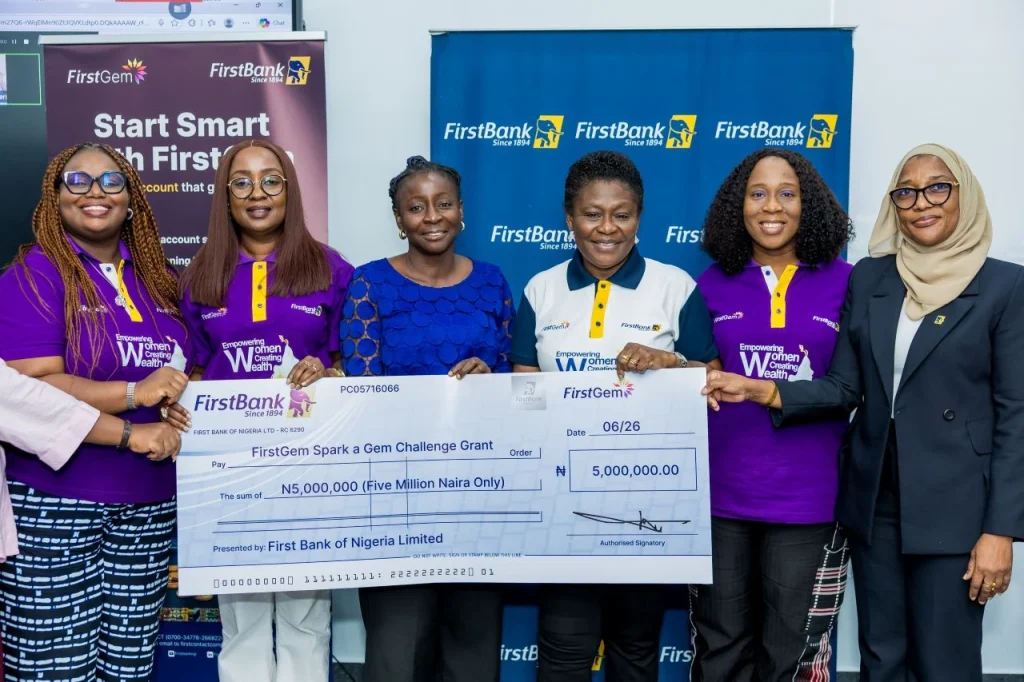
For many women entrepreneurs, having a good business idea is only the beginning.
The bigger challenge often lies in accessing the capital, knowledge, networks and support needed to turn that idea into a sustainable and growing business.
FirstBank is seeking to address some of these barriers through the maiden edition of its Spark-A-Gem Challenge, a women entrepreneurship initiative designed to support women-owned and women-led businesses with more than just access to funding.
The initiative, organised under the bank’s FirstGem proposition, brought together women entrepreneurs from across Nigeria for a structured business development programme combining education, mentorship, capacity building, pitching and financial support.
The maiden edition attracted 356 applications from women owned businesses operating across sectors including agriculture, education, healthcare, food services and other areas of the economy.
Following a competitive selection process, eight entrepreneurs emerged as finalists and participated in an intensive four day training and capacity building program before presenting their businesses to an independent panel of judges during the final Pitch Day.
Beyond the Grant
At the heart of the Spark-A-Gem Challenge is an idea that is increasingly becoming important in conversations around women’s economic empowerment: access to finance alone is not always enough.
A business may receive funding, but without financial management skills, market knowledge, mentorship and the right networks, the money may not translate into sustainable growth.
The programme was therefore structured to combine these different forms of support.
The eight finalists received business education and capacity-building support designed to strengthen their understanding of business management and improve their readiness for growth.
The final stage gave participants the opportunity to pitch their businesses before an independent panel, putting not only their ideas but also their business models, growth potential and ability to communicate their vision to the test.
The approach reflects a broader shift in how entrepreneurship support program are being designed moving from one off financial interventions towards more structured support that helps entrepreneurs develop the capabilities needed to manage and grow their businesses.
₦10 Million in Grants for the Finalists
The financial component of the challenge culminated in ₦10 million in total grants awarded to the top three finalists.
Onyinye Obayi, founder of Honeypot Confections Ltd., emerged as the grand prize winner and received ₦5 million.
The first runner-up received ₦3 million, while the second runner-up received ₦2 million.
While the grants provide immediate financial support, the broader value of the initiative lies in the combination of capital and capacity development.
For small businesses, funding can help purchase equipment, increase inventory, improve operations, hire workers or expand into new markets. But sustainable growth often requires entrepreneurs to make informed decisions about pricing, cash flow, marketing, customer acquisition, staffing and long-term strategy.
By bringing these elements into one programme, Spark-A-Gem seeks to position women entrepreneurs for growth beyond the initial grant.
Building a Wider Pipeline of Women-Owned Businesses
Another important aspect of the initiative is that the impact is not limited to the eight finalists.
The wider pool of applicants has been integrated into the FirstGem ecosystem, creating opportunities for future banking relationships, credit access and advisory support.
This creates a larger pipeline of women-owned businesses that can potentially benefit from financial and business development services beyond the competition itself.
That broader approach is important because women entrepreneurs across Nigeria operate at very different stages of business development.
Some are just starting out. Others have established businesses but need capital to expand. Some may have the capital but lack the technical or managerial capacity required to scale.
A sustainable entrepreneurship ecosystem therefore needs different forms of support for businesses at different stages.
Why Supporting Women-Owned Businesses Matters
Women-owned businesses are an important part of Nigeria’s economic landscape.
Across sectors, women are running businesses that provide goods and services, employ people, support families and contribute to their communities.
Yet women entrepreneurs can face significant barriers when trying to access finance, business networks, skills and opportunities for growth.
This makes programmes focused on women’s economic empowerment particularly relevant to conversations around inclusive growth.
When women-owned businesses become stronger, the potential impact extends beyond individual business owners.
Growing businesses can create jobs, increase household incomes, develop local supply chains and provide products and services within communities.
For this reason, supporting women entrepreneurs is not simply a gender issue. It is also an economic development issue.
The Financial Inclusion Connection
The Spark-A-Gem Challenge also sits within a wider conversation around financial inclusion.
Access to a bank account is an important starting point, but meaningful financial inclusion goes further.
For entrepreneurs, it can include access to appropriate credit, financial literacy, business advisory services, digital financial tools and relationships that help businesses make better financial decisions.
FirstBank’s FirstGem proposition has historically focused on supporting women through financial services, business support and financial literacy.
The Spark-A-Gem Challenge extends that approach into a more competitive entrepreneurship-development format, identifying businesses with growth potential while providing participants with skills and connections that can support their next stage of development.
This is particularly relevant for small and growing businesses, where the difference between survival and expansion can sometimes depend on access to the right information and financial tools at the right time.
From Entrepreneurship to Job Creation
One of the most important reasons to support women-owned businesses is their potential to become employers.
A small business that moves from serving only its founder to employing two, five, ten or more people begins to create a wider economic impact.
Funding can help a business acquire equipment or increase production. Training can improve its ability to manage operations. Mentorship can help the founder avoid common business mistakes. Access to networks can open doors to new customers, suppliers and partnerships.
Together, these interventions can create a stronger foundation for business growth.
This is why entrepreneurship programmes should increasingly be measured not only by the amount of money distributed, but by what happens to the businesses afterwards.
Do they survive?
Do they grow?
Do they create jobs?
Do their revenues increase?
Can they access additional financing?
And are the entrepreneurs better equipped to make decisions independently?
These are some of the longer-term indicators that can determine whether an empowerment programme creates lasting impact.
A Bigger Conversation About Corporate Social Impact
The Spark-A-Gem Challenge also highlights an important question for companies implementing social impact programmes: what does meaningful empowerment actually look like?
A cash grant can provide immediate relief, but empowerment becomes more sustainable when people also receive the knowledge, skills and networks required to use that capital effectively.
For women entrepreneurs, this can mean combining financial support with business education, mentorship, access to markets and opportunities to build relationships with other entrepreneurs and institutions.
That model can potentially create a multiplier effect.
Instead of supporting an entrepreneur once, companies can help build the capacity of entrepreneurs to continue creating value long after the programme has ended.
Keeping Women at the Centre of Inclusive Growth
Nigeria’s economic growth will depend partly on how effectively it enables more people to participate in productive economic activity.
Women are already active participants in entrepreneurship across the country. The challenge is creating an environment where more women-owned businesses can move from small-scale survival to sustainable growth.
Initiatives such as the Spark-A-Gem Challenge are one part of that broader effort.
The ₦10 million in grants may provide a significant boost for the three winners, but the larger story is the attempt to combine funding with skills, mentorship and access to a wider business ecosystem.
For the women participating, the ultimate measure of success will not simply be winning a competition.
It will be whether the knowledge, capital and relationships gained through the programme help them build stronger businesses, create opportunities for others and contribute meaningfully to the communities and economy around them.
And that is where corporate empowerment can become more than a campaign when support is designed not just to help people start, but to help them grow.
Read also: State Government and First Bank Empower Entrepreneurs with ₦50 Million