Apply Now: Smart Africa, FAO Open Applications for Innovate Africa Challenge with Up to US$50,000 Support for AI Solutions
 ONYINYECHI NWAIGBA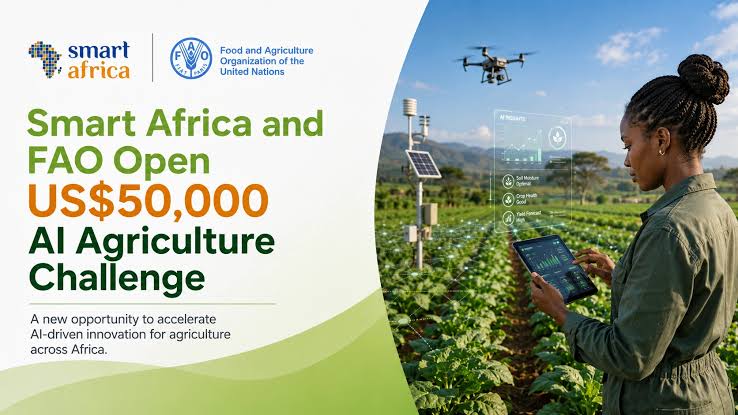
The Smart Africa Secretariat and the Food and Agriculture Organization of the United Nations (FAO) have opened applications for the 2026 edition of the Innovate Africa Challenge, an initiative designed to help African technology innovators move artificial intelligence solutions from development and testing into real-world agricultural deployment.
Now in its third edition, the challenge is themed “From Ideation to Deployment” and focuses on AI-powered solutions capable of addressing some of Africa’s most pressing agricultural and climate challenges.
The selected solution will receive support to deploy, validate and scale its technology in an African agricultural setting, with the opportunity to access up to US$50,000 in funding, alongside technical support, real-world validation and exposure to potential partners within Africa’s agriculture and technology ecosystems.
Applications close on August 31, 2026.
What is the Innovate Africa Challenge?
The Innovate Africa Challenge is a joint initiative of Smart Africa and FAO aimed at accelerating the use of artificial intelligence to strengthen Africa’s agricultural systems and climate resilience.
For the 2026 edition, the organisers are moving beyond the traditional focus on ideas and prototypes.
The theme, “From Ideation to Deployment,” reflects a deliberate shift towards solutions that can demonstrate practical value for farmers, agricultural institutions and extension services.
According to FAO, many promising African innovations remain at the pilot stage and are not sufficiently integrated into national agricultural systems or deployed at scale. The challenge is designed to help close that gap by identifying a proven AI-driven solution and supporting its deployment in a Smart Africa Member State.
The initiative will work with national ministries responsible for agriculture, ICT and innovation, FAO country offices, technical experts and the Smart Africa Secretariat to test and validate the selected solution in a real-world environment.
The goal is not simply to produce another technology demonstration.
It is to generate evidence that an AI solution can improve farmer decision-making, agricultural productivity or climate resilience and potentially be replicated in other African markets.
What Does the Winner Receive?
The 2026 challenge offers up to US$50,000 to support the deployment, validation and scaling of the selected AI solution.
Beyond the financial support, the opportunity is designed to provide something that can be just as valuable for an early-stage technology company: access to real agricultural environments where its product can be tested and validated.
The programme offers selected innovators opportunities for:
- Deployment and validation of their AI solution in a target African country
- Technical support during implementation
- Exposure to agricultural and technology stakeholders
- Collaboration with government ministries and FAO country offices
- Evidence generation around the solution’s impact
- Opportunities to build partnerships that could support future expansion
- Greater visibility within Africa’s innovation ecosystem
The official programme describes the expected outcome as the deployment of one proven AI solution that has been adapted and validated for African agricultural realities, with measurable benefits for farmers and a pathway for wider adoption.
This makes the opportunity particularly relevant to startups that already have a functioning solution and are looking for the resources, partnerships and environment needed to move into a new stage of growth.
What Kind of Solutions Are Eligible?
The challenge is focused specifically on AI-driven solutions for climate-smart agriculture.
The organisers are particularly interested in technologies that can help farmers and agricultural institutions make better decisions while improving productivity and resilience to climate change.
Priority areas include:
Precision agriculture and input optimisation
AI solutions that help farmers use seeds, fertiliser, water and other agricultural inputs more efficiently can qualify.
Such technologies could help reduce waste, improve resource allocation and potentially lower production costs while reducing environmental pressure.
Crop yield prediction and forecasting
Solutions that use agricultural, climate, remote-sensing or other relevant data to predict crop yields can help farmers, governments and agricultural businesses make better production and market decisions.
Pest and disease surveillance
AI-powered tools that identify pests and crop diseases early can help farmers respond before infestations cause significant losses.
Climate risk modelling
Solutions that help farmers understand weather patterns, climate risks and potential agricultural shocks can strengthen preparedness and adaptation.
Water and natural-resource optimisation
Technologies that improve the management of water and other agricultural resources are also within the challenge’s focus.
The programme also welcomes solutions that can provide climate and agronomic decision support to farmers, agricultural institutions or extension services.
Who Can Apply?
This is where prospective applicants need to pay close attention.
The opportunity is not simply open to anyone with an agricultural idea.
The official 2026 criteria require applicants to be startups, innovators or solution developers actively developing or deploying AI-driven solutions for climate-smart agriculture.
Applicants must also demonstrate technological maturity, operational experience, potential for measurable impact and a credible pathway to scaling and financial sustainability.
The current criteria include the following:
- Applicants must be a legally registered entity or an individual/team with a proven track record of developing or deploying relevant AI solutions.
- Teams must have at least two members, with at least 50 percent of their working hours dedicated to the solution.
- The solution must have a Technology Readiness Level (TRL) between 3 and 6, covering technologies from proof of concept through validated technology.
- The startup should be at least pre-seed funded and no further than Series A funded.
- Applicants must have a working, deployed or deployment-ready AI solution relevant to climate-smart agriculture.
- They must demonstrate operational experience through existing deployments, paying customers or validated pilots.
- They must have the technical capacity to deploy and support the solution in a new country.
- They must comply with data protection, privacy and responsible AI requirements.
The organisers will give additional preference to solutions that already operate in Smart Africa Member States, serve smallholder farmers—including women and young farmers—and have partnerships with ministries, research institutions or farmer organisations.
Experience integrating a solution into national agricultural or extension systems is also an advantage.
Which African Countries Are Involved?
The challenge has a continental ambition, but the 2026 deployment and validation activities are prioritised in five Smart Africa Member States: Rwanda, Kenya, Ghana, Malawi and Uganda.
This is an important distinction for applicants outside those countries.
Being based elsewhere does not necessarily mean the solution cannot be considered. However, applicants should be prepared to demonstrate that their technology can be adapted and deployed effectively in one of the priority countries.
For Nigerian innovators, this means the opportunity can still be strategically relevant even though Nigeria is not one of the five priority deployment countries listed for this edition.
A Nigerian agritech startup with a proven AI solution, for example, could potentially use the opportunity to demonstrate that its technology can operate in another African agricultural context while building relationships that may eventually support wider regional expansion.
What Makes a Strong Application?
One of the clearest messages from the 2026 criteria is that the organisers are looking for evidence, not just ambition.
A startup saying that its AI tool “could help farmers” is unlikely to be as compelling as one that can demonstrate how the solution has already been tested, who has used it, what results it produced and how those results were measured.
Applicants should therefore be prepared to explain:
- The agricultural problem being addressed
- How AI is used within the solution
- The current Technology Readiness Level
- Existing pilots or deployments
- Customer or farmer adoption
- Evidence of technical validation
- Measurable impact achieved so far
- The target users of the solution
- How the solution can operate in low-connectivity environments
- How it will work with incomplete or fragmented datasets
- How it can be adapted to different languages and farming systems
- Existing or potential partnerships with governments, researchers or farmer organisations
- The business and revenue model
- How the company intends to scale sustainably
The application form also asks applicants to explain their solution, business model, strategic fit with climate-smart agriculture, evidence of impact or technical validation, deployment feasibility, data partnerships, inclusivity, competition, market research and long-term financial sustainability.
In other words, applicants should think of the application as both a technology demonstration and a business case.
Responsible AI Is Also Important
Because the challenge involves technologies that could influence agricultural decisions, the organisers are placing emphasis on responsible AI.
Applicants are expected to comply with relevant data protection and privacy requirements, use responsible and explainable AI practices and demonstrate how they identify and mitigate bias.
The programme also requires respect for farmers’ data rights and appropriate consent for data use.
This matters particularly in agricultural systems where technology may be deployed among smallholder farmers with varying levels of digital literacy, connectivity and access to information.
An impressive AI model alone is therefore not enough.
The solution must also be capable of operating within the realities of African agricultural environments.
The programme specifically highlights challenges such as incomplete datasets, low-connectivity environments, multilingual settings, diverse agro-ecological conditions and informal or smallholder farming systems.
How to Apply
Interested innovators can submit their applications through the official FAO programme portal.
Applicants will be asked to provide information about their startup, including its country of operation, year of launch, legal registration status, annual turnover, team composition and previous participation in innovation or acceleration programmes.
They will also need to provide detailed information about their AI solution, including its development stage, previous funding, target users, impact evidence, business model, deployment plans, partnerships and scaling strategy.
The application deadline is August 31, 2026.
Applicants can access the official programme information and application portal through the FAO Innovate Africa Challenge 2026 page.
Why This Matters for African Agriculture
Africa’s agricultural sector is facing a combination of challenges that cannot be solved by traditional approaches alone.
Climate variability is affecting production. Farmers need better information about weather and climate risks. Agricultural resources such as water need to be used more efficiently. Crop pests and diseases can cause major losses, while fragmented data makes it harder for farmers and institutions to make timely decisions.
At the same time, Africa has a growing technology ecosystem capable of developing locally relevant digital solutions.
The challenge sits at the intersection of these two developments.
Rather than treating AI as technology for its own sake, the initiative is asking a more practical question: Can AI solve a real agricultural problem for African farmers, and can that solution work at scale?
That question is particularly important because many technology solutions struggle to move beyond pilots.
A product may work in a controlled environment but fail when confronted with unreliable connectivity, limited data, different languages, different farming practices or the realities of smallholder agriculture.
The Innovate Africa Challenge is designed to test exactly that transition from technology that works in theory or in a pilot to technology that can operate within a real agricultural ecosystem.
The Opportunity Is Bigger Than the US$50,000
For applicants, the financial support is undoubtedly attractive.
But the potential value of the challenge goes beyond the headline figure.
A successful startup could gain access to government institutions, agricultural stakeholders, technical experts and real-world deployment environments. It could also generate independent evidence demonstrating that its technology works in an African agricultural context.
That evidence can become valuable when approaching customers, investors, development partners and governments in other markets.
For Africa’s agricultural technology ecosystem, the wider opportunity is equally significant.
If successful solutions can be tested, validated and replicated across countries, AI could move from being a promising technological concept to becoming a practical tool for improving productivity, strengthening climate resilience and supporting better decisions across the agricultural value chain.
For innovators considering the application, however, the message is clear: this is not an opportunity for an idea that is still sitting on paper.
The strongest candidates will be those that can show what they have already built, who is using it, what difference it has made and how they can take it into a new African market.
With applications closing on August 31, 2026, African agritech and AI innovators with proven climate-smart agriculture solutions have a limited window to demonstrate that their technology is ready for the next stage.
The real opportunity is not simply to win funding.
It is to prove that an African-built solution can move from innovation to deployment and deliver measurable results for the farmers and food systems that need it most.
[give_form id="20698"]