


 admin
admin 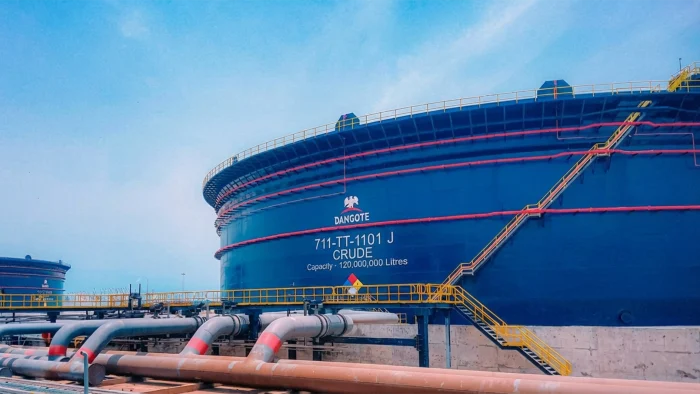
As Nigeria’s oil refining sector records its strongest growth in years, the real test is whether rising refining capacity can translate into jobs, stronger local businesses, energy security and wider economic value.
Nigeria’s oil refining industry is having a moment.
In the second quarter of 2026, the sector grew by 43.94% year-on-year, its strongest quarterly performance under the rebased GDP series, according to data from the National Bureau of Statistics. The surge has been driven largely by rising output from the Dangote Petroleum Refinery, which increased its crude processing capacity from 650,000 barrels per day to 700,000 barrels per day following maintenance and expansion work completed in February.
For a country that has spent decades exporting crude oil while importing much of the petroleum products it consumes, the shift is significant.
But growth figures alone do not tell the full story.
The more important question is what this refining boom means beyond refinery gates. Does it create more decent jobs? Does it strengthen Nigerian businesses? Does it make energy more accessible and reliable? Does it create opportunities for communities and small businesses? And can Nigeria capture more value from every barrel of crude it produces?
That is where the real measure of impact lies.
From Exporting Crude to Creating More Value
For decades, Nigeria’s oil economy has largely been built around extracting and exporting crude.
That model created government revenues and foreign exchange earnings, but it also left the country heavily dependent on imported refined petroleum products. The long-running weakness of Nigeria’s state-owned refineries meant that crude produced locally often travelled abroad for processing before refined products returned to the country.
The expansion of domestic refining changes that equation.
The U.S. Energy Information Administration reports that Nigeria’s seaborne petroleum product exports averaged 350,000 barrels per day in the second quarter of 2026, compared with an annual average of just 46,000 barrels per day in 2023. Total seaborne petroleum product shipments averaged 561,000 barrels per day during the quarter.
At the same time, seaborne imports of petroleum products fell to less than 130,000 barrels per day in Q2 2026, compared with nearly 400,000 barrels per day in 2023.
That is more than a refinery story. It is a sign that Nigeria is beginning to capture more value from its own natural resources.
But capturing value nationally is only the first step.
The next question is how widely that value is distributed.
The Jobs Question
A large refinery can create thousands of direct and indirect jobs across engineering, operations, transportation, logistics, maintenance, security, catering and other services.
But the bigger opportunity lies beyond direct employment.
Refining creates demand for businesses across its supply chain. Nigerian manufacturers can supply equipment and materials. Transport companies can move products. Technology firms can provide digital and automation services. Professional services firms can support operations. Small businesses can provide food, accommodation, maintenance and other services around industrial hubs.
That means the success of Nigeria’s refining sector should not be measured only by barrels processed.
It should also be measured by how many Nigerian businesses are participating in the value chain.
This is where local content becomes important.
If rising refining activity simply creates a highly capital-intensive industry that relies heavily on imported expertise, equipment and services, its wider economic impact will be limited.
But if it helps build Nigerian technical capacity, develops local suppliers and creates opportunities for SMEs, the benefits can spread much further.
Can the Refining Boom Improve Energy Security?
There is also a strong energy-security argument.
Nigeria’s dependence on imported petroleum products has historically exposed consumers and businesses to international prices, exchange-rate pressures, shipping costs and supply disruptions.
Increasing domestic refining capacity provides a degree of protection against those external pressures.
The EIA says Nigeria became more self-sufficient in refined petroleum products as domestic supply increased, with imports falling while exports expanded.
But energy security is not simply about having a refinery operating at high capacity.
For ordinary Nigerians and businesses, the real measure is whether the benefits eventually show up through more reliable supply, improved availability and a more stable energy environment.
For manufacturers, transport operators, farmers and small businesses, energy costs can determine whether they expand, remain small or shut down.
So the refining boom will have greater social and economic significance if it contributes to a more predictable energy system.
The SME Opportunity Cannot Be Ignored
One of the biggest risks with large industrial projects is that their economic benefits remain concentrated among a relatively small number of major companies.
Nigeria’s refining expansion presents an opportunity to avoid that pattern.
A growing refining industry needs a wide ecosystem of suppliers and service providers. The question is whether Nigerian SMEs will be positioned to participate in it.
This requires more than simply telling local businesses to “take advantage of the opportunity.”
Companies need access to finance, technical standards, procurement information, training and opportunities to qualify as suppliers.
Large industrial operators can also play a role by developing local supplier programmes, supporting technical training and creating transparent procurement pathways for qualified Nigerian businesses.
That is where corporate responsibility becomes more than philanthropy.
The most meaningful impact may not be a donation to a community. It may be creating an economic ecosystem in which more people and businesses can participate in the value being generated.
What About the Communities?
The social impact conversation cannot stop at jobs and contracts.
Large-scale industrial activity also affects the communities around it.
Questions around land, infrastructure, traffic, environmental management, waste, water use, air quality and community relations become increasingly important as industrial operations expand.
Responsible refining therefore requires strong environmental and social safeguards alongside economic growth.
Communities should not only be viewed as beneficiaries of corporate social investment. They are stakeholders in the operations themselves.
That means meaningful engagement, clear grievance mechanisms, transparent communication and investment in community development should form part of the broader conversation around Nigeria’s refining expansion.
Growth Must Come With Responsibility
Nigeria needs industrial growth. There is no question about that.
The country cannot build a stronger economy while remaining heavily dependent on importing products that it has the resources and potential to produce locally.
But industrialisation without responsibility creates a different set of problems.
As refining capacity grows, companies will have to pay attention to emissions, waste management, water use, occupational health and safety, community relations and other environmental and social risks.
This is particularly important because the scale of Nigeria’s refining ambitions is enormous.
The EIA reports that the Dangote Group plans to add another 750,000-barrel-per-day crude distillation unit by 2028, potentially doubling the refinery’s capacity.
The bigger the industrial footprint, the greater the responsibility to manage its impact.
The Bigger Test for Nigeria
Nigeria’s refining boom is undoubtedly a positive development for a country that has struggled with inadequate domestic refining capacity for decades.
But it should not become another story where impressive headline numbers mask limited benefits for the wider population.
The real success story would be one where increased refining leads to stronger local supply chains, more skilled Nigerian workers, stronger SMEs, greater energy security, new industrial opportunities and better economic prospects for communities.
It would also mean a refining industry that operates responsibly and is transparent about its environmental and social impact.
That requires collaboration between government, refinery operators, local businesses, communities, regulators and workers.
Government has a role in creating a predictable policy and regulatory environment. Companies have a responsibility to invest responsibly and build inclusive value chains. Local businesses need to develop the capacity to compete. And regulators must ensure that growth does not come at the expense of safety, communities or the environment.
So, Who Really Benefits?
Nigeria’s refining growth is already changing the country’s petroleum landscape.
The numbers are encouraging: refining grew 43.94% in Q2 2026, domestic capacity has expanded, imports have fallen and Nigerian refined products are increasingly reaching international markets.
But the biggest benefit will not be measured in barrels alone.
It will be measured in livelihoods created, businesses strengthened, skills developed, communities supported and value retained within the Nigerian economy.
That is the difference between an industrial project that is simply large and one that creates lasting impact.
Nigeria has spent decades asking how to refine its crude.
Now that refining capacity is finally expanding, perhaps the more important question is: how do we make sure the value reaches more Nigerians?
[give_form id="20698"]



1 thought on “Nigeria’s Refining Boom: Who Really Benefits?”