


Who Is Documenting Africa’s Food Heritage Before It Disappears? AFSA Opens 2026 Research Call
 ONYINYECHI NWAIGBA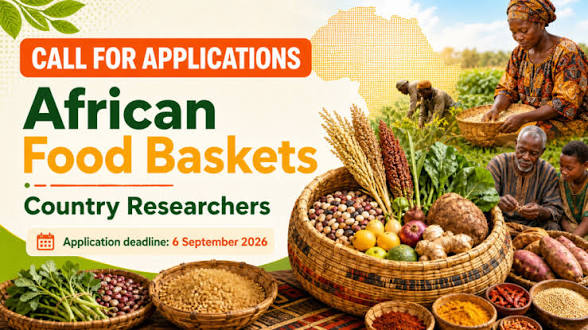
The African Food Baskets initiative will select 10 researchers to document local foods, recipes, stories and indigenous knowledge, with each selected researcher receiving US$1,000 in facilitation support.
Africa’s food heritage is more than what appears on a plate.
It carries knowledge about seasons, farming, seeds, preparation methods, community traditions and the people who have preserved these practices across generations.
But much of that knowledge remains undocumented, often passed down orally within families and communities. As diets change and imported and ultra-processed foods become increasingly prominent, some traditional foods and the knowledge surrounding them risk disappearing.
The Alliance for Food Sovereignty in Africa (AFSA) is now taking steps to document that heritage through its African Food Baskets initiative, calling for researchers across 10 participating African countries to help build a continental record of the foods Africans grow, prepare, consume and celebrate.
The initiative forms part of AFSA’s My Food Is African campaign and the TAFS Project, funded by Sida. Its goal is not simply to create a catalogue of African foods, but to preserve food knowledge that can support advocacy, research, education, communication and policy engagement.
Ten Researchers, Ten Countries
AFSA will select 10 Country Researchers, with one researcher assigned to each participating country.
The selected researchers will work directly with communities and local knowledge holders to document their country’s “food basket.”
That documentation will go beyond identifying popular dishes.
Researchers are expected to capture foods, dishes and beverages, recipes, food sources, menus, stories, proverbs, cultural meanings and photographs.
They will also identify foods considered to be at risk of disappearing.
According to the Terms of Reference, each country’s minimum data package is expected to include between 30 and 50 food, dish and beverage records, at least 10 recipes and preparation records, examples of daily and seasonal or festive menus, at least 10 food stories, proverbs or cultural meanings, and documentation of foods identified as being at risk.
The researchers will use AFSA’s African Food Baskets KoboToolbox Toolkit to collect and organise the information.
This Is More Than a Food Catalogue
The significance of the initiative lies in what sits behind the food.
A traditional meal can contain information about agriculture, biodiversity, local economies, cultural identity and environmental knowledge.
A recipe can reveal which crops thrive in a particular environment. A seasonal dish can reflect local farming cycles. A disappearing food can signal changes in diets, agricultural practices or access to traditional crops.
This makes documenting food heritage relevant to the broader conversation about sustainable food systems.
AFSA says African foods carry not only nutritional value but also language, seasons, seed systems, memory, ceremony and knowledge held by the people who grow, gather, cook and share them.
The initiative therefore places communities and their knowledge at the centre of the documentation process rather than treating traditional food knowledge simply as information to be extracted.
That distinction matters.
Communities Must Have a Voice
The research assignment requires selected researchers to engage communities and explain the purpose of the documentation before collecting information.
They must also obtain informed consent from communities and individual participants before collecting information or media.
Findings must subsequently be validated with the communities concerned before they are submitted to AFSA.
This approach introduces an important principle into the project: the people whose knowledge is being documented should have a role in determining how that knowledge is represented.
For cultural heritage projects, that is particularly important.
Documentation can preserve knowledge, but it can also create questions around ownership, consent, representation and who ultimately benefits from the information collected.
AFSA’s requirement for community engagement, consent and validation is therefore an important part of the initiative not simply an administrative requirement.
Researchers Will Receive $1,000
Each selected researcher will receive US$1,000 as facilitation support.
However, AFSA makes clear that this is not a conventional consultancy fee.
The payment will be made after the complete country data package has been submitted and accepted, and is intended to cover the researcher’s time, local travel, communication and community engagement costs.
The assignment begins with online training on the African Food Baskets Toolkit and continues through fieldwork, community validation, data cleaning and submission of the final package.
Researchers will also participate in a continental review session with other Country Researchers.
Who Can Apply?
The opportunity is open to qualified African researchers who are nationals of, or residents and actively working in, the country they are applying to document.
AFSA says applicants should have a background in research, preferably in areas such as:
- Food systems
- Agriculture
- Agroecology
- Nutrition
- Anthropology
- Sociology
- Development studies
- Environmental studies
- Cultural heritage
A postgraduate qualification is an advantage, although strong demonstrated field research experience may also be considered.
Applicants are expected to submit a CV of no more than two pages, a country concept note of no more than three pages and an example of previous relevant work, such as a report, article, thesis chapter or documentation product.
Why This Matters for Africa’s Food Future
There is a tendency to discuss food security primarily in terms of production: how much food is grown, how much is imported and how much is available.
But food sovereignty asks a broader question.
Who controls the food system, and what happens to the knowledge, cultures and communities that sustain it?
That is where initiatives such as African Food Baskets become significant.
Preserving traditional food knowledge does not automatically solve Africa’s food insecurity challenges. Nor does documenting a disappearing crop guarantee that farmers will continue growing it.
But documentation can create a foundation for further action.
A properly developed continental food resource could help researchers, educators, advocates and policymakers better understand Africa’s existing food diversity and the pressures threatening it.
It could also help shift the narrative around African food from something that must be replaced by imported alternatives to a resource containing knowledge, identity, nutritional value and economic potential.
The Bigger Question: What Happens After Documentation?
For all its potential, the initiative should ultimately be judged by what happens to the knowledge after it is collected.
Will communities be able to access and use the information?
Can the documentation support policies that protect indigenous food systems?
Can it contribute to greater recognition of traditional crops and local food producers?
Could it support education, research or local food businesses?
And how will AFSA ensure that communities whose knowledge forms the foundation of the resource continue to have a voice in how that knowledge is used?
These questions will become increasingly important as the project moves from documentation to advocacy and policy engagement.
For now, however, AFSA is creating an opportunity for researchers to help ensure that some of Africa’s food knowledge is recorded before it disappears.
How to Apply
Applications for the African Food Baskets Country Researchers initiative must be submitted to the official website by September 6, 2026.
Applications may be submitted in English, French or Portuguese.
Interested researchers should review the full Terms of Reference and ensure their application meets the stated requirements before submission.
The initiative may only begin with 10 researchers, but its ambition is considerably larger: to create a continental record of Africa’s food heritage and, potentially, preserve knowledge that future generations might otherwise never get to recover.
[give_form id="20698"]


1 thought on “Who Is Documenting Africa’s Food Heritage Before It Disappears? AFSA Opens 2026 Research Call”