


Can Gas Power Nigeria’s Green Industrialisation Without Undermining Its Climate Goals?
 ONYINYECHI NWAIGBA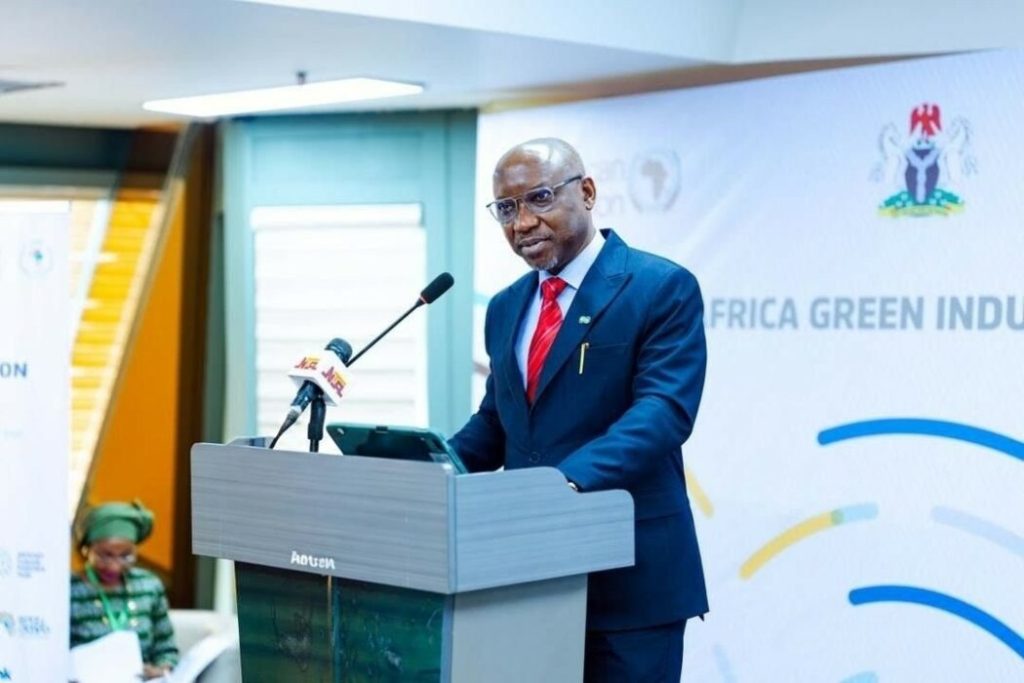
As the Federal Government links the AKK and OB3 gas pipelines to Nigeria’s industrialization ambitions, the bigger question is whether gas can serve as a transition tool without locking the country into a higher-carbon future.
Nigeria’s green industrialization conversation is entering an interesting phase.
The Federal Government is increasingly presenting natural gas not simply as an extractive resource, but as part of the infrastructure needed to power industries, support manufacturing and build a more competitive economy.
At the Africa Green Industrialization Initiative (AGII) Technical Workshop in Abuja, Minister of State for Petroleum Resources (Gas), Ekperikpe Ekpo, linked Nigeria’s gas expansion agenda and major infrastructure projects, including the Ajaokuta–Kaduna–Kano (AKK) and Obiafu–Obrikom–Oben (OB3) pipelines, to the country’s broader industrialization ambitions.
His argument is straightforward: Africa cannot industrialize without reliable and affordable energy, and natural gas can help provide that energy while the continent develops its renewable energy capacity and other low-carbon technologies.
But for a country that has also committed to reducing greenhouse gas emissions and reaching net zero by 2060, the question is bigger than whether gas can power factories.
It is whether Nigeria can expand gas infrastructure today without creating a long-term dependence that makes tomorrow’s climate targets harder to achieve.
The case for gas
Nigeria’s energy challenge is difficult to ignore.
Unreliable electricity supply has long constrained businesses, manufacturers and households, while dependence on diesel and petrol-powered generators has created significant costs for the economy.
The Federal Government therefore sees gas as one part of the answer.
According to the minister, natural gas remains important for power generation, fertilizer production, food security and petrochemical industries. The government is pursuing the Decade of Gas Initiative, the Presidential Compressed Natural Gas Initiative and major pipeline projects such as AKK and OB3.
The government is also positioning gas as a means of unlocking domestic industrial value.
Instead of exporting raw resources, the ambition is to use Nigeria’s energy and mineral resources to support local manufacturing, develop integrated value chains, attract investment and create jobs.
That argument matters.
Green industrialization cannot simply mean replacing one energy source with another while leaving African economies dependent on importing finished products. For Nigeria, the transition also has to answer a development question: How do we use the country’s resources to create productive industries and better livelihoods?
That is where gas enters the government’s equation.
But “transition fuel” cannot mean “permanent fuel”
The problem is that industrial infrastructure lasts.
A pipeline built today can operate for decades. Gas-fired power plants, processing facilities and other infrastructure connected to the gas economy can also create economic incentives to keep using gas long after cheaper or cleaner alternatives become available.
This is why Nigeria’s green industrialization strategy cannot be judged simply by how much gas becomes available.
It must also be judged by what happens alongside that expansion.
Nigeria’s Energy Transition Plan envisages gas playing a transitional role, with gas generation initially helping establish reliable baseload capacity while renewable energy expands. The plan ultimately sees solar and other cleaner technologies taking a greater role in the electricity system.
That distinction is crucial.
If gas is genuinely being used to bridge Nigeria from an unreliable, generator-dependent energy system towards a cleaner and more productive economy, it could play a practical role in the transition.
But if gas infrastructure expansion becomes an excuse to delay investment in renewable energy, energy efficiency and cleaner technologies, the transition becomes much harder to defend.
The methane question
There is another issue that deserves far more attention: methane.
At the Abuja workshop, Ekpo said Nigeria was working to reduce methane emissions, end routine gas flaring and decarbonise petroleum operations. The government also highlighted investments in gas-to-power, LPG, renewable energy and other low-carbon technologies.
These commitments are important because the climate impact of gas is not limited to what happens when it is burned.
Methane can escape during production, processing and transportation, and its impact on warming makes leakage a critical issue for any gas-led transition strategy.
That means Nigeria’s climate ambition will require more than statements about responsible gas development.
It will require measurable monitoring.
How much methane is being released?
How frequently are facilities being inspected?
How quickly are leaks repaired?
How much routine flaring has actually been eliminated?
And, perhaps most importantly, who independently verifies the numbers?
These are the kinds of questions that determine whether “cleaner gas” remains a policy slogan or becomes an accountable environmental outcome.
What happens to the communities?
There is also a social dimension to Nigeria’s green industrialization ambitions.
A successful industrialization strategy should not only move gas through pipelines. It should translate energy infrastructure into functioning businesses, employment, skills development, local supply chains and improved livelihoods.
The government itself has argued that Africa must move beyond exporting raw materials and instead develop integrated value chains that generate wealth on the continent.
That creates an important test for projects such as AKK and OB3.
If additional gas supply becomes available, what industries will it power?
Will manufacturers have more reliable and affordable energy?
Will new processing and petrochemical businesses emerge?
How many jobs will be created?
Will host communities see tangible economic benefits?
And will Nigerian companies participate meaningfully in the value chains created around these projects?
These questions matter because infrastructure should ultimately be judged by what it enables not simply by whether it is completed.
Nigeria already has a climate commitment to meet
The tension between industrialization and climate action becomes clearer when Nigeria’s existing climate commitments are considered.
Under its NDC 3.0, Nigeria has committed to reducing greenhouse gas emissions by 32 percent by 2035, relative to 2018 levels, while maintaining a pathway towards net zero by 2060.
That means the country has to pursue economic growth and emissions reduction at the same time.
It is not an easy balance.
Nigeria needs more electricity, more manufacturing, more jobs and stronger industrial capacity. But it also needs to reduce emissions, improve energy efficiency, expand renewables and limit methane and gas-flaring emissions.
The answer therefore cannot simply be “gas versus renewables.”
Nigeria may need both—but with a clear understanding of what role each is expected to play.
The real test is execution
The Federal Government’s argument that gas can support green industrialization is not inherently contradictory.
In fact, for Nigeria’s current energy reality, gas could play a role in improving electricity reliability and supporting industries while renewable capacity scales.
The bigger risk is allowing a transitional solution to become a permanent destination.
Nigeria’s green industrialization agenda will therefore need clear milestones.
Gas infrastructure should deliver measurable improvements in energy access, industrial productivity and local value creation. At the same time, renewable energy investment must continue to grow, methane emissions must be transparently monitored, routine flaring must decline and the country must remain on track with its climate commitments.
There should also be public reporting on what major energy projects actually deliver: electricity generated, businesses connected, jobs created, investment mobilised, emissions reduced and communities benefiting.
Because ultimately, the success of green industrialization will not be determined by how convincingly it is described at conferences.
It will be determined by whether Nigeria can build an economy that is more productive, more energy secure and more inclusive without making its climate problem harder to solve.
For Nigeria, that is the real test of whether gas is a bridge to a greener industrial future or simply another long road in the fossil-fuel economy.
[give_form id="20698"]


1 thought on “Can Gas Power Nigeria’s Green Industrialisation Without Undermining Its Climate Goals?”