ONYINYECHI NWAIGBA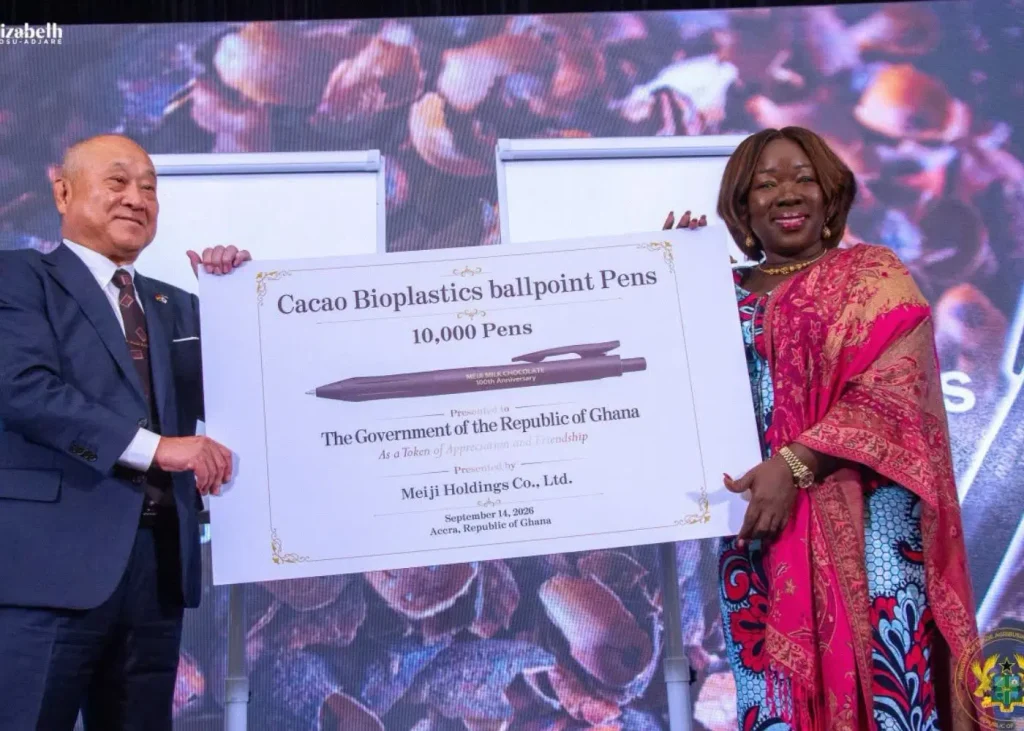
Ghana’s cocoa story may be entering a new chapter, one where the value of cocoa is no longer measured only by the beans harvested from its farms.
The country is deepening its cooperation with Japan to build a more sustainable cocoa industry, with a growing focus on technology, climate resilience, local value addition and, importantly, finding new uses for materials that would normally be treated as agricultural waste.
On September 14, 2026, the Government of Ghana signed a Letter of Intent with the Government of Japan and Japanese food company Meiji Holdings Co. Ltd. to strengthen cooperation around the sustainable development of Ghana’s cocoa industry and the promotion of a circular economy.
The agreement was signed in Accra during an event marking the 100th anniversary of Meiji Milk Chocolate. Ghana’s Minister for Trade, Agribusiness and Industry, Elizabeth Ofosu-Adjare, signed on behalf of Ghana, while Japan’s Ambassador to Ghana, Hiroshi Yoshimoto, signed for Japan. The Chief Executive Officer of Meiji Holdings also initialed the agreement.
But the significance of the agreement goes beyond another international partnership.
It points to a different way of thinking about Ghana’s cocoa industry: not just how much cocoa the country can produce, but how much value it can create from the entire cocoa value chain.
What Happens to Cocoa Waste?
Cocoa production generates more than the beans eventually used to make chocolate.
The cocoa pod contains materials that are often left behind after the useful parts have been extracted. These include cocoa husks and other underutilized portions of the fruit.
The new Ghana-Japan cooperation is exploring how some of these materials can be given a second life.
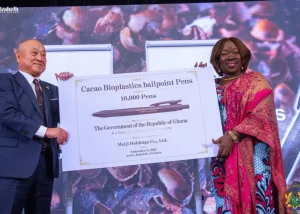
One example was presented during the signing ceremony, when Meiji gave the Ghanaian government 10,000 ballpoint pens made using cacao bio plastic. The pens demonstrate how materials from cocoa production can potentially be transformed into products outside the traditional food and chocolate industries.
This is where the circular economy comes in.
Instead of following a traditional model where agricultural resources are produced, used and discarded, a circular economy looks for ways to keep materials in use for longer, reduce waste and create additional value from resources that might otherwise be thrown away.
For a major cocoa-producing country like Ghana, that could open another layer of opportunity.
From Waste to Value
Meiji is already exploring the commercial potential of underutilized cocoa materials.
In July 2026, the company announced that it had been selected for a Japanese government-supported feasibility study examining the development of bio plastics using agricultural waste such as cacao cascara and cocoa husks in Ghana, Ecuador and Mexico.
The project is designed to assess whether these materials can support a circular manufacturing model that creates value in cocoa-producing countries. Meiji says the initiative could contribute to increased farmer income and local employment while developing a lower-environmental-impact manufacturing model.
For Ghana, the implications could extend beyond waste management.
If cocoa by-products can be collected, processed and converted into commercially useful materials, new activities could emerge around research, processing, manufacturing, logistics and technology.
That means the cocoa sector could potentially create economic value at more points along the chain.
Building a More Sustainable Cocoa Industry
The partnership is not focused on cocoa waste alone.
The Letter of Intent also covers areas including technology transfer, climate-resilient agriculture and efforts to improve productivity, quality, traceability and value addition across Ghana’s cocoa value chain.
These priorities are important because cocoa farming is increasingly being affected by environmental pressures.
Climate change can affect rainfall patterns, temperatures, pests and diseases, creating additional challenges for farmers and the long-term sustainability of cocoa production.
The partnership builds on existing cooperation between Ghana and Meiji, including the Meiji-Ghana Traceability Program, which began in 2007. The company has also supported initiatives involving farmers, seedlings, agroforestry and communities involved in cocoa production.
The latest agreement therefore adds a new dimension to a relationship that has already existed for years.
Ghana Wants More Value From Its Cocoa
There is another major issue behind the partnership: value addition.
Ghana remains one of the world’s largest cocoa producers, producing more than 700,000 tonnes of cocoa beans annually, according to the Ghana News Agency.
However, much of the processing and manufacturing value associated with cocoa has historically been captured outside the country.
At the September 14 forum, Ghana’s Chief of Staff, Julius Debrah, said the country wants to increase local processing and manufacturing so that more economic value can remain within Ghana.
Japan is an important market in that conversation. According to the Ghana News Agency, about 70 per cent of Japan’s cocoa imports come from Ghana.
Rather than viewing local processing as a threat to the existing Ghana-Japan relationship, Ghanaian officials described it as an opportunity to deepen it.
The idea is straightforward: Ghana can produce and process more cocoa locally, while Japanese companies can continue to contribute technology, manufacturing expertise, product development and access to international markets.
That approach could allow both countries to participate in more stages of the cocoa value chain.
The Real Test Will Be Implementation
The signing of the Letter of Intent marks an important step, but the real impact will depend on what happens after the ceremony.
Ideas such as turning cocoa waste into bio plastics are promising, but moving from demonstration products to commercially viable production requires investment, research, infrastructure, technology and reliable systems for collecting and processing agricultural waste.
It will also require farmers and cocoa-producing communities to see tangible benefits from the new opportunities being created around the crop.
That is why implementation will matter.
At the signing ceremony, Julius Debrah urged relevant government institutions and stakeholders to work together and focus on delivering practical results from the agreement.
If the cooperation develops as planned, Ghana’s cocoa industry could become an example of how sustainability and economic value creation can work together.
The opportunity is no longer limited to producing cocoa beans and exporting them.
It could include turning previously underused cocoa materials into new products, strengthening local processing, creating jobs, supporting farmers and reducing waste at the same time.
For a country whose economy has long been closely connected to cocoa, that represents a significant shift in perspective.
The question is no longer simply how much cocoa Ghana can produce.
It is also how much value Ghana can create from every part of the cocoa it produces.
[give_form id="20698"]