Eche Munonye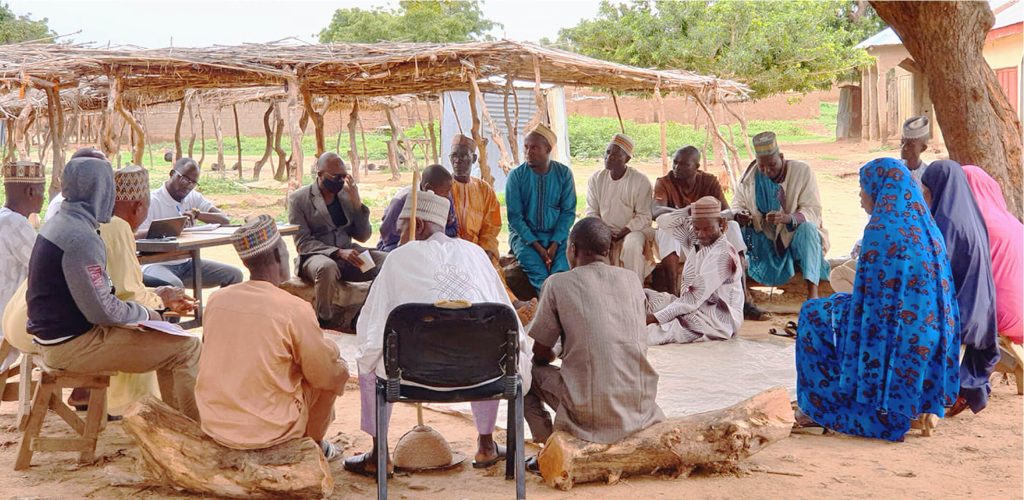
Community Trust Can’t Be Self-Reported: Here’s What the Data Actually Shows
Every sustainability report says the company enjoys strong community relationships. Almost none of them ask the community. We looked at what independent evidence exists, what it says, and where it goes worryingly quiet.
Imagine the launch of a sustainability report. The hall is cool and well lit. A slide behind the presenter reads, in a tasteful serif, “We maintain strong and trusting relationships with our host communities.” Heads nod. Someone in the second row photographs the slide.
This scene is imagined, a composite of launches many of us have attended.
Now picture a different setting, a few hundred kilometres away. A community elder sits under a canopy outside his compound. He has never seen the report. Nobody from the company has asked whether he trusts it. If they had, his answer might have been generous, or it might have taken an hour, and it would almost certainly have included a story about a promise made years ago.
Both scenes describe the same relationship. Only one of them was consulted for the report.
That, in a few sentences, is the problem with self-reported community trust. Trust lives on one side of a relationship, and the company has been writing about the other side’s feelings without asking.
A claim about someone else’s feelings
Read enough sustainability reports and you begin to notice that the sentence about community relationships is nearly always written in the company’s own voice, about the community’s inner life. “Strong relationships.” “Mutual trust.” “Broad support for our operations.” These are statements about what other people think, made by the party that benefits most from those people thinking well of it.
It is a bit like a student marking their own exam and publishing the result as the school’s. The student may be honest. They may even be right. But nobody outside can tell, and the person best placed to check, the teacher, has not been invited.
Reporting has also become so routine that it is easy to mistake it for proof. KPMG’s 2024 survey found that 96% of the world’s 250 largest companies report on ESG and sustainability. When almost everyone reports, the existence of a report tells you very little. What matters is whether anyone other than the company can test what it says.
What the independent data can and cannot tell us
We wanted to build this article on evidence rather than impression, so we went looking for independent data on how Nigerians feel about the companies operating around them. The honest summary is that there is some, it is scattered, and it goes quiet exactly where we need it most.
The big surveys measure the mood, not the relationship
The Edelman Trust Barometer is the best-known yardstick of trust in business worldwide. Its 2025 edition put Nigeria’s overall Trust Index, an average of trust in business, government, media and NGOs, at 65, up four points on the year before. The 2026 release lists Nigeria among the highest-scoring markets, at 72. On the surface, that sounds like good news.
Look closer and the picture shifts. In 2025, 72% of Nigerians surveyed reported a moderate or higher sense of grievance, meaning a belief that government and business serve narrow interests while the wealthy benefit and ordinary people struggle. In 2026, the trust gap between high-income and low-income Nigerians stood at 26 points, among the widest of any country surveyed, level with Indonesia and behind only the United States at 29.
Two lessons sit inside those numbers. First, an average can be high while a large part of the population feels left out. Second, these are national attitudes toward business in general. They cannot tell you whether the people living beside a particular plant or terminal trust the company that runs it. The surveys are also conducted through online interviews, which raises a fair question about how well any such method reaches the most remote communities.
As far as we could find, nobody tracks it company by company
Afrobarometer is the gold standard for public-opinion research in Africa. Its 2020 survey in Nigeria interviewed 1,599 adults chosen through a random, stratified sample, with a margin of error of about 2.5 percentage points, and its Nigerian fieldwork runs in languages including Hausa, Yoruba, Igbo, Pidgin, Tiv, Ibibio and Ijaw. That is what rigorous looks like. But the trust questions we could find in its results concern institutions such as the presidency, parliament, and traditional and religious leaders, not companies.
So the first finding is a finding about absence. As far as we were able to establish, there is no independent, recurring and representative measure of how host communities in Nigeria rate the individual companies in their midst. Every company’s claim about community trust goes unchallenged by a national dataset.
The absence of independent data does not mean trust is high. It means nobody has checked.
What the community-level evidence says
Where researchers have gone into oil-producing communities and asked, the answers point in an uncomfortable direction. We should be careful here. These are small studies, mostly qualitative or regional, and not all have been through rigorous peer review. None can be treated as a national verdict. But they are consistent with one another.
- A survey of 400 people across 16 oil-producing localities in the operating zones of two major oil companies found that residents knew about the companies’ community development programmes but felt unequipped to take part, and described the programmes as self-serving.
- A study based on open-ended interviews with residents of ten communities in Delta and Rivers states found that meaningful two-way communication with the companies was largely absent, and that communities held negative views of the companies’ CSR messages.
- A questionnaire study in Delta State, with 174 completed responses, concluded that respondents saw the impact of oil company CSR as more negative than positive, and often as a cover for irresponsibility.
Notice the word that keeps returning: communication. What companies report is spending. What communities describe is a relationship, and the relationship is where things seem to go wrong.
A separate ethnographic study in eight Delta State communities adds a quieter warning. Its researchers noted that residents were reluctant to share information with strangers. It is a useful reminder that independent measurement is not easy. Trust is needed in order to measure trust.
What actually predicts trust
The strongest evidence on what builds trust comes from outside Nigeria, and it deserves attention. In a well-cited longitudinal study of an Australian mining region, Kieren Moffat and Airong Zhang found that the quality of a company’s contact with the community predicted trust, while the quantity of contact did not. The strongest predictor of trust in their model was procedural fairness, meaning whether people felt the company dealt with them fairly. Impacts that turned out worse than expected reduced trust. Their model explained 68% of the variation in community acceptance.
The setting is very different from Nigeria, and we should not stretch the finding too far. But look at what it implies. The things companies most like to report, such as meetings held, projects announced and naira spent, are quantity measures. The things that appear to drive trust, fairness and the quality of contact, can only be judged by the people on the receiving end.
The clearest test case: host community trusts
Nigeria has produced something close to a natural experiment in what happens when voluntary CSR becomes a legal obligation. The Petroleum Industry Act 2021 requires oil and gas companies to pay 3% of the previous year’s actual operating expenditure into a Host Communities Development Trust for the communities where they operate. It replaced a patchwork of voluntary arrangements that carried no legal backing and depended on company goodwill.
The headline numbers are real and worth acknowledging. According to a five-year review by the BudgIT Foundation, also carried by BusinessDay, more than 160 trusts had been incorporated and cumulative contributions had passed ₦373 billion by October 2025, funding more than 1,100 community projects. The regulator, NUPRC, which now counts 172 incorporated trusts, says the framework is working. It points to schools, hospitals and other infrastructure, and to greater calm in communities that were once volatile.
The same review then turns to the harder part.
- No settlor met the nine-month deadline the law set for establishing a trust, and an estimated 30% of licence holders still had no incorporated trust five years on.
- As of mid-2024, roughly 97 of the trusts that had been incorporated were still unfunded.
- Even where companies say they have paid their 3%, communities frequently have no means of checking the figure against actual operating expenditure.
- Disputes over trust boundaries, inclusion and board composition have slowed implementation and ended up in litigation.
- Although the regulator can fine defaulters or revoke licences, no sanctions had been documented.
Read together, these points show the pattern this article is about. Even under a statute, with a regulator watching, the account of how much has been paid and how well it is working leans heavily on what companies and officials report. The people who live with the outcome cannot easily verify it.
The evidence at a glance
| What the evidence says | Source |
| 72% of Nigerians report a moderate or higher sense of grievance toward business and government (2025) | Edelman 2025 |
| 26-point trust gap between high- and low-income Nigerians (2026) | Edelman 2026 |
| Nearly every large company reports on sustainability: 96% of the world’s 250 largest | KPMG 2024 |
| 160+ host community trusts incorporated; ₦373bn+ contributed by October 2025 | BudgIT; BusinessDay |
| About 30% of licence holders still had no incorporated trust | BudgIT; BusinessDay |
| About 97 incorporated trusts were unfunded as of mid-2024 | BudgIT; BusinessDay |
| No regulatory sanctions documented against defaulting companies | BudgIT; BusinessDay |
Figures as reported by the sources named. Community-level studies are omitted from the table because they are small and not nationally representative.
A lesson from our own desk
I would be a poor critic if I did not admit where we have stumbled ourselves. When we first built a RANKED list of Nigeria’s most community-trusted brands, we leaned on evidence that could be verified from the outside: published disclosures, third-party reports, public records. It was careful work, and it still contained a subtle mistake. Disclosure quality and CSR spend are inputs. Community trust is an outcome. A company can excel at the first two and still be distrusted by the people next door.
The case that made us see it was Seplat Energy, which sat at number two on our list. We then found a documented pattern of host-community protest: three different Delta State communities, in November 2024, December 2025 and March 2026, each alleging exclusion from decisions despite the company’s GMoU framework. These are allegations, and the company is entitled to answer them. But they told us our measure was not measuring what we said it measured.
So we published a standalone accountability review correcting the placement, redefined community trust around actual social licence (community-reported conflict, how grievances are resolved, and independent civil-society assessment), and paused the list while we run the same check on the other nine. We share this because if a team whose whole purpose is scrutiny can be misled by disclosure, so can any reader of any annual report.
Why self-reporting fails
It is tempting to blame bad faith, but the problem is more structural than that. Three things go wrong even when everyone means well.
A conflict of interest. The reporter is also the one being judged. Even honest people round upward when the score is their own.
The wrong unit of measurement. Companies can count what they do: meetings, boreholes, scholarships, naira. They cannot count how it was received. Trust is not a quantity of activity. It is a judgement made by someone else.
The wrong people in the room. A well-known risk in stakeholder research is that company-run consultations reach the people the company already knows: community leaders, contractors, project beneficiaries. Those are often the people with the most to gain from the relationship and the least reason to say anything that puts it at risk. The elder under the canopy, the young fisherman and the woman trader may never be asked.
What credible measurement looks like
None of this means companies should stop reporting. It means the reporting should stand on evidence others can check. Six habits would take us a long way.
- Ask the community, and let someone independent do the asking. Use random sampling, local languages and enumerators the community does not associate with the company, in the spirit of the Afrobarometer model.
- Measure what predicts trust. Ask about fairness of process, quality of contact, and whether impacts turned out better or worse than expected, not just satisfaction with projects.
- Publish the grievances. Report how many complaints were received, how many were resolved and how long resolution took, including the ones nobody enjoys reading.
- Triangulate. Set survey results against protests, litigation, regulator records and independent site visits. Any one source can mislead. Together they are harder to fool.
- Let communities check the money. Where a payment is calculated from a formula, such as the 3% under the Petroleum Industry Act, publish the base it was calculated on so the people it is meant for can do the arithmetic.
- Report bad news alongside good. A trust score that never moves is not evidence of stability. It is a sign that nobody is really measuring.
There is a fair objection to all this. Communities are not monoliths, a survey can be dominated by loud voices, and a complaint is not always proof of distrust. All true, and it is exactly why no single measure should be trusted on its own. But that is an argument for better measurement, not for letting the company grade itself.
Three questions for the next report
- Who was asked, how were they chosen, and who did the asking?
- Who was not in the room?
- What would the results have had to look like for the company to say trust was low?
If the report cannot answer these, it may still be sincere. But sincerity is not evidence, and communities deserve more than a well-meaning sentence about how they feel.
At CSR Reporters, we treat community trust as something to be earned and tested from the outside in: through independent site visits, community-reported conflict and, wherever we can, a right of reply for the company being examined. We are still refining how we measure it, and we say so plainly.
Trust is not something a company can declare. It is something a community can grant, and only the community can tell us whether it has.
[give_form id="20698"]