Nigeria Is Giving Young People Digital Devices, Will That Create Real Opportunities for Young Nigerians?
 ONYINYECHI NWAIGBA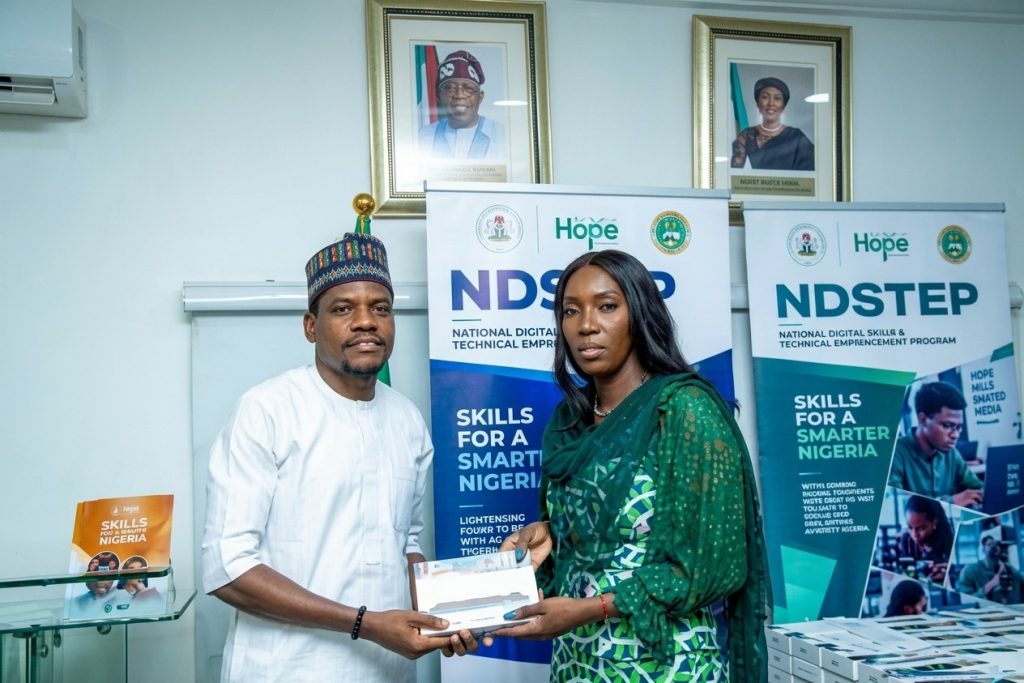
The Federal Government plans to distribute 400,000 digital devices to young Nigerians, students, artisans, entrepreneurs and vulnerable groups. But beyond handing out tablets and laptops, the bigger question is whether recipients will have the skills, connectivity and opportunities to turn those devices into sustainable livelihoods.
A laptop can be a classroom.
A smartphone can be a shop.
A tablet can become a workplace, a marketing tool, a way to find customers or even a gateway into a new career.
But only if the person holding it can actually use it for those things.
That is the bigger question behind the Federal Government’s plan to distribute 400,000 digital devices to young Nigerians.
The devices are being distributed under the National Digital Skills and Technical Empowerment Program (NDSTEP), with young people, students, artisans, entrepreneurs and vulnerable groups among the intended beneficiaries.
The Senior Special Assistant to the President on Technical, Vocational and Entrepreneurship Education, Dr Abiola Arogundade, announced the plan in Abuja on September 24, saying the initiative is intended to expand access to digital skills, vocational training and entrepreneurship opportunities. Tablets were also presented to 70 digital media personnel at a stakeholder meeting.
The thinking behind the program is straightforward.
Many Nigerians already have skills.
What they may not have is the digital equipment needed to turn those skills into income.
A tailor may know how to make clothes but lack a device for displaying products online.
A makeup artist may have clients but no reliable way to build a digital portfolio.
An artisan may be good at a trade but struggle to reach customers beyond the people who already know them.
A student may have access to online courses but not a suitable device on which to complete them.
So the device itself can matter.
But it is only the beginning.
A device can open a door, but it cannot walk through it
One of the most interesting ideas behind the initiative is the government’s argument that digital devices should be treated as economic tools rather than luxury items.
Arogundade described phones and laptops as tools that can help artisans find new customers and help people turn training into certification and employment.
That reflects a wider change in the Nigerian economy.
The internet is no longer simply a place for entertainment and social interaction.
For many people, it has become a marketplace, classroom, portfolio, recruitment platform and networking space.
A fashion designer can display products on social media.
A graphic designer can work with a client in another state.
A student can take an international course without leaving Nigeria.
A small business can receive orders through digital platforms.
A freelancer can provide services to clients thousands of kilometers away.
But all of those opportunities depend on having the tools to participate.
This is where the 400,000-device plan becomes more than a distribution exercise.
It becomes a test of whether access to technology can translate into access to economic opportunity.
Nigeria’s digital divide is not only about internet coverage
When people talk about the digital divide, the conversation often focuses on connectivity.
Can someone access the internet?
Is there mobile network coverage?
Is broadband available?
Those questions are important.
But there is another question that is sometimes overlooked:
What device is the person using to access the internet?
Someone may live in an area with network coverage but still struggle to participate in digital learning or work because they only have access to a basic phone, an old device or no personal device at all.
The gap becomes more obvious when the task requires more than WhatsApp or social media.
Graphic design, coding, video editing, online courses, digital marketing, data analysis and many forms of remote work can require devices with enough processing power, storage and battery life to handle them.
So connectivity without appropriate devices can still leave people on the edge of the digital economy.
But then comes the skills question
Giving someone a laptop does not automatically make that person employable.
A tablet does not automatically create a business.
And internet access does not automatically create income.
This is why the skills component of the program matters just as much as the hardware.
The Federal Government has already been running other youth-focused skills initiatives.
In August, the Federal Ministry of Youth Development said 239,726 young Nigerians had received digital, employability and practical skills through the Nigerian Youth Academy, or NiYA. The ministry also reported that more than 1.2 million certificates had been downloaded from the platform.
NiYA’s current program model combines learning with employment, entrepreneurship, mentorship and access to opportunities, reflecting the idea that skills acquisition works better when people have pathways to use those skills.
That same principle will matter for the 400,000 devices.
The question should not simply be:
How many devices were distributed?
It should also be:
How many recipients learned something useful with them?
How many used them to find work?
How many gained customers?
How many completed certifications?
How many started or expanded businesses?
How many were able to earn income because they had the device?
Those are the numbers that would tell the bigger story.
For artisans, the opportunity could be especially practical
The program’s focus on artisans and small entrepreneurs is significant.
Digital inclusion does not have to mean turning everyone into a software developer.
A carpenter can use digital platforms to showcase completed projects.
A fashion designer can build a catalogue and receive orders online.
A photographer can market services beyond their immediate neighbourhood.
A food business can manage orders and communicate with customers.
A mechanic can use digital tools to learn about newer vehicle technologies.
A small retailer can use digital payments, inventory tools and online marketing.
The device becomes valuable because it connects an existing skill to a larger market.
That distinction matters.
Digital empowerment should not be measured only by how many people are taught to code or use artificial intelligence.
It should also be measured by how effectively technology strengthens the economic activities people are already engaged in.
There is another problem: data costs money
Even with a free device, using it is not necessarily free.
Internet access costs money.
Electricity costs money.
Repairs cost money.
Software and subscriptions can cost money.
And in many households, one device may be expected to serve several people.
This means that the real cost of digital participation extends beyond the device itself.
A student who receives a tablet but cannot regularly afford data may struggle to complete online training.
An entrepreneur who receives a laptop but experiences frequent power interruptions may still find it difficult to work consistently.
Someone who breaks a device after six months may have no affordable repair or replacement option.
This is why digital inclusion needs to be viewed as an ecosystem rather than a handover ceremony.
Electricity is part of the digital-device conversation
There is also a less obvious issue.
A digital device needs power.
That sounds simple, but reliable electricity remains a practical constraint for many Nigerians.
A laptop can provide access to opportunities, but it cannot help someone work if it repeatedly runs out of battery and there is no reliable way to recharge it.
For young people using technology to study, work or run businesses, electricity becomes part of the cost of digital participation.
This means that initiatives designed to expand digital access are connected to broader infrastructure questions around electricity, connectivity and affordability.
The device may be the most visible part of the intervention.
It is not necessarily the part that determines whether the intervention succeeds.
Reaching the people who need the devices most
Another important question is distribution.
Who gets the devices?
How are beneficiaries selected?
Will young people in rural communities have the same opportunity to participate as those in major cities?
Will people with disabilities be included?
What about young Nigerians who are not currently in school or formal employment?
The program says it is targeting young Nigerians, students, artisans, entrepreneurs and vulnerable groups across the country.
But a national program can only have national impact if its reach goes beyond people who already have strong access to information about government programmes.
This is where communication becomes important.
The government has specifically highlighted the role of media and digital media managers in helping information about its programmes reach communities and potential beneficiaries.
That sounds administrative, but it is actually a major part of program effectiveness.
An opportunity that people do not know exists is not really an accessible opportunity.
The Oyo model offers a glimpse of what could work
The device program is also coming alongside practical skills interventions.
In Oyo State, the Federal Government recently announced a program to train 200 young people in graphics and artificial intelligence, makeup and fashion design.
The beneficiaries are also expected to receive tools linked to their training: laptops for graphics and AI trainees, makeup kits for makeup trainees, and sewing machines and starter kits for fashion trainees.
The program is scheduled to run from September 28 to October 9, with the government saying it will be replicated across the six geopolitical zones. Five hundred tablets are also expected to be distributed during the program’s grand finale.
This approach points to an important principle.
Tools become more useful when they are connected directly to skills.
A sewing machine makes more sense when the recipient has been trained to sew.
A laptop becomes more valuable when the recipient has been trained in a marketable digital skill.
A tablet becomes more useful when there is a clear pathway from learning to employment, entrepreneurship or further education.
What happens after the photographs?
This may ultimately be the most important question.
Large-scale empowerment programmes often produce easy-to-count numbers.
Number of beneficiaries.
Number of devices.
Number of training sessions.
Number of certificates.
Those figures matter, but they do not tell the whole story.
The more difficult measurement comes later.
Six months after receiving a device, is it still being used?
A year later, has it helped the recipient earn more?
Has a student completed a course?
Has an artisan gained new customers?
Has a small business expanded its digital presence?
Has someone found employment because they acquired a particular skill?
Has the device been repaired when it developed a fault?
These are harder questions, but they are closer to actual impact.
The risk of measuring distribution instead of impact
There is always a temptation with large empowerment initiatives to treat distribution as the achievement.
Four hundred thousand devices sounds impressive.
And reaching that number would represent a substantial logistical exercise.
But distribution is an output.
Impact is what happens afterwards.
The difference is important.
If 400,000 devices are distributed but many recipients lack the skills, electricity, connectivity or opportunities required to use them productively, the intervention may not produce the economic transformation its designers hope for.
On the other hand, if the devices become part of a broader system that connects young Nigerians to skills, markets, employers, finance and entrepreneurship opportunities, their value could extend far beyond the hardware itself.
Digital inclusion should mean participation, not possession
Nigeria’s young population represents a large potential workforce for the digital economy.
But potential does not automatically become productivity.
Young people need access to education, relevant skills, affordable connectivity, reliable power, devices, finance and opportunities to use what they have learned.
The 400,000 devices can address one part of that equation.
They cannot solve all of it.
That is not necessarily a weakness of the program.
It simply means the success of the intervention should be judged as part of a larger system.
The device is the tool.
The skill is what makes the tool useful.
The connectivity makes it accessible.
The opportunity gives it purpose.
And the ability to generate income or improve a person’s livelihood is what ultimately turns digital access into social and economic impact.
So, can 400,000 devices change young Nigerians’ opportunities?
They can create opportunities for people who currently lack the tools to participate fully in the digital economy.
But the bigger impact will depend on what happens after the devices are handed over.
If recipients receive relevant training, affordable connectivity, reliable power and pathways to jobs, customers or markets, the devices could become productive assets rather than simply government-issued gadgets.
That is where the real test begins.
Not at the handover.
Not in the photographs.
Not in the number of boxes distributed.
But months later, when a young entrepreneur uses the device to win a customer, a student completes a course, an artisan reaches a new market or a job seeker finds work that would have been harder to access before.
Because digital inclusion is not simply about putting a device in someone’s hands. It is about giving them a better chance to use technology to change what is possible
[give_form id="20698"]