Can Solar Irrigation Help Nigerian Farmers Cut Costs and Farm Beyond the Rainy Season?
 ONYINYECHI NWAIGBA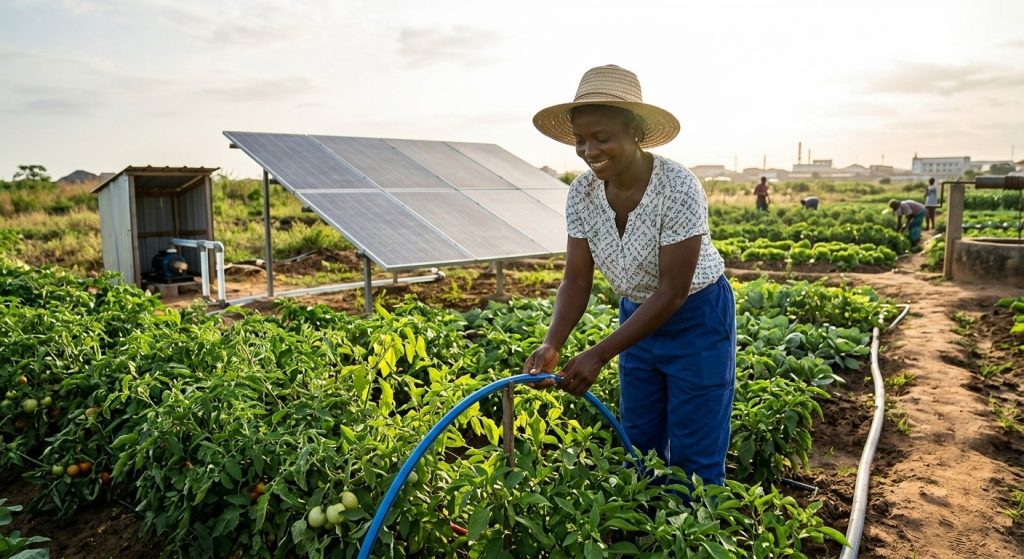
More than 1,500 farmers in Bauchi have received solar-powered irrigation equipment, highlighting how access to alternative energy for water pumping could affect farming costs, dry-season production and rural livelihoods.
For farmers who depend on irrigation, water is only part of the challenge.
The other question is how much it costs to get that water onto the farm.
Across many farming communities, petrol and diesel-powered pumps remain important tools for irrigation. They provide farmers with a way to cultivate crops when rainfall is limited, but the fuel required to keep those pumps running can become a significant operating expense.
When fuel prices rise, the cost of pumping water rises with them.
That can affect how much a farmer is able to cultivate, what crops they can afford to grow and how profitable dry-season farming becomes.
A recent intervention in Bauchi State is attempting to address part of that challenge by replacing conventional fuel-powered irrigation equipment with solar-powered systems.
More than 1,500 farmers in the Darazo/Ganjuwa Federal Constituency have received DC solar pumps and three solar panels each, according to reports on the intervention. The equipment is intended to help farmers reduce their dependence on petrol and diesel while lowering the cost of irrigation.
On the surface, it is an agricultural support program.
But there is a bigger question underneath it:
Can access to solar-powered irrigation help Nigerian farmers produce more while spending less?
Why Irrigation Costs Matter
Rainfall remains a major determinant of agricultural production in many parts of Nigeria.
Farmers who rely heavily on rain-fed agriculture are exposed to changes in rainfall patterns, delayed rains, dry spells and increasingly unpredictable weather conditions.
Irrigation can provide another option.
It allows farmers to supply water to crops when rainfall is insufficient and can make production possible outside the traditional rainy season.
That can open opportunities for dry-season farming, which can be particularly important for crops such as vegetables and other produce with strong local demand.
But irrigation comes with a cost.
Pumps need energy.
For farmers using petrol or diesel-powered pumps, every additional hour of irrigation can mean additional fuel expenditure.
Over an entire farming season, those costs can become substantial.
Reducing the cost of pumping water could therefore affect the economics of farming itself.
What Changes When the Sun Becomes the Fuel?
Solar-powered irrigation works on a relatively straightforward principle.
Solar panels generate electricity, which powers a pump that draws water and delivers it to the farm.
Unlike a petrol or diesel pump, the solar system does not require the farmer to purchase fuel every time the pump is operated.
That does not mean solar irrigation is free.
Farmers still have to pay for the equipment, installation, maintenance and eventual replacement of components.
But once the system is installed, the cost structure is different.
The farmer is no longer dependent on purchasing fuel for every pumping cycle.
Research published in 2026 has found that solar-powered irrigation can reduce operating costs and greenhouse-gas emissions compared with fossil-fuel-powered pumping, while also identifying challenges around upfront investment, maintenance and technical capacity.
For farmers operating on narrow margins, that difference can matter.
What Could Lower Irrigation Costs Mean for Farmers?
Suppose a farmer spends a significant amount of money every week on fuel to operate an irrigation pump.
If part of that cost disappears, the farmer has more money available for other inputs.
That could include seeds, fertilizer, labor, pesticides, transportation or post-harvest handling.
It could also simply increase the farmer’s margin.
The impact therefore goes beyond the pump itself.
Lower operating costs can potentially change how a farmer makes decisions.
A farmer who previously irrigated only a small section of land because of fuel costs may be able to cultivate more.
Someone who avoided dry-season farming because it was too expensive may consider it more viable.
Another farmer may be able to invest savings from reduced fuel expenditure into improving production.
These are potential outcomes, not automatic ones.
But they explain why energy costs are an important part of agricultural productivity.
Dry-Season Farming Could Become More Accessible
One of the biggest opportunities associated with irrigation is the ability to farm beyond the rainy season.
For farmers who can access reliable water, dry-season cultivation can provide another production cycle and another opportunity to earn income.
This can be particularly valuable in regions where agricultural activity traditionally slows when rainfall declines.
If solar-powered irrigation reduces the cost of accessing water, it could make some forms of dry-season farming more financially attractive.
That could potentially increase the supply of certain crops during periods when production would otherwise fall.
For consumers, more consistent production could also contribute to food availability.
For farmers, it could mean another source of income.
But again, irrigation is only one part of the equation.
Farmers still need access to seeds, fertilizer, markets, storage, transportation and affordable financing.
There Is an Environmental Benefit Too
The economic argument for solar irrigation is only one side of the story.
There is also an environmental dimension.
Petrol and diesel engines produce greenhouse-gas emissions when they operate.
Replacing some fossil-fuel-powered irrigation with solar energy can reduce the amount of fuel being burned for water pumping.
That matters as agriculture increasingly has to deal with the effects of climate change while also trying to reduce its own environmental footprint.
The irony is that farmers are often among those most exposed to changing climate conditions.
They need energy to adapt to unpredictable rainfall, but the conventional energy systems used to support that adaptation can themselves contribute to emissions.
Solar-powered irrigation offers one way of addressing both sides of that challenge.
But Solar Equipment Is Not Maintenance-Free
It would be easy to present solar irrigation as a perfect solution.
It is not.
Solar equipment can have a long useful life, but it still requires maintenance.
Pumps can fail.
Panels can become damaged or dirty.
Electrical components can develop faults.
Wiring can be stolen or damaged.
Farmers may also need technical support when equipment stops working.
This is particularly important in rural communities where specialized technicians may not be readily available.
If farmers receive equipment but do not have access to maintenance services, the benefits can decline over time.
That is why the long-term success of solar irrigation program mes should be measured not just by the number of pumps distributed, but by whether those pumps are still working years after distribution.
The Upfront Cost Problem
There is another challenge.
Solar irrigation may reduce operating costs, but the equipment itself can require significant upfront investment.
For a smallholder farmer, purchasing solar panels, pumps, wiring and related infrastructure may be difficult even if the long-term savings are attractive.
That is one reason public interventions and financing program mes can play an important role in helping farmers adopt the technology.
But support should ideally go beyond simply providing equipment.
Farmers need to understand how the systems work, how to maintain them and how to use them efficiently.
Otherwise, an intervention designed to reduce costs could eventually become an underused or abandoned asset.
What Does This Mean for 1,500 Farmers?
For the more than 1,500 farmers benefiting from the Bauchi intervention, the immediate value is access to irrigation equipment that can operate without the same dependence on petrol and diesel.
Each farmer reportedly receives a DC solar pump and three solar panels.
The stated goal is to reduce farming costs and support agricultural productivity.
But the longer-term impact will depend on what farmers are able to do with that access.
Will they cultivate more land?
Will production increase?
Will they be able to grow crops during longer periods of the year?
How much will their irrigation expenses fall?
Will household incomes increase?
Will farmers invest the savings into other areas of their businesses?
These are the questions that will tell us whether the intervention has created lasting economic value.
The Real Test Is What Happens After Distribution
There is often a temptation to measure agricultural interventions by inputs.
How many farmers received equipment?
How many pumps were distributed?
How much money was spent?
Those numbers matter, but they only tell us what happened at the beginning.
The more useful measures come later.
How many farmers continue using the equipment?
How much fuel are they actually saving?
Has their cultivated area increased?
Has productivity improved?
Are household incomes higher?
Are farmers able to produce during periods when they previously could not?
And what happens when a pump develops a fault?
These questions are especially important for solar irrigation because the technology is intended to provide benefits over several years.
The impact therefore needs to be measured over time.
Solar Irrigation Cannot Solve Every Agricultural Problem
It is also important not to overstate what solar irrigation can achieve.
A farmer can have a functioning solar pump and still struggle because of poor roads, expensive fertilizer, limited access to credit, inadequate storage or weak markets.
Producing more food is only useful if farmers can sell that food at a sustainable price.
A farmer who increases production but loses a large portion of the harvest because of inadequate storage may not experience the full economic benefit of irrigation.
Similarly, farmers need access to markets that can absorb additional production.
This means solar irrigation should be viewed as one part of a broader agricultural system.
It addresses an important constraint — access to affordable water — but other constraints remain.
Could the Model Be Scaled?
The Bauchi intervention also raises a larger question.
If solar irrigation can help farmers reduce fuel costs, could similar models be expanded to other agricultural communities?
Nigeria has millions of smallholder farmers operating across different climatic zones and agricultural value chains.
Many face energy and irrigation challenges.
The potential scale of solar-powered irrigation is therefore considerable.
But scaling would require more than distributing more equipment.
It would require appropriate financing models, reliable equipment, local technical support, training, spare parts and systems for monitoring whether installations remain operational.
It would also require understanding the needs of different farming communities.
A solar irrigation model that works in one location may need to be adapted to another depending on water availability, crops, farm sizes and local conditions.
An Energy Question Hidden Inside an Agriculture Problem
Perhaps the most interesting thing about the Bauchi intervention is that it shows how closely energy and agriculture are connected.
Farmers need water.
Moving that water requires energy.
The cost of that energy affects the cost of farming.
The cost of farming affects profitability.
And profitability influences whether farmers can continue investing in production.
Solar power therefore enters the conversation not simply as an environmental alternative but as an agricultural business tool.
That is an important shift.
The question is no longer only whether solar energy is cleaner.
It is whether cleaner energy can also make agricultural production more economically sustainable.
Beyond the Solar Panels
The distribution of solar irrigation equipment to more than 1,500 farmers in Bauchi is a relatively specific intervention.
But it points to a much larger opportunity for Nigeria’s agricultural sector.
If farmers can reduce the amount they spend on fuel, they may have more resources available for production.
If they can irrigate more reliably, they may be able to cultivate beyond the rainy season.
If dry-season production increases, communities could have additional sources of food and income.
And if solar systems remain operational over the long term, farmers could gain an energy asset rather than simply receiving a one-time intervention.
But the real measure of success will not be the number of solar panels distributed.
It will be whether those panels continue powering productive farms months and years from now.
For Nigeria, the opportunity lies in connecting energy solutions with the everyday economics of farming.
Because sometimes, reducing the cost of agriculture does not begin with a bigger harvest.
It begins with making it cheaper to get water to the crops.
[give_form id="20698"]