ONYINYECHI NWAIGBA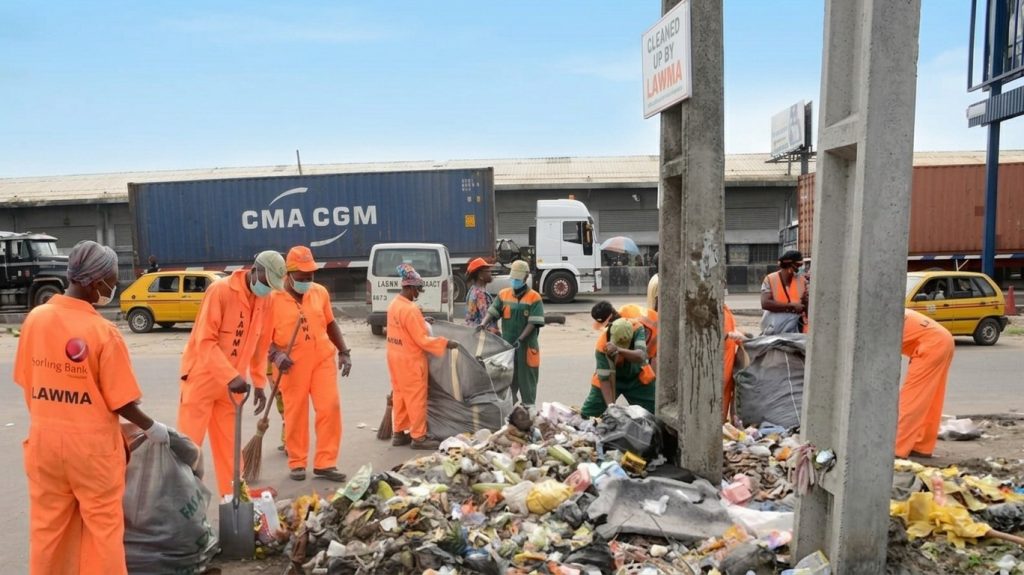
Residents are being urged to take responsibility for sanitation, but irregular waste collection is leaving some communities with a difficult question: what happens when people clean their surroundings but have nowhere reliable to take the waste?
There is a familiar scene in many Lagos neighborhoods.
Residents sweep their compounds. Streets are cleared. Drainage channels are opened up. Traders clean around their shops. Domestic workers and paid cleaners gather piles of refuse that have accumulated during the week.
For a moment, the neighborhood looks better.
Then comes the harder part.
Where does all the waste go?
That question is becoming increasingly important in parts of Lagos where residents say waste collection is irregular, leaving refuse to remain on roads and around homes even after communities have participated in sanitation activities.
During recent sanitation activities in Maiyegun Oro Street in Amukoko and Okerube in Ikotun, residents told the News Agency of Nigeria that irregular evacuation was making it difficult to maintain clean surroundings. Some said they were turning to informal waste collectors when formal operators failed to arrive on time.
At Okerube, one resident said informal collectors sometimes charged between ₦1,500 and ₦2,000 to evacuate refuse.
Another resident said the community did not regularly see PSP operators and therefore had little choice but to rely on alternative collectors.
The problem reveals something bigger about urban sanitation.
Keeping Lagos clean is not only about whether residents sweep their streets.
It is also about whether the system has somewhere reliable for the waste to go.
Cleaning the street is only the first step
Environmental sanitation often places attention on what residents are doing.
Are people dumping refuse in drains?
Are traders keeping their surroundings clean?
Are households storing waste properly?
Are businesses following sanitation rules?
These questions matter.
But waste management does not end when someone ties a bag of rubbish and carries it outside.
That bag still has to be collected, transported and taken to an appropriate facility.
If collection does not happen consistently, the waste simply moves from one location to another.
A clean compound can quickly become surrounded by refuse.
A cleared drainage channel can become blocked again.
A roadside that was cleaned during sanitation can become another dumping point.
That is why collection is not a minor part of sanitation.
It is the bridge between individual responsibility and a functioning waste-management system.
The PSP system was designed to fill that gap
Lagos has operated a Private Sector Participation model for domestic waste collection for decades.
According to the Lagos Waste Management Authority, private-sector participation in waste collection and transportation began in 1997 and was subsequently restructured under LAWMA’s management and monitoring framework. LAWMA currently lists PSP operators assigned to different areas across the state.
The idea is relatively straightforward.
Private operators collect household waste within designated areas, while the state agency provides oversight and coordinates the wider waste-management system.
The model has also created employment.
LAWMA says the number of PSP operators has grown over the years, with more than 3,500 staff currently associated with the program.
But the system has not eliminated service gaps.
In fact, LAWMA’s own assessment of its PSP program lists “unreliable service delivery” among its weaknesses. It also identifies insufficient waste compactors and poor road infrastructure as threats to effective collection.
That is important because it shows that irregular collection is not simply a complaint coming from residents.
It is also a recognized operational challenge within the system itself.
When formal collection fails, informal collection fills the gap
The experience reported by residents in Okerube shows what happens next.
People still generate waste.
Homes still produce food scraps, packaging and household refuse.
Businesses still produce waste every day.
So when formal collectors do not arrive, residents have to find another option.
That is where informal collectors come in.
For some households, paying someone to remove the waste may be preferable to leaving it outside for days.
From the resident’s perspective, the decision can seem practical.
But from a wider waste-management perspective, it creates another problem.
If informal collectors are not operating within the formal disposal system, there is a risk that waste may eventually be dumped somewhere it should not be.
LAWMA has recently intensified enforcement against unauthorized waste collection and illegal dumping, including the seizure of carts and arrests over alleged waste-related offenses. The agency has warned that unregulated collection can undermine organist waste management, particularly where waste is later disposed of at unauthorized locations.
This creates a difficult cycle.
Formal collection is unreliable in some areas.
Residents seek alternatives.
Informal collectors step in.
Authorities crack down on unauthorized collection.
But unless the original service gap is fixed, the demand that created the informal market remains.
Enforcement cannot be the entire solution
There is an important place for enforcement.
People should not dump waste into drainage channels, roads or waterways.
Businesses and households have responsibilities.
Illegal dumping can contribute to blocked drainage and create environmental and public-health risks.
But enforcement works best when people also have a practical alternative.
It is difficult to build a sustainable waste-management culture if residents are told not to use informal collectors but cannot depend on the formal service to collect their waste when it is generated.
This is why service delivery and enforcement have to move together.
Residents need to know:
Who is responsible for their area?
When should collection happen?
What should they do if the operator does not show up?
How can they report missed collection?
And how quickly will the complaint be addressed?
A sanitation system becomes stronger when residents can participate in it rather than simply being punished when it breaks down.
Waste collection is also a flood issue
The consequences go beyond unpleasant smells and ugly streets.
Lagos is particularly vulnerable to flooding, and waste dumped in drainage channels can restrict the movement of stormwater.
LAWMA itself identifies free-flowing drainage and reduced incidences of flooding among the goals of its waste-management program.
Recent reporting from Amukoko also showed the connection.
Residents in the area said accumulated refuse, inadequate waste bins and irregular collection were contributing to sanitation problems, while rainfall could worsen flooding around affected areas.
This means waste management and flood management cannot really be treated as completely separate issues.
A plastic bag thrown into a gutter may look like a small act.
Multiply that by thousands of households and businesses across a densely populated city, and the cumulative effect becomes much larger.
The health question is just as important
Waste that remains exposed for days can create unpleasant and potentially unhealthy conditions.
Accumulated refuse can attract flies and other pests, produce offensive odours and affect the environment around homes, shops and food businesses.
For traders, the consequences can become economic as well as environmental.
If customers do not want to walk through a dirty or foul-smelling area, businesses operating there can suffer.
This is particularly relevant in markets and densely populated commercial communities where people spend long hours around accumulated waste.
So waste collection is not simply a matter of making Lagos look cleaner.
It is connected to the quality of the environment in which people live, work and trade.
Lagos is dealing with a volume problem too
A city the size of Lagos produces enormous quantities of waste every day.
That means the system needs more than occasional clean-up exercises.
It needs a reliable chain from the point where waste is generated to the point where it is processed, recycled, transferred or disposed of.
That chain requires trucks.
It requires functioning roads.
It requires transfer and disposal infrastructure.
It requires workers.
It requires monitoring.
And it requires residents to participate.
A weakness at any point can affect the entire system.
A truck that cannot reach a neighborhood because of poor roads creates a collection delay.
A shortage of compactors can create a backlog.
A delayed transfer operation can affect collection schedules.
And when households have nowhere to put accumulating waste, public spaces eventually become storage areas.
The city is trying to address the problem
LAWMA has said it is moving beyond simply clearing waste black spots after refuse has accumulated.
Its stated approach combines evacuation with improved collection arrangements, enforcement, infrastructure upgrades and community engagement, with the aim of preventing cleared locations from becoming dumping points again.
That shift is important.
Repeatedly clearing the same location does not necessarily solve the reason waste keeps returning.
If a road median becomes a dumping point because nearby residents have no reliable collection service, clearing it today does not prevent another pile from appearing tomorrow.
The more sustainable question is:
Why did the waste end up there in the first place?
Was collection missed?
Was the assigned operator unable to reach the area?
Are there enough bins?
Is the collection schedule clear?
Is the disposal point accessible?
Are residents deliberately dumping there despite having alternatives?
The answer may be different from one neighborhood to another.
What should a better system look like?
A functioning waste-management system should make the correct behavior reasonably easy.
Residents should have access to appropriate waste collection.
Collection schedules should be predictable.
Operators should be monitored against service expectations.
Complaints should have a clear channel and response mechanism.
Waste should move through authorized routes.
And communities should understand their role in the system.
There is also an opportunity to think beyond disposal.
Waste contains materials that can potentially be recovered, reused or recycled.
LAWMA itself identifies recyclable materials as an opportunity for local industrial use and income generation, while source separation can create incentives for residents to participate in sorting.
That means Lagos’s waste problem is also an economic opportunity.
Plastic, paper, metal, organic waste and other materials do not necessarily have to end their journey in a landfill.
But recycling cannot become a meaningful part of the system if waste collection itself is unreliable.
The first step is getting the waste into the right system.
Residents have a responsibility. So does the system.
It is possible to hold two truths at the same time.
Residents should not dump refuse indiscriminately.
And residents also need reliable waste collection.
One responsibility does not cancel the other.
A cleaner Lagos requires households and businesses to store and dispose of waste responsibly.
But it also requires government agencies and waste operators to provide the infrastructure and services that make responsible disposal possible.
This is particularly important in communities where residents say they are already participating in sanitation exercises but are still left with bags and piles of waste afterwards.
Telling people to clean their surroundings without ensuring that the waste is evacuated simply moves the problem a few meters down the road.
The real measure is consistency
Sanitation exercises can produce visible results.
Roads are swept.
Drainages are cleared.
Waste is packed.
Photographs show a cleaner environment.
But a sustainable waste-management system should not depend on occasional clean-up days.
The real test comes on an ordinary Tuesday.
When a household fills its bin, does the collector come?
When a market generates waste, is it removed before it piles up?
When it rains, are drainage channels still clear?
When a resident reports a missed collection, does somebody respond?
When a blackspot is cleared, does it stay clear?
Those everyday questions are more revealing than a one-day sanitation exercise.
A clean street is not the same as a functioning waste system
Lagos does not have a waste problem because its residents do not know how to sweep.
The city has a much more complicated challenge.
Millions of people generate waste every day, and that waste has to move through a system that can keep up with the city’s population, businesses, roads and changing patterns of consumption.
Residents have a role.
Waste operators have a role.
LAWMA has a role.
The state government has a role.
And communities themselves have a role in ensuring that waste does not return to the places that have just been cleaned.
The complaints from Amukoko and Okerube are therefore about more than piles of refuse.
They raise a broader question about what happens between the moment a resident puts waste outside and the moment that waste disappears from the community.
Because a clean environment is not created simply by removing yesterday’s waste.
It is created when the system makes sure tomorrow’s waste has somewhere reliable to go.
[give_form id="20698"]