
Thirteen days to the first Nigeria CSR Impact Ranking. Here is the question it was built to answer.
 Eche Munonye, Founder and Chief Strategist, CSR Reporters
Thirteen days to the first Nigeria CSR Impact Ranking. Here is the question it was built to answer.
Every year, Nigerian organisations spend billions of naira on schools, clinics, scholarships, environmental programmes and small-business support. Ask what difference that money made, and the answers get thin.
Many companies can tell you how much they spent and how many people attended. Far fewer can show what changed for those people afterwards.
We call that distance the Accountability Gap: the space between what an organisation claims and what it can independently demonstrate.
On 29 November, CSR REPORTERS will unveil the Nigeria CSR Impact Ranking 2026, the first edition of an independent, evidence-led assessment of corporate responsibility, sustainability and social impact in Nigeria. Before we reveal who is in it, you should know what it measures and why.
What we found
The clearest result of the assessment is not about any single company. It is about the whole field.
- Impact measurement is the weakest area. Many organisations could show activities. Fewer could show outcomes. Very few could show lasting impact.
- Programmes are judged by the wrong yardstick. Beneficiaries reached, naira invested and activities completed are still the usual measures, rather than what changed.
- Disclosure is improving, unevenly. The gap between the best and weakest reporters within the same industry is still wide.
- Independent verification is rare. Most sustainability claims remain self-reported.
Spending alone does not make a sustainability leader. The ability to show lasting value to society, and to answer for it, does.
How we ranked
A claim is not treated as evidence because it appears in a company’s own communications. Every organisation was tested against four linked questions:
- What does the organisation claim?
- What evidence supports the claim?
- What changed?
- What can be independently corroborated?
The stronger the evidence that an intervention has moved along the path from Activity to Output to Outcome to Impact, the stronger the assessment.
Every ranked organisation is scored from 0 to 100 on the same five dimensions, with the same published weights:
- Impact (30%): What meaningful change has the organisation demonstrated?
- Strategic Alignment (20%): Is responsibility built into strategy and governance?
- Measurement & Evaluation (20%): Can it measure, evaluate and learn from its own performance?
- Sustainability & Scale (15%): Can positive interventions endure and scale responsibly?
- Transparency & Accountability (15%): How openly and credibly does it disclose and substantiate its performance?
Impact carries the most weight because the purpose of responsible business is to produce meaningful, measurable outcomes. Investment size alone does not decide an Impact score.
Our publication rule is simple. No company receives a different scoring architecture because of its sector, size, visibility, commercial relationship, or participation in CSR REPORTERS activities.
On the ground. Nine organisations submitted formal project entries, and CSR REPORTERS visited those projects to test whether the claims made were consistent with what we observed. A site visit is not an audit of a company’s overall performance, and the absence of one is not treated as negative evidence.
Not all evidence is equal
We grade evidence by strength. At the top sit independent evaluations, third-party verification, audited or assured information, and documented site-visit findings. Below them come a company’s own sustainability and annual reports, then press releases and website announcements, then media reports and commentary. Lower tiers can inform an assessment, but they are never treated as equivalent to evidence that has been independently corroborated.
Each assessment also carries an evidence-confidence grade, which does not change the score. An organisation assessed on public evidence alone is graded Moderate at most, however polished its disclosure looks, because its claims were not tested on the ground.
Who gets assessed
A company does not have to enter or submit anything to be assessed. Inclusion does not depend on sponsorship, advertising, event participation, award nominations or any commercial relationship with CSR REPORTERS. We identify organisations through independent research, sector mapping and public disclosures. The Top 50 is a ranking of assessed organisations, not a list of volunteers.
What this ranking is not
It is not an awards programme. It is not a reputation survey. It does not reward the biggest budget or the loudest announcement. Heavy spending, extensive publicity or a strong reputation does not produce a high score on its own.
A lower score does not mean an organisation has no positive social or sustainability activity. It means less of that activity could be demonstrated against the evidence we assessed. This is a benchmark and a learning tool, and our aim is to raise standards, not to hand out praise.
Why it matters now
Investors want stronger ESG performance. Regulators are tightening disclosure rules. Host communities are better informed and more willing to speak up. Good intentions and a well-told story no longer carry a company far. Stakeholders are asking for proof.
Held to our own standard
We expect companies to answer for their claims, so we answer for ours. The methodology is published. Where a material error in an assessment, calculation or published data is established, our corrections policy provides for a published note recording what was wrong, what changed, and whether a ranking or score moved.
Coming up
Next Monday, 23 November, we will share what separates the strongest performers from the rest.
On 29 November, we will show who has closed the Accountability Gap, and who still has work to do.
Responsible business cannot be self-declared. It has to be tested, measured and, in the end, trusted.
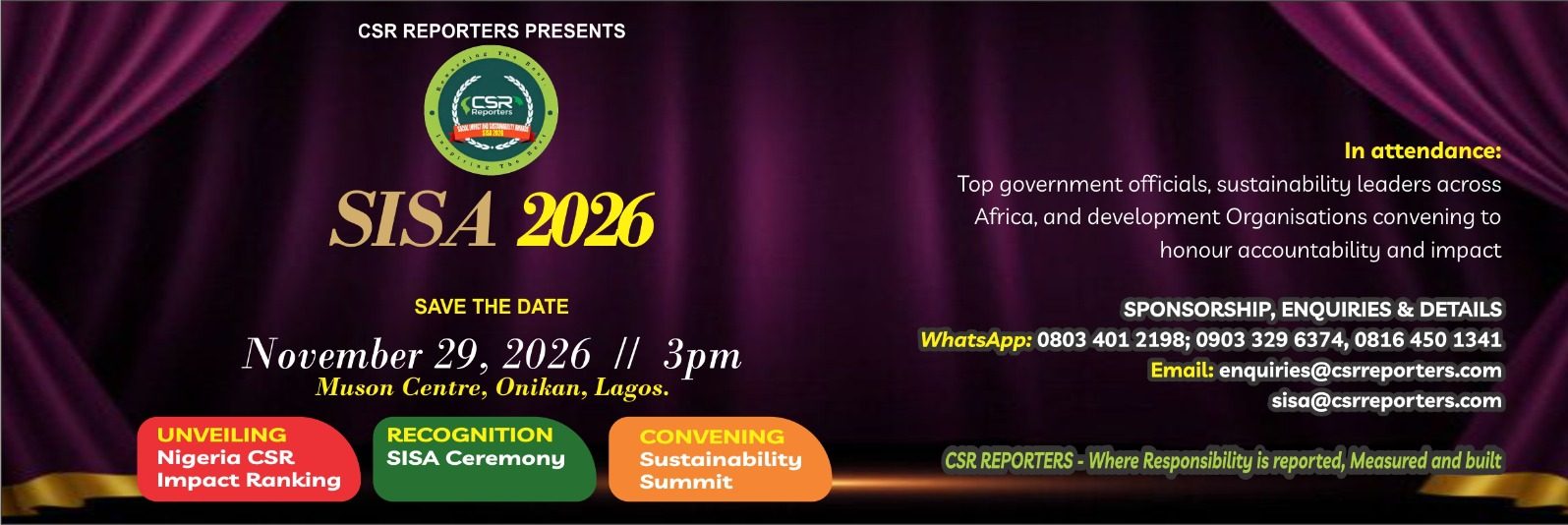
Save the date: 29 November 2026.
[give_form id="20698"]