Africa Wants One Market. But Can It Build Borders That Work?
 ONYINYECHI NWAIGBA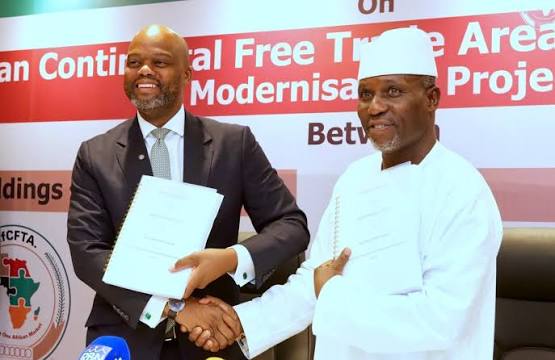
Africa has spent years building the framework for a more connected economy.
The African Continental Free Trade Area (AfCFTA) was created with an ambitious promise: bring African economies closer together, reduce barriers to trade and create a single market where goods and services can move more freely across the continent.
But there is a difference between creating a market on paper and making that market work in practice.
A trader can have a customer in another African country and still struggle to get the goods there.
A manufacturer can find demand across a border and still face delays that make the transaction less profitable.
An exporter can meet every requirement and still spend days navigating procedures, inspections and paperwork.
This is the practical problem that a new $3.1 billion customs modernisation deal is attempting to address.
The AfCFTA Secretariat has signed a 20-year concession agreement with Nigerian firm Bergmans Security Consultants and Supplies to support the modernisation of customs administration across about 50 African countries. The initiative is expected to introduce digital customs infrastructure, improve cargo clearance, strengthen information sharing and harmonise customs processes across participating countries.
The size of the investment is significant.
But the bigger question is not how much money is being committed.
It is whether African businesses, traders and consumers will actually experience a better way of moving goods across borders.
AfCFTA cannot succeed on paper alone
The promise of AfCFTA is difficult to dispute.
A more integrated African market could create opportunities for investment, industrialisation, job creation and economic diversification.
Instead of African economies largely trading with markets outside the continent, more businesses could sell to customers within Africa.
Instead of importing finished products, countries could increasingly participate in regional value chains, with different stages of production taking place across borders.
But none of this happens simply because a trade agreement exists.
Trade requires functioning systems.
Goods need to be inspected, documented, cleared and transported.
Payments need to move.
Information needs to move.
And, perhaps most importantly, businesses need to know what to expect when they reach a border.
When those systems fail, the cost is not limited to the customs office.
It spreads through the economy.
A delayed shipment can disrupt production.
Higher logistics costs can increase prices.
Uncertainty can discourage investment.
And businesses that might otherwise expand into neighbouring markets may decide that the risks are simply too high.
This is why customs reform deserves to be viewed as part of Africa’s broader development agenda.
The border is where policy meets reality
Trade policy can be negotiated in conference rooms.
But its success is ultimately experienced at the border.
For the person moving agricultural products from one country to another, the question is not how ambitious AfCFTA is.
The question is how long the journey takes.
For the manufacturer waiting for imported inputs, the question is not how many countries have signed the agreement.
It is whether the shipment arrives when it is needed.
For a business looking to enter a new African market, predictability can matter just as much as tariff reductions.
This is where customs modernisation could make a meaningful difference.
The proposed project is expected to deploy digital systems, data centres, multilingual customs portals and non-intrusive inspection technology.
Done properly, these systems could reduce unnecessary paperwork, improve information sharing and make the movement of goods more transparent.
But technology should not become the headline.
The outcome should be.
Digital does not automatically mean better
There is a temptation whenever a major technology project is announced to assume that digitalisation automatically solves inefficiency.
It does not.
A bad process placed online is still a bad process.
If customs agencies use incompatible systems, if requirements remain unclear, or if officials and traders are not adequately trained, a new digital platform may simply add another layer to an already complicated system.
The real opportunity lies in using technology to redesign the process itself.
Businesses should be able to understand what is required before they reach a border.
Information should not have to be repeatedly submitted to different agencies.
Customs authorities should be able to access reliable data and identify legitimate risks without unnecessarily delaying compliant shipments.
And traders should have clearer visibility into where their goods are and why delays occur.
That is where digital transformation becomes meaningful.
It is not about replacing paper with screens.
It is about making the system work better.
There is a governance question too
Customs is not only about trade.
It is also about governance.
Every time a shipment crosses a border, there are rules, payments, inspections and decisions involved.
Where processes are opaque, businesses can face uncertainty.
Where requirements vary without clear explanation, compliance becomes harder.
Where there is little visibility into how decisions are made, trust suffers.
A modern customs system should therefore aim for more than speed.
It should create greater predictability, transparency and accountability.
Digital records can make transactions easier to track.
Standardised procedures can reduce confusion.
Better information sharing can help different authorities coordinate.
And clearer processes can make it easier for businesses to comply with the rules.
But these benefits will only materialise if governments are willing to strengthen the institutions behind the technology.
A digital system cannot create accountability where there is no institutional commitment to accountability.
Nigeria’s role makes the deal even more interesting
There is also a significant Nigerian dimension to the project.
The Nigerian firm involved in the concession is expected to bring experience from Nigeria’s customs modernisation efforts into a wider continental programme.
That gives Nigeria an opportunity to contribute to the infrastructure supporting Africa’s economic integration.
Nigeria is already one of the continent’s largest economies and markets.
If expertise developed locally can help improve trade systems elsewhere in Africa, the potential impact goes beyond commercial value.
It could contribute to a more connected regional economy.
But that opportunity also comes with a responsibility.
The project will need to demonstrate that the systems being introduced can work across countries with different institutions, languages, infrastructure and regulatory environments.
A solution that works in one country cannot simply be copied and assumed to work everywhere.
What about the people behind the trade?
It is easy to discuss customs modernisation using words like data, infrastructure, clearance and digital platforms.
But there are people behind every shipment.
There is the farmer trying to reach a new market.
The manufacturer waiting for raw materials.
The driver moving goods across borders.
The entrepreneur trying to sell products beyond their home country.
The consumer ultimately paying for the goods.
When trade barriers are high, all of them can feel the consequences.
And when trade becomes more efficient, the benefits can also travel through the economy.
Lower delays can reduce costs.
More predictable logistics can support investment.
Access to wider markets can allow businesses to expand.
Expansion can create demand for workers and suppliers.
That is why trade facilitation has a social and economic dimension that goes beyond customs offices.
The real test is not the $3.1 billion
Large numbers naturally attract attention.
A $3.1 billion investment sounds transformative.
But the amount invested should not become the primary measure of success.
The real indicators will be much more practical.
How much faster are goods cleared?
How much paperwork has been eliminated?
How much has the cost of moving goods fallen?
How many border processes can be completed digitally?
How much information is shared between customs authorities?
How much have complaints about delays and uncertainty reduced?
And perhaps most importantly, do people who depend on cross-border trade actually notice a difference?
These are the questions that should follow the announcement.
Because an expensive system that produces little improvement is not a successful development project.
Africa needs more than a free-trade agreement
AfCFTA represents one of Africa’s most important economic integration efforts.
But economic integration is not created by agreements alone.
It requires infrastructure, institutions, reliable energy, efficient transport networks, digital systems and policies that work beyond national boundaries.
Customs is one part of that much larger picture.
The new modernisation project cannot solve every challenge facing African trade.
It cannot build every road.
It cannot fix every port.
It cannot eliminate every regulatory difference.
But it can address one of the points where the continent’s ambitions repeatedly meet practical reality.
The border.
If the project succeeds, the benefits could extend beyond faster clearance.
It could make regional trade more predictable.
It could support stronger African value chains.
It could make it easier for businesses to reach customers in other countries.
And it could help turn AfCFTA from a powerful policy idea into something that is increasingly visible in everyday economic life.
The opportunity and the accountability
Africa has said it wants to trade more with itself.
Now it has to build the systems that allow that to happen.
The $3.1 billion customs modernisation deal is therefore worth watching not because of the size of the cheque, but because of what it promises to change.
If it delivers faster borders, better information, stronger transparency and more predictable trade, it could become an important piece of Africa’s economic integration story.
But if the benefits remain trapped in policy documents and technology deployments while traders continue to face the same delays and uncertainty, then the continent will have invested heavily without solving the problem that matters.
The real measure of AfCFTA will not be how many agreements Africa signs.
It will be how easily an African product can move from one African market to another.
That is where integration becomes real.
And that is where this $3.1 billion experiment will ultimately have to prove itself.
[give_form id="20698"]