Can AI Finally Learn to Speak Africa? A New Challenge Wants Builders to Try
 ONYINYECHI NWAIGBA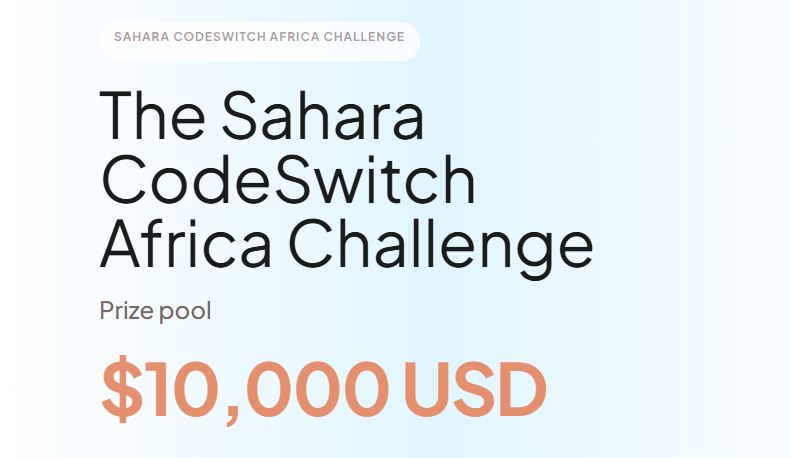
Artificial intelligence is learning fast.
But there is still a basic problem when it comes to how many Africans actually communicate.
People do not always speak in perfectly standard English, French or another single language.
They switch.
They mix languages in the same conversation. They speak with different accents. They use local expressions. They move between formal and informal speech depending on who they are talking to.
For humans, this can be completely normal.
For AI systems, it can be much harder.
That gap is at the centre of the Sahara CodeSwitch Africa Challenge 2026, a new innovation competition inviting developers, researchers, startups, students and other builders across Africa and the African diaspora to create real-world voice AI solutions that can work better in African contexts.
The challenge comes with a US$10,000 total prize pool, alongside opportunities for technical feedback, partner demo days, visibility among investors and ecosystem partners, additional API credits and potential pilot or deployment opportunities.
But perhaps the more interesting part of the opportunity is not the prize money.
It is the problem participants are being asked to solve.
The AI problem Africa speaks every day
Imagine asking a voice assistant a question in English and then naturally switching into Yoruba, Igbo, Hausa or another language halfway through the conversation.
For many Africans, that is not unusual.
It is simply how people communicate.
This phenomenon, known as code-switching, happens when speakers move between two or more languages within the same conversation.
AI systems trained primarily on standardised or predominantly Western speech data can struggle to interpret these conversations accurately.
They may misrecognise words, misunderstand context or produce poor transcriptions.
And when voice technology is used for something more important than transcription, the consequences can become bigger.
A healthcare tool needs to understand what a patient is saying.
A financial service needs to correctly interpret a customer’s request.
An educational platform needs to understand learners.
A public-service tool needs to work for the people it is designed to serve.
If the technology cannot understand the way people actually speak, its usefulness becomes limited.
That is the gap the Sahara CodeSwitch challenge is trying to address.
This is not just a speech-to-text competition
Participants are not being asked simply to build another transcription tool.
The challenge requires them to create or improve a real-world voice AI application where voice is used to complete or support a practical task.
Possible applications include voice assistants, healthcare and patient-support tools, agricultural advisory services, education platforms, customer-service solutions, financial applications and legal or public-service tools.
That distinction matters.
The objective is not simply to make AI recognise words.
It is to make voice technology useful.
A farmer could potentially use a voice-based agricultural service without having to navigate a complex written interface.
A patient could interact with a healthcare support tool using natural speech.
A learner could access educational content through voice.
A customer could communicate with a financial service without having to struggle through unfamiliar digital systems.
The possibilities extend beyond convenience.
They touch on accessibility and inclusion.
Who can apply?
The competition is open to builders across Africa and the African diaspora.
Developers and engineers, AI and machine-learning researchers, startups, product teams, university students, open-source builders, NGOs, civic-tech teams and companies developing voice or customer-facing solutions can apply.
Applicants can participate individually or as teams, with teams of between two and five people recommended.
That makes the opportunity broader than a traditional startup competition.
A university student with a strong idea can participate.
A developer can build with other engineers.
An existing startup can test a new voice-based product.
A civic-tech organization can explore how voice AI could improve access to public services.
The common requirement is the willingness to build something that addresses a real problem. Apply here.
Five areas, one bigger objective
The challenge is organised around five impact categories:
- Health
- Legal and Public Services
- Fintech, Telco and Customer Experience
- Agriculture and Education
- Other High-Impact Use Cases, including accessibility, media, commerce, transport and culture.
The range is significant because it demonstrates where African-language voice technology could eventually have practical value.
Healthcare and education are obvious examples.
But there is also potential in areas such as transport, commerce and financial services, where communication is central to how people access products and services.
The challenge therefore sits at the intersection of AI innovation and real-world problem-solving.
Builders will have to prove that it works
There is also a technical component.
Participants are expected to benchmark their solution’s performance on code-switched audio using the Sahara API and other speech models.
Submissions must compare performance across at least three speech models, including the Intron Sahara API.
Applicants will also need to submit a description of the problem and proposed solution, a working prototype or integrated application, a short demonstration video, code or technical documentation and benchmark results.
There is also an important responsible-AI requirement.
Participants must address issues including privacy, consent, safety and responsible use of AI.
That is particularly important when voice technology is being applied to areas such as healthcare, finance and public services.
Building something that works is one thing.
Building something that people can trust is another.
What will the judges be looking for?
The competition will assess entries based on real-world impact, code-switching performance, product quality and usability, technical execution, ethics and safety.
Solutions addressing meaningful problems affecting significant numbers of people may receive additional consideration.
That means a technically impressive product will not necessarily be enough.
The strongest solutions will need to demonstrate that they solve a problem that actually matters.
This is an increasingly important principle for Africa’s technology ecosystem.
The continent does not simply need more technology for technology’s sake.
It needs technology that responds to the realities of the people who will use it.
Why African-language AI matters
Language is often treated as a technical problem.
But it can also be an inclusion issue.
If digital services work best for people who speak a particular version of a global language, then everyone else may face an additional barrier to access.
That becomes particularly important as AI becomes embedded in everyday services.
Voice interfaces could make technology more accessible to people who may find text-heavy digital systems difficult to navigate.
But that only works if the technology understands them.
Developing AI that can handle African accents, languages and code-switching therefore has implications beyond this competition.
It is part of a much larger conversation about who gets included in the next phase of digital transformation.
The opportunity for African builders
The Sahara CodeSwitch Africa Challenge offers more than a chance to compete for $10,000.
It gives African builders an opportunity to work on a problem that is closely connected to the continent’s everyday realities.
The build period runs through September 15, with the final submission deadline also set for September 15, 2026. Finalists are expected to be announced on September 25, with winners announced on October 1. Registration opened on August 5.
For developers already working in AI, speech technology or multilingual applications, the challenge could provide an opportunity to test an idea against a real technical problem.
For students and emerging builders, it could provide exposure to a growing area of technology.
And for startups, it could be an opportunity to explore voice applications that have commercial and social potential.
Africa does not just need AI. It needs AI that understands its people.
The future of artificial intelligence will not be defined only by how powerful models become.
It will also be defined by how well those models understand the people using them.
For Africa, that means recognizing that language, accents and communication habits are not edge cases.
They are everyday reality.
The Sahara CodeSwitch Africa Challenge is asking builders to work directly on that reality and to turn it into something useful.
The US$10,000 prize pool may be the immediate attraction.
But the bigger opportunity is building technology that does not ask Africans to change how they speak before technology can understand them.
The challenge is now open. And for African builders, the question is simple: what could you build if AI finally learned to speak the way Africa speaks?
[give_form id="20698"]