csrreporters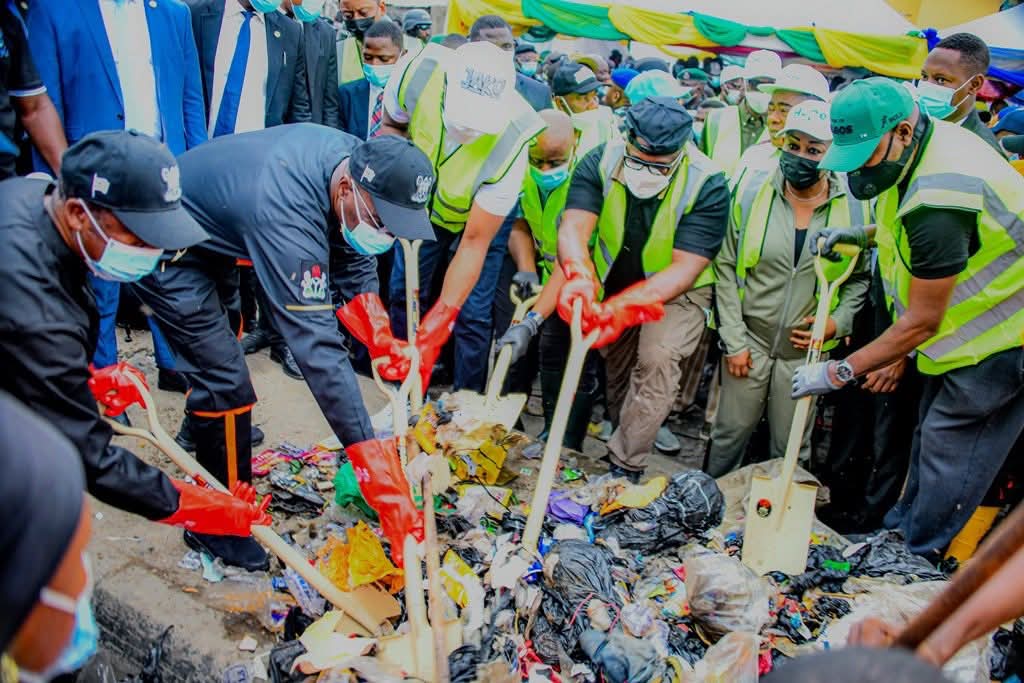
Image from @NTANewsNow on X
The return of Lagos’s monthly environmental sanitation exercise drew mass participation and government praise. Yet a deeper look exposes troubling ESG gaps, a coercion controversy, and the absence of the private sector from a crisis it helped create.
On the last Saturday of April 2026, Lagos awoke to something genuinely striking. Residents across diverse communities emerged before sunrise, brooms and bags in hand, to clean drains, clear debris, and scrub streets during a government-mandated two-hour window. Officials reported compliance rates exceeding 98 percent.
The state’s First Lady toured multiple local council areas, commending residents for their enthusiasm. The Environment Commissioner declared the exercise a resounding success. On the surface, Lagos had managed something rare: mass civic participation in a shared environmental goal, after nearly a decade-long hiatus.
However, scratch beneath the optics and a far more complicated picture emerges. The reintroduction of the exercise, which authorities initially positioned as entirely voluntary and free from movement restriction, quickly became the subject of legal dispute, operational criticism, and serious governance concern. Together, these threads reveal not a sanitation triumph, but an urgent case study in the gap between ESG aspiration and ESG execution in one of Africa’s largest cities.
Participation Versus Reality
The government billed the April 25 exercise as voluntary and explicitly free from coercive movement controls. Yet reports from several neighborhoods tell a distinctly different story.
Residents in areas including Surulere and Agege described being stopped, questioned, and in some cases extorted by a combination of enforcement officials and informal actors operating under the exercise’s authority. One resident reportedly paid a cash sum before being permitted to continue to his place of business.
A senior legal practitioner who has challenged the exercise in court publicly accused the state of deploying multiple agencies, alongside informal street-level enforcers, to harass citizens exercising their constitutional right to move freely.
The government’s Attorney-General responded by citing a 2021 Court of Appeal judgment validating the state’s broad environmental powers. Nonetheless, the legal dispute continues at the Supreme Court level, meaning the exercise currently operates in a zone of contested legitimacy. That tension matters considerably, because policy ambiguity corrodes public trust, and public trust is a foundational pillar of any sustainable civic program.
Participation without logistics is performance. Lagos mobilized residents effectively but could not sustain the operational chain needed to convert effort into lasting impact.
The Operational Breakdown
Even where participation was genuine and enthusiastic, the operational machinery failed many residents visibly. Waste collected during the exercise was bagged and deposited at roadsides, precisely as instructed. Then rain arrived.
Without timely evacuation by waste authorities, the debris scattered back into the very drains residents had spent two hours clearing. Social media captured the irony vividly, with multiple posts documenting that the collected waste had been washed back onto roads and into gutters overnight.
Therefore, the core problem becomes clear. Waste authority officials insisted that collection trucks were deployed across the state. Meanwhile, the volume of complaints suggests coverage was uneven, particularly in higher-density areas where the sanitation challenge is most acute.
Furthermore, residents proposed a more sensible alternative: rotating the exercise across individual local councils each week, thereby concentrating collection resources meaningfully. That logic, so far, has gone unaddressed by authorities.
Enforcement and the Governance Deficit
The role of informal enforcers introduces a serious governance failure that authorities have yet to meaningfully confront. In several locations, these actors exploited the ambiguity of the exercise to extort residents, acting with apparent impunity under the cover of state-endorsed mobilization. This is not a peripheral concern. It directly contradicts the government’s assurance that the exercise would be free, voluntary, and citizen-centered.
Inconsistent enforcement across local government areas compounds the problem further. Compliance appeared highest in areas where senior officials were physically present, suggesting the exercise functioned more as a supervised event than an institutionalized civic practice.
In contrast, communities outside the monitoring radius experienced enforcement gaps, extortion attempts, and delayed waste collection simultaneously. Genuine governance strength means consistent outcomes regardless of who is watching.
The ESG Analysis
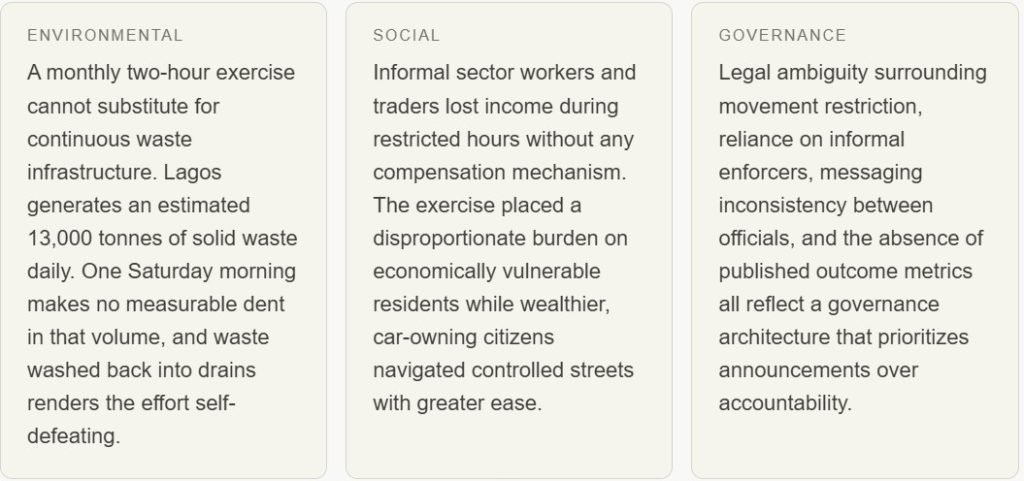
Taken together, these ESG gaps reveal a city that is still organizing sanitation around civic theater rather than systemic infrastructure. Consequently, the meaningful ESG gains that Lagos urgently needs, measured reductions in waste volumes, flood incidence, and disease burden, remain out of reach so long as the exercise remains episodic rather than embedded.
What Advanced Systems Do Differently?
The contrast with well-functioning sanitation systems elsewhere is instructive. Germany’s Extended Producer Responsibility framework places the cost and logistics of waste management on manufacturers and distributors, creating a continuous, commercially incentivized system that does not depend on monthly civic mobilization. Singapore’s approach is infrastructure-first: aggressive investment in collection technology, real-time monitoring, and mandatory corporate participation ensures that environmental outcomes are measurable and consistent rather than episodic.
OECD nations increasingly use data-driven waste management platforms that track volumes, contamination rates, and collection efficiency in near-real time. The result, in each case, is a system, not an event. Critically, corporate actors in these contexts carry formal, enforceable shares of environmental responsibility, because companies generate significant portions of the waste that governments then struggle to manage alone.
Where Is the Private Sector?
This brings us to the most conspicuous absence in Lagos’s sanitation conversation: the private sector. Lagos hosts thousands of businesses, from major manufacturers and fast-moving consumer goods distributors to street traders and informal market operators. These entities generate substantial volumes of packaging waste, food waste, and commercial debris daily.
Yet the April 25 exercise made no formal demand of them. No binding waste reduction targets, no contribution to collection infrastructure funding, and no mandatory reporting on environmental footprint were required of any corporate actor. The government asked residents to clean up problems that businesses partly create, and that is neither equitable nor sustainable ESG policy.
Global ESG frameworks increasingly recognize this imbalance. Extended producer responsibility, corporate environmental compacts, and sector-level waste reduction agreements are now standard expectations in mature markets. Lagos, as a city increasingly courting foreign investment and continental economic leadership, cannot afford to lag on corporate environmental accountability.
From Ritual to System
The Lagos monthly sanitation exercise is not a failure. It is, however, an incomplete idea. The genuine enthusiasm of residents, the willingness of officials to participate publicly, and the widespread desire for a cleaner city are all real and worth building upon. Nonetheless, what is missing is the architecture that converts enthusiasm into outcomes.
Moving forward, Lagos needs measurable waste reduction targets published monthly, not compliance estimates. It needs binding corporate waste responsibilities codified in enforceable law. It needs logistics infrastructure capable of removing waste generated during cleanup drives before the next rainfall.
Moreover, it needs consistent enforcement entirely free from informal actors and unresolved legal ambiguity. These are not aspirational recommendations. They are the baseline requirements of credible urban ESG governance.
Cleaning a city for two hours a month is a gesture. Building systems that keep it clean every hour of every day is governance. The question for Lagos, and for the companies profiting from its over 15 million consumers, is whether they are ready to move from gesture to system. The answer will define not just the city’s environment, but its ESG credibility on the continental stage.
[give_form id="20698"]