Apply Now: GASUP 2026 Applications to Help Nigerian Agribusinesses Scale Sustainably
 ONYINYECHI NWAIGBA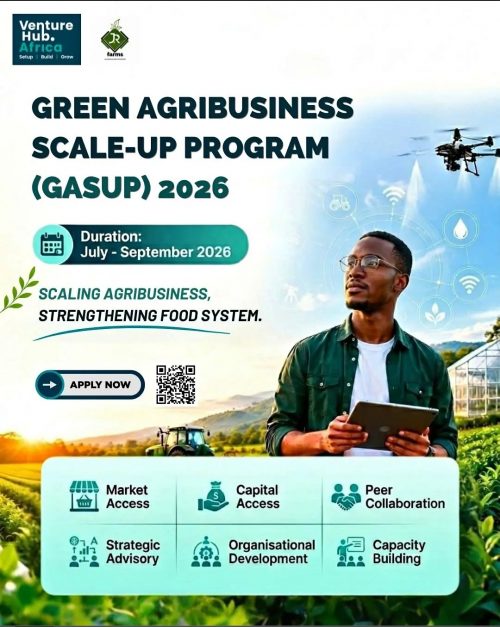
As Nigeria continues to strengthen its agricultural sector and improve food security, the need to support businesses capable of driving innovation, increasing productivity, and creating jobs has never been greater.
Recognising this need, applications have opened for the 2026 edition of the Growth and Agribusiness Scale-Up Programme (GASUP), a three-month accelerator designed to equip growth-stage Nigerian agribusinesses with the knowledge, systems, and strategic support required to scale sustainably.
Rather than focusing solely on early-stage start-ups, the programme targets businesses that have already established a market presence and are looking to overcome the operational and financial challenges that often limit long-term growth.
By combining business advisory services, mentorship, investor-readiness support, and market access opportunities, GASUP aims to help agribusinesses build stronger foundations for expansion while contributing to Nigeria’s broader agricultural transformation.
Strengthening Businesses Beyond Start-Up Stage
Nigeria’s agriculture sector remains one of the country’s largest employers and contributes significantly to national economic development. Yet many promising agribusinesses struggle to grow beyond the small and medium-sized enterprise stage.
Challenges such as limited access to finance, weak business systems, poor operational structures, inadequate governance, and insufficient investor readiness often prevent businesses from reaching their full potential.
Programmes like GASUP seek to address these challenges by helping entrepreneurs strengthen the internal systems that support sustainable growth rather than focusing only on short-term revenue increases.
The programme is designed to help founders build businesses that are resilient, scalable, and capable of attracting investment while delivering lasting economic and social impact.
What Participants Will Gain
Successful participants will have access to a structured accelerator programme that combines practical learning with expert support.
The programme is expected to provide participants with:
- Business advisory sessions from experienced industry experts.
- One-on-one mentorship and coaching.
- Support to improve operational efficiency and business systems.
- Financial management and strategic planning guidance.
- Investor-readiness training to prepare businesses for fundraising opportunities.
- Access to market linkages and strategic partnerships.
- Networking opportunities with agribusiness founders, investors, and ecosystem stakeholders.
- Practical tools to help businesses scale sustainably and compete in larger markets.
Rather than offering grants alone, the programme focuses on building the capacity of businesses to achieve sustainable growth through stronger management, improved governance, and better decision-making.
Why Scaling Agribusinesses Matters
Agriculture remains central to Nigeria’s efforts to improve food security, create employment, reduce poverty, and diversify the economy.
However, increasing agricultural production alone is not enough.
The country also needs businesses that can process food, improve value chains, reduce post-harvest losses, adopt innovation, and create sustainable employment opportunities.
Supporting growth-stage agribusinesses allows successful enterprises to expand production, reach new markets, improve operational efficiency, and contribute more meaningfully to national development.
As climate change, rising production costs, and supply chain disruptions continue to affect agriculture, building resilient agribusinesses has become increasingly important.
Businesses with stronger financial systems, better governance structures, and improved operational processes are generally better positioned to withstand economic shocks and adapt to changing market conditions.
Who Can Apply?
According to the programme organisers, GASUP 2026 is intended for established Nigerian agribusinesses that have demonstrated business growth and are ready to scale.
To be eligible, applicants are expected to:
- Operate within Nigeria’s agriculture or agribusiness sector.
- Have an established business with proven market traction.
- Generate a minimum annual revenue of ₦20 million.
- Demonstrate clear growth potential.
- Show a commitment to strengthening internal business systems and scaling sustainably.
- Participate fully in the programme throughout its duration.
The accelerator is particularly suited for entrepreneurs seeking to improve their business operations, strengthen financial management, attract investment, and expand into new markets.
Supporting Sustainable Agricultural Development
Beyond helping individual businesses, initiatives such as GASUP contribute to broader national development priorities.
Stronger agribusinesses can improve food production, strengthen agricultural value chains, increase rural employment, encourage innovation, and attract private investment into the sector.
The programme also supports several Sustainable Development Goals, including Zero Hunger (SDG 2), Decent Work and Economic Growth (SDG 8), Industry, Innovation and Infrastructure (SDG 9), and Partnerships for the Goals (SDG 17).
By helping agribusinesses become more resilient and investment-ready, programmes like GASUP contribute to building a stronger agricultural ecosystem capable of supporting Nigeria’s long-term food security and economic development ambitions.
Application Details
Applications for the 2026 Growth and Agribusiness Scale-Up Programme are currently open.
The accelerator will run over a three-month period, providing selected businesses with practical training, mentorship, strategic advisory services, and opportunities to connect with investors and industry leaders.
Interested agribusinesses are encouraged to review the programme requirements carefully and submit their applications before the stated deadline. See link HERE
As Nigeria continues to pursue sustainable agricultural development, initiatives that strengthen existing businesses, rather than simply supporting business creation will play an increasingly important role in building resilient food systems, creating jobs, and driving inclusive economic growth.
[give_form id="20698"]