ROSEMARY IMOBHIO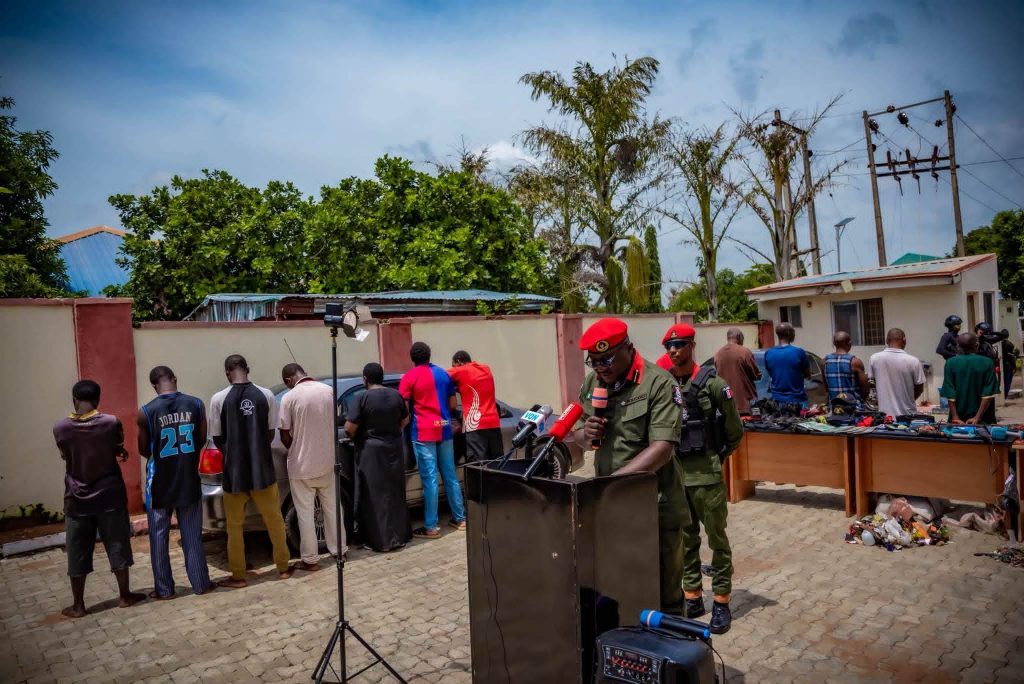
The Nigerian Army has arrested 18 suspected illegal miners at a mining site. This happened in Izom, Gurara Local Government Area of Niger State. The operation recovered ₦2.47 million and several items believed to have been used for unauthorised mining activities.
Troops of the 102 Guard Battalion made the arrests during a routine operation in the area. Following the operation, the suspects and recovered exhibits were handed over to the Nigerian Security and Civil Defence Corps (NSCDC) Mining Marshals in Sauka, Abuja.
The development has drawn attention to the growing enforcement drive against illegal mining and the wider challenge of protecting Nigeria’s mineral resources. According to the NSCDC Mining Marshals, preliminary investigations indicated that the suspects allegedly operated without licences. They didn’t have permits or affiliation with any registered mining company. They also reportedly could not provide evidence of lawful mineral titles or authorisation from relevant regulatory authorities.
Army, Mining Marshals Strengthen Collaboration
The handover highlights the importance of cooperation between security agencies and regulators in tackling illegal mining. Assistant Commandant of Corps John Onoja Attah, Commander of the NSCDC Mining Marshals, commended the Nigerian Army for what he described as a professional and patriotic intervention. According to Attah, the swift arrest and handover demonstrated the military’s commitment to the rule of law and the protection of Nigeria’s solid mineral resources.
For the Mining Marshals, the collaboration also provides an enforcement pathway. Security personnel can identify and apprehend suspects during operations. Then the relevant regulatory authorities can continue investigations and pursue prosecution.
This is important because illegal mining is not simply a security concern. It also involves questions around licensing, environmental protection, resource governance and public revenue. Therefore, effective enforcement requires cooperation that can connect field operations with regulatory oversight and legal accountability.
Millions and Mining Equipment Recovered
The operation also resulted in the recovery of several items suspected to have been used at the mining site. They included motorcycles, pumping machines, crusher engines and communication devices. Cash amounting to ₦2,468,750 was also recovered.
While the recovered cash represents a direct financial finding from the operation, the equipment offers another indication of the scale of activity being investigated. More importantly, the discovery raises questions about how unauthorised mining operations are established and sustained.
Where mining takes place without the required approvals, regulators lose visibility over who is extracting resources, what is being extracted and how the activity is being conducted. Consequently, the challenge extends beyond individual arrests. It becomes a question of whether Nigeria can maintain effective oversight of its mineral resources and ensure that legitimate operators are not disadvantaged by illegal activity.
Illegal Mining Carries Environmental Costs
Illegal mining has also become an environmental concern across Nigeria. Mining activities can disturb land, alter waterways and contribute to the degradation of ecosystems. The possibility of this is even greater when they are conducted without adequate regulatory oversight.
However, the environmental consequences can vary depending on the mineral being extracted, the mining method and the location of the operation. Therefore, claims about specific environmental damage should be tied to evidence from individual sites. Nevertheless, the broader concern remains significant.
When mining activities operate outside formal regulatory systems, monitoring environmental standards becomes more difficult. Moreover, operators may avoid requirements designed to reduce environmental harm and protect surrounding communities. That makes enforcement relevant not only to government revenue but also to responsible natural resource management.
Protecting Nigeria’s Mineral Wealth
Nigeria has increasingly identified its solid minerals sector as an important area for economic diversification. The country possesses deposits of gold, lithium, tin, tantalite, iron ore and other minerals. However, the economic value of these resources depends partly on how effectively they are governed.
Illegal exploitation can undermine that process. When minerals are extracted outside the formal system, government agencies may lose revenue. Revenue that could otherwise support public services and economic development. At the same time, legitimate mining companies can face unfair competition from operators who do not meet the same regulatory requirements.
Furthermore, weak enforcement can make it harder for authorities to establish reliable information about production levels and mineral flows. The Niger operation therefore reflects a broader governance issue. Protecting mineral resources requires the government to know where extraction is taking place, who is responsible for it and whether operators are complying with the law.

From Arrests to Accountability
The Mining Marshals said investigations into the suspects had been concluded. They are being processed for prosecution under relevant provisions of the Nigerian Minerals and Mining Act, 2007. That next step will be important.
Arrests can disrupt illegal activity, but prosecution and due process determine whether enforcement ultimately produces accountability. The case also illustrates why inter-agency cooperation must extend beyond the initial arrest. Security agencies, mining regulators and the justice system each have different responsibilities in ensuring that suspected offences are properly investigated and handled.
For the solid minerals sector, consistent enforcement could also strengthen confidence among legitimate operators. At the same time, enforcement must remain transparent and grounded in evidence. Individuals accused of illegal mining should be afforded due process while authorities work to establish whether offences have been committed.
A Wider Test for Resource Governance
The arrest of 18 suspected illegal miners in Niger State may appear to be a single enforcement operation. However, it points to a much larger challenge facing Nigeria’s solid minerals sector. The country’s mineral wealth can support economic growth, employment and government revenue. Yet those benefits depend on responsible extraction and effective oversight.
For that reason, tackling illegal mining should involve more than periodic raids. It should include stronger licensing systems, reliable monitoring, environmental safeguards, community engagement and effective prosecution where violations are established.
The Army’s cooperation with the NSCDC Mining Marshals provides one example of how different institutions can work together to address the problem. However, the lasting measure of success will not simply be the number of arrests or the amount of equipment recovered. Instead, it will be whether such enforcement helps move mining activity into a transparent, lawful and environmentally responsible system.
As Nigeria seeks to unlock greater value from its solid minerals, protecting those resources will remain just as important as extracting them.
Stay informed on the decisions, developments and actions shaping Nigeria’s sustainability landscape. Follow CSR Reporters for more stories that matter.
[give_form id="20698"]