Bank Gives N25m Grants, Equipment to 300 Akwa Ibom Women to Strengthen Small Businesses
 ONYINYECHI NWAIGBA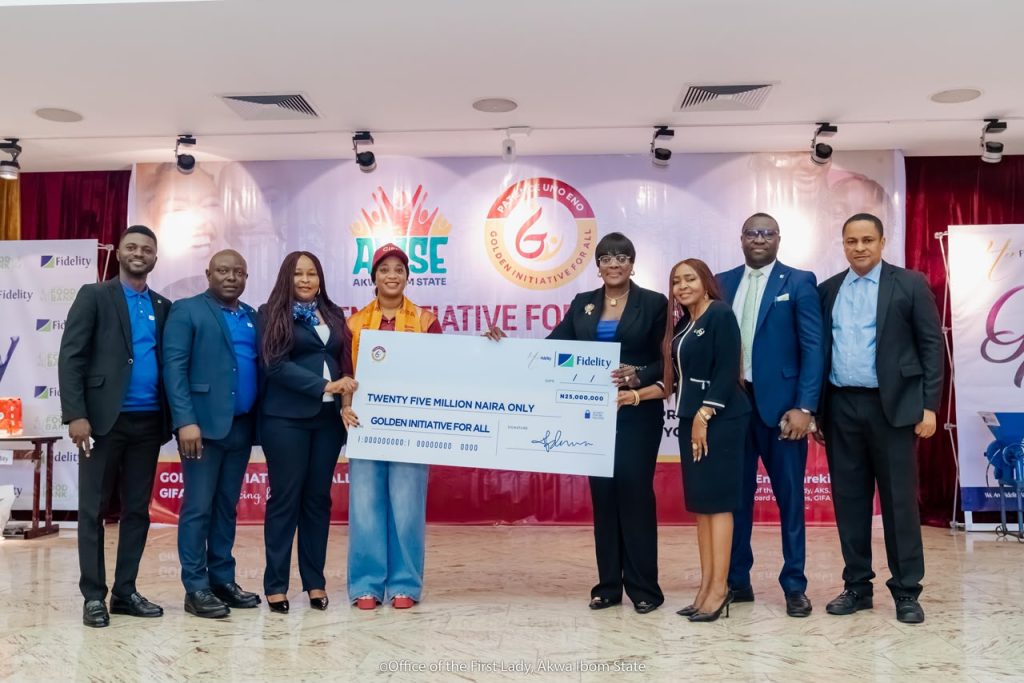
Fidelity Bank Plc has provided N25 million in business grants and equipment to 300 women entrepreneurs in Akwa Ibom State, in an intervention aimed at helping women strengthen their businesses, increase their earning capacity and improve household livelihoods.
The support was delivered under the bank’s Give Her Power Initiative through a partnership with the Golden Initiative For All (GIFA) and the Office of the First Lady of Akwa Ibom State.
Unlike interventions that focus solely on cash transfers, the latest programme combines financial support with productive equipment, including sewing machines, grinding machines and Point-of-Sale (POS) machines, giving beneficiaries assets they can use directly in their businesses.
The intervention also included food items for women across the state through Fidelity Bank’s Food Bank Initiative.
The presentation was held at Government House, Uyo, where Fidelity Bank Executive Director, Pamela Shodipo, said the initiative reflected the bank’s commitment to supporting women entrepreneurs and contributing to economic development in Akwa Ibom.
According to Shodipo, the bank’s support is based on its belief in the resilience, creativity and enterprise of women and their ability to build businesses, strengthen families and contribute to the development of their communities.
How the N25 Million Support Will Reach the Women
The N25 million financial support is being provided under the GIFA Economic Women Empowerment Programme, while the equipment and food items are being distributed as part of the broader intervention.
The programme has been structured to support women working across different areas of the local economy.
One hundred women in the tailoring and fashion industry will receive sewing machines, while another 100 women will receive grinding machines to support agricultural processing and other commercial activities.
Twenty beneficiaries will receive financial support alongside POS machines, while 80 other women will receive cash grants.
This means the intervention is not limited to a single type of business or livelihood.
For women already working in tailoring and fashion, the sewing machines can provide an opportunity to increase their production capacity without having to first raise the capital required to purchase equipment.
For women involved in agricultural processing and related businesses, grinding machines can serve as productive assets that can be used repeatedly to generate income.
The POS machines, meanwhile, provide another category of beneficiaries with equipment that can support financial transactions and potentially create an additional income stream.
The combination of cash and equipment is significant because small businesses often require more than working capital. Access to the right productive asset can determine how much a business is able to produce, how many customers it can serve and, ultimately, how much income the owner can generate.
Why Equipment Matters in Women’s Economic Empowerment
For many women running small businesses, the challenge is not necessarily a lack of willingness to work.
It is often the absence of the capital and tools required to move from surviving in business to growing one.
A tailor who cannot afford a sewing machine may depend on rented equipment or have to turn down orders when production capacity is limited. A woman processing agricultural products may lose income opportunities when she lacks the machinery required to process larger quantities.
In such cases, providing equipment can have a longer-term effect than a one-off financial intervention.
The asset remains available for use after the initial support has been spent.
That is one of the more important aspects of the Fidelity Bank intervention. The programme is designed not only to provide immediate financial relief but also to place productive resources in the hands of women who can use them to build or expand income-generating activities.
Shodipo encouraged beneficiaries to use the support to build sustainable businesses and create opportunities for other women as their enterprises grow.
The expectation is therefore that the impact should extend beyond the 300 direct beneficiaries.
If a beneficiary uses a sewing machine to increase production, for example, business expansion could eventually create work for apprentices or other workers. A woman who expands an agricultural processing business could increase the volume of products she handles and potentially create additional opportunities within her supply chain.
The same principle applies to other small businesses supported under the programme.
Reaching Women Across Akwa Ibom’s 31 LGAs
The intervention is also notable for its geographical reach.
According to Helen Eno Obareki, Coordinator of the Office of the First Lady of Akwa Ibom State, the programme is designed to strengthen female entrepreneurship across all 31 local government areas of the state.
Obareki said the latest intervention would increase the number of women reached through GIFA to about 7,000.
The scale is important because economic empowerment programmes can have limited impact when support is concentrated in only a few urban centres.
Taking support into different communities creates an opportunity to reach women who may otherwise have limited access to formal financial services, business support programmes or productive assets.
GIFA has also continued to take some of its interventions directly into communities through its “GIFA at Your Doorstep” initiative.
The programme provides business equipment and financial support to small business owners at their homes and shops, bringing assistance closer to the people it is designed to serve.
For women operating small businesses within local communities, this kind of approach can reduce some of the barriers associated with accessing formal support.
Turning Grants Into Sustainable Businesses
While the provision of grants and equipment is important, the sustainability of such interventions ultimately depends on what happens after beneficiaries receive the support.
Obareki urged the women to treat the grants and equipment as business capital rather than one-off gifts.
She also encouraged beneficiaries to apply the financial management and business skills they had acquired to improve their ventures.
That message points to a broader issue around empowerment programmes in Nigeria.
Providing capital can help a business overcome an immediate constraint, but sustained impact requires beneficiaries to be able to manage that capital, understand their markets, control costs, attract customers and reinvest in their businesses.
For this reason, the combination of financial support, productive assets and business skills can be more valuable than a cash-only intervention.
The ultimate measure of success will not simply be how many women received grants or equipment, but how many businesses are able to grow because of the support.
Will beneficiaries increase their revenues?
Will they employ additional workers?
Will they be able to reinvest their profits?
Will businesses that were previously operating at a very small scale become more stable?
These are the outcomes that determine whether an empowerment intervention produces lasting economic value.
From Women’s Businesses to Household Livelihoods
The economic significance of supporting women-owned businesses extends beyond individual beneficiaries.
Small businesses often provide income that supports entire households.
For many women entrepreneurs, business revenue contributes to food, education, healthcare, housing and other household needs. Strengthening the business can therefore strengthen the financial resilience of the family depending on it.
This is particularly relevant in communities where women operate businesses alongside other household responsibilities.
When such businesses become more productive, the benefits can circulate within the local economy.
A tailor buys fabric and accessories from suppliers. A food processor purchases raw materials from farmers and traders. A POS operator serves customers within a community. Each transaction connects one small business to several other economic actors.
This means that interventions targeted at women-owned businesses can potentially generate wider economic activity beyond the initial beneficiaries.
Fidelity Bank’s Wider Commitment to Akwa Ibom
The latest intervention is part of Fidelity Bank’s broader engagement with Akwa Ibom.
Shodipo said the bank recently commissioned a new branch along Grace Bill Road in Eket Local Government Area to expand access to financial services in the state.
She described Akwa Ibom as a market with entrepreneurs, farmers, traders, artisans and young people with ideas and businesses capable of contributing to economic growth.
The bank said it would continue its partnership with the state and support interventions focused on sustainable businesses and inclusive economic development.
For Fidelity Bank, the women’s empowerment programme therefore sits within a wider effort to deepen its presence and engagement with businesses and communities in the state.
The Bigger CSR Question
Corporate social responsibility programmes increasingly have to demonstrate more than the size of a donation.
The more important question is what happens to the people who receive the support after the programme ends.
In the case of the 300 women in Akwa Ibom, the intervention provides a combination of resources that can potentially address some of the practical barriers facing small businesses: lack of capital, limited access to productive equipment and inadequate tools for business operations.
But the long-term value will depend on whether those resources translate into stronger businesses and more sustainable livelihoods.
The programme’s expansion to about 7,000 women through GIFA also highlights the potential for community-based interventions to reach women operating outside the formal corporate economy.
For the 300 beneficiaries receiving support in this phase, the immediate opportunity is to turn the grants and equipment into productive assets.
For the communities around them, the potential benefit is broader: stronger women-owned businesses, increased household income, more local economic activity and, eventually, new opportunities for others.
That is where the real test of empowerment lies.
An intervention becomes more meaningful when the support received today gives beneficiaries the capacity to earn tomorrow, grow their businesses and create opportunities for others.
[give_form id="20698"]