
 ONYINYECHI NWAIGBA
From tree-planting campaigns to school donations and community projects, corporate social responsibility is often measured by what companies do. But the more important question is what changes because they do it.
A company announces that it has planted 1,000 trees. Another sponsors students through school. A third donates millions of naira to a community project.
The announcements attract attention. Photographs capture smiling beneficiaries, reports highlight the numbers, and social media posts celebrate the milestones.
On the surface, these are encouraging developments. Businesses have a role to play in addressing social and environmental challenges, and investments in communities can make a meaningful difference.
But after the announcements have been made and the photographs have circulated, an important question remains: what has actually changed?
Did the trees survive and contribute to environmental restoration? Did the students gain better access to education and the support needed to complete their studies? Did the community experience improvements that continued long after the project ended?
These questions are not intended to dismiss corporate social responsibility efforts. Rather, they point to a distinction that deserves greater attention: the difference between carrying out an activity and demonstrating its impact.
Good Intentions Are Only the Beginning
Corporate social responsibility has become an important part of how businesses engage with society. Across different sectors, companies support education, healthcare, environmental protection, skills development and community welfare.
These initiatives can address genuine needs. However, their value cannot always be determined by the amount of money spent, the number of projects launched or the number of people present at an event.
Consider a company that funds a skills-training programme for 500 young people. The number of participants is useful information, but it does not tell the whole story.
How many participants completed the training? How many acquired practical skills? How many secured employment, started businesses or increased their income as a result?
The answers provide a clearer picture of what the programme achieved.
The same principle applies to environmental initiatives, health interventions, scholarships and community development projects. The activity is the starting point. The results reveal more about its value.
This is why credible CSR requires companies to look beyond what they have done and pay closer attention to what their efforts have achieved.
The Difference Between Activity and Impact
One of the challenges in evaluating corporate responsibility is that visible activities can easily be mistaken for lasting results.
A donation can meet an immediate need, but it may not address the underlying problem. A training programme can attract hundreds of participants, but attendance alone does not demonstrate improved livelihoods. An environmental campaign can generate publicity without necessarily delivering long-term environmental benefits.
This does not mean that donations, campaigns or one-off interventions are unimportant. Immediate assistance can be essential, particularly when communities face urgent challenges.
The issue is whether companies understand the purpose of their interventions, assess their outcomes and communicate their results honestly.
A more meaningful approach begins with a few basic questions:
- What problem was the initiative designed to address? A clear understanding of the problem helps establish whether the intervention is relevant.
- Who benefited, and how? Numbers matter, but they should be supported by evidence of the changes people experienced.
- What results can be demonstrated? Companies should be able to explain what happened after the activity, not simply describe what took place.
- Will the benefits last? Where possible, assessments should consider whether positive outcomes continue beyond the initial intervention.
These questions help shift the conversation from the appearance of responsibility to its actual value.
Why Measurement and Accountability Matter
Measuring CSR impact does not mean that every social or environmental outcome can be reduced to a single number. Some changes take years to become visible, while others require communities, independent assessors and businesses to work together to understand what has improved.
Nevertheless, companies can establish clear objectives, track progress, collect relevant evidence and evaluate whether their initiatives are achieving their intended results.
Accountability is equally important. It requires businesses to explain their decisions, report progress transparently and acknowledge areas where their efforts have fallen short.
Not every initiative will deliver the expected outcome. What matters is whether companies are willing to learn from the evidence, make improvements and take responsibility for the results.
When measurement and accountability become part of CSR practice, businesses can make better decisions about where resources are needed, which approaches are working and how future interventions can be improved.
It also gives stakeholders a stronger basis for understanding and evaluating corporate claims.
Moving the CSR Conversation Forward in Nigeria
For Nigeria, the conversation about credible CSR is particularly important. Communities face interconnected challenges involving education, healthcare, unemployment, environmental sustainability and access to economic opportunities.
Businesses can contribute to addressing these challenges, but the scale of an initiative or the popularity of its announcement should not be the only measure of its value.
There is a need for greater attention to evidence, consistency and the outcomes of corporate interventions. Companies should be encouraged to demonstrate the difference their investments make, while stakeholders should have meaningful ways to assess and discuss those efforts.
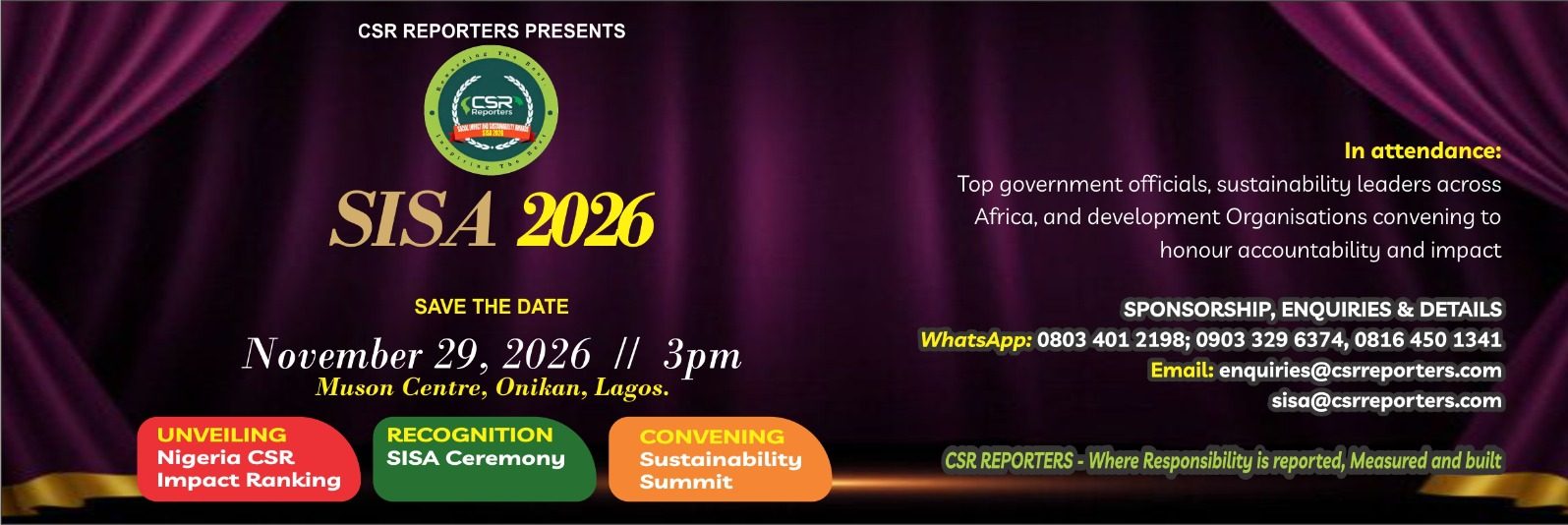
This is the broader conversation surrounding the Nigeria CSR Impact Ranking 2026, which will be unveiled at the Social Impact and Sustainability Awards (SISA 2026).
The ranking provides a platform for a closer examination of corporate responsibility in Nigeria and raises an important question for businesses and stakeholders alike: how should credible CSR performance be assessed?
The objective is to encourage a more informed conversation about responsibility, impact and accountability, rather than treating the number of activities carried out as the final measure of success.
SISA 2026: Putting Impact and Accountability in Focus

The Social Impact and Sustainability Awards (SISA 2026), organised by CSR Reporters, will bring together business leaders, sustainability professionals and other stakeholders to recognise responsible practices and advance conversations about meaningful impact.
The event will feature the SISA Ceremony, the unveiling of the Nigeria CSR Impact Ranking 2026, and the Sustainability Summit.
Together, these activities will provide an opportunity to reflect on corporate responsibility, recognise efforts that deserve attention and examine how businesses can strengthen their contributions to society.
As the event approaches, one question remains central to the conversation: when a company says it is making a difference, what evidence should demonstrate that claim?
The answer matters because responsible business is not simply about being seen to do good. It is about understanding the needs being addressed, assessing the outcomes and being accountable for the results.
SISA 2026 will take place on November 29, 2026, at 3:00 PM at MUSON Centre, Onikan, Lagos.
As Nigeria’s CSR community looks ahead to the event and the unveiling of the Nigeria CSR Impact Ranking 2026, the challenge is clear: move beyond the headlines and pay closer attention to the impact behind them.
[give_form id="20698"]