ROSEMARY IMOBHIO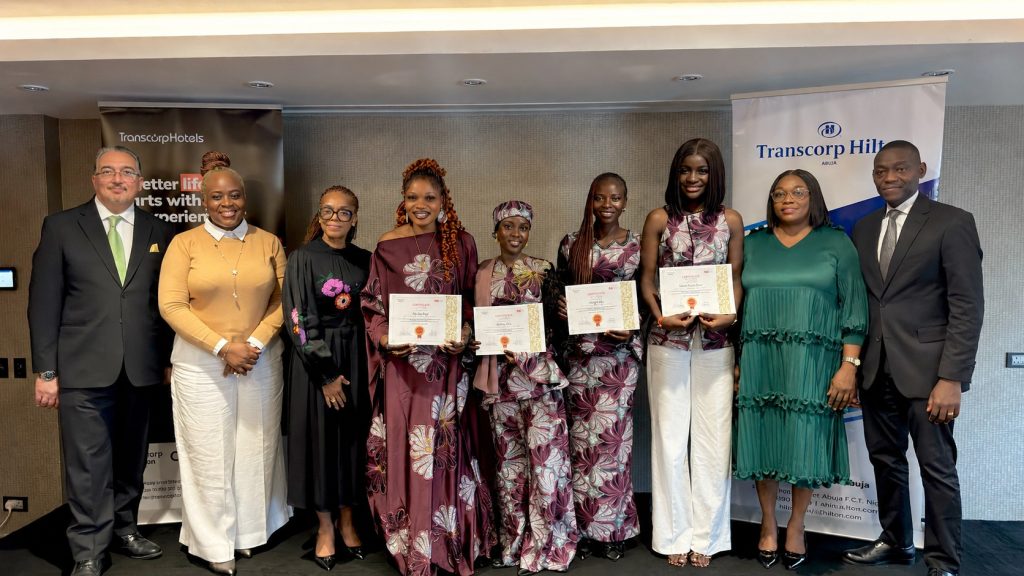
Image from Transcorp Hotels PLC
In Abuja last month, Transcorp Hotels Plc marked another milestone in its Business Empowerment Programme for Women (BEPW). It graduated its 16th cohort in a ceremony attended by the company’s leadership and its charity partner. On the surface, it looked like the kind of event that corporate Nigeria stages often. It featured certificates, speeches, photographs, and a donation of equipment to send participants on their way.
Beneath that surface, however, sits a more interesting question that stretches far beyond a single hotel group in Abuja. Can something as ordinary as discarded bedsheets and pillowcases become the foundation of a small business? And if it can, what does that suggest about how Nigerian companies might rethink both waste and community investment at the same time?
This is a story about how a business can generate environmental and social value from the same activity, rather than treating the two as separate budget lines.
How the Programme Works
Transcorp Hotels launched BEPW in 2016 in partnership with ACE Charity. The initiative has since become one of the company’s flagship sustainability commitments. According to the company, the programme was designed to move women from informal or unstable work into structured entrepreneurship. It does this by equipping them with a trade they could immediately monetise rather than a one-off handout.
Each cohort spends six months in training. Participants learn tailoring and garment construction, alongside modules in financial management, marketing, customer service, and broader business development. That curriculum is deliberately practical. Graduates are meant to leave with the skills to run a shop, not just sew a seam.
Reports on the most recent cohort describe additional coverage of supply chain basics and digital marketing for small enterprises. This reflects a curriculum that has grown more sophisticated as the programme has matured.
At graduation, each woman receives a sewing machine and other essential equipment, effectively a starter kit for launching her own tailoring business. As a result, the programme closes the gap between learning a skill and being able to use it commercially. A gap that derails many well-intentioned training schemes elsewhere in the country.
With the latest ceremony, the total number of women who have passed through BEPW since 2016 reached 64.
The Circular Economy Connection
This is where the programme becomes more than a standard skills initiative. Instead of buying new fabric for training exercises, Transcorp repurposes pre-used hotel bedding. This includes sheets and linens that have reached the end of their functional life in guest rooms. Trainees learn to cut, sew, and construct garments using material the hotel would otherwise discard.
This detail matters because textile waste is becoming a serious problem, both globally and locally. Worldwide, an estimated 90 million tonnes of textile waste is generated annually, and only around 15 percent of it is recycled. In Nigeria, the recovery infrastructure needed to sort and reprocess that waste remains limited, meaning the true reuse rate is likely far lower still.
Lagos alone offers a striking local snapshot. A 2025 study by Lagos Fashion Week and Style House Files estimated that the city generates roughly 260,000 tonnes of textile waste every year (1). This is spread across markets, garment factories, and households. Much of Nigeria’s fabric waste ends up burned in the open or dumped in drains, both of which carry environmental and public health costs.
Hotels are significant, if often overlooked, contributors to this waste stream. Bedding, towels, and linens are replaced on a rolling cycle for hygiene and guest experience reasons. In a large hospitality operation, that adds up to a steady flow of textiles reaching the end of their commercial life long before the fabric itself is truly spent.
Repurposed Waste
The circular economy, in simple terms, is an approach that keeps materials in use for as long as possible. This can be through reuse, repair, or repurposing, rather than following the traditional take-make-dispose model.
Transcorp’s use of hotel linen as training material is a modest but concrete illustration of that principle. It does not claim to solve Nigeria’s textile waste crisis, and Transcorp has not made that claim either. What it does show is that materials with no further use in their original context can still carry economic and educational value elsewhere, provided a business is willing to design a system around that reuse.

Why This Matters Beyond Transcorp
The broader CSR landscape is shifting under the feet of companies that once relied on cheque-writing to demonstrate social commitment. Corporate responsibility trends in 2026 show that businesses are increasingly expected to show measurable, sustained outcomes rather than one-off donations. Institutional capital is reinforcing that shift too, with ESG-linked assets under management climbing toward an estimated $33.9 trillion globally this year.
That pressure is changing what “doing good” looks like inside a company. Rather than distributing momentary financial aid, programmes like BEPW demand rigorous skills acquisition and operational training, positioning graduates to access formal credit and build businesses that can outlast the initial goodwill. This is consistent with a wider move among corporations toward what some CSR commentators now call outcome-based giving. Here success is tracked through participation, retention, and livelihood creation rather than the size of a cheque.
Programmes that combine an environmental angle, such as textile reuse, with a social outcome, such as entrepreneurship training, also tend to align more naturally with ESG reporting frameworks, since they generate evidence across more than one pillar at once.
Could Other Nigerian Businesses Do This?
The Transcorp model raises an obvious follow-up question. Could other sectors replicate it using their own waste streams?
Manufacturers routinely generate offcuts, packaging remnants, and factory seconds that could feed vocational training in similar ways. Food companies produce organic waste that some Nigerian social enterprises already convert into compost or animal feed businesses. A parallel worth watching as that sector matures.
Banks and telecoms firms, while less obviously linked to physical waste, could apply the same underlying logic to decommissioned electronics or office equipment, feeding refurbishment and repair training schemes. Airlines retire uniforms, seat covers, and cabin textiles on a predictable cycle, offering a plausible fit for programmes resembling BEPW. Hospitals generate large volumes of linen and packaging as well, though any reuse there would understandably require far stricter safety and sterilisation controls than a hotel setting demands.
None of these are guaranteed successes. They are simply areas where the underlying logic, converting a disposal cost into a training resource, appears transferable, provided the company invests in proper design and oversight.
Challenges and Opportunities
For all its promise, this model of CSR carries real challenges. Tracking what happens to graduates after they leave a six-month programme is difficult. Public reporting on BEPW so far has focused more on enrolment and graduation numbers than on long-term business survival rates.
Additionally, access to finance remains a persistent barrier for Nigerian micro-entrepreneurs generally. A sewing machine alone does not guarantee working capital for fabric, rent, or marketing. Ongoing mentorship, beyond the six-month training window, often determines whether a small business survives its first difficult year.
These are not criticisms unique to Transcorp. They apply across the sector wherever companies run skills-based CSR programmes without a clear, published mechanism for tracking graduates over time. Measuring genuine impact, as opposed to counting certificates issued, remains one of the hardest problems in corporate community investment anywhere in the world.
Conclusion
The future of corporate social responsibility in Nigeria may ultimately depend more on how creatively companies can solve a business problem and a community problem using the same set of resources. Transcorp’s decision to turn retired hotel linen into training material for aspiring entrepreneurs will not, on its own, resolve Nigeria’s textile waste burden. It does, however, offer a working example of what happens when a company stops treating waste and welfare as separate departments and starts asking what one might do for the other.
References
- Style House Files (2025). PROJECT IRAPADA: Mapping Textile Waste in Lagos —Volumes, Flows, and Circular Pathways. https://stylehousefiles.com/wp-content/uploads/2025/12/v.4-Project_-Irapada-3-updated.pdf