csrreporters
Children’s rights need priority now
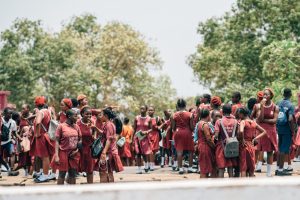
Across Nigeria, children continue to bear the brunt of a systemic collapse that undermines their most basic rights such as to be healthy, to learn, to be protected.
The statistics are damning, but what is worse is the continued silence, the corporate complicity, and the government’s lethargy that together sustain this crisis. From a sustainability standpoint, this is not just a humanitarian emergency. It is a national development catastrophe in disguise.
At a media dialogue marking the 2025 Day of the African Child, Celine Lafoucriere, Chief of UNICEF in the South-West, issued a sobering warning: that inefficient and insufficient budgeting continues to compromise the realisation of children’s rights in Nigeria. “Budgeting for children shouldn’t be treated as a separate exercise,” she said. And she is right. In a country where nearly every metric of child wellbeing is in freefall, the issue is no longer about marginal gains, it’s about foundational survival.

Yet, in Nigeria’s largest commercial hub, Lagos, a city that boasts some of the continent’s biggest corporations and business districts, families are still largely funding education out-of-pocket. This is not just a government failure; it is also a failure of corporate conscience.
Where are the companies that routinely trumpet their Corporate Social Responsibility (CSR) investments on full-page newspaper ads and LinkedIn banners? If CSR is not directly confronting the issues faced by over 18 million out-of-school children, then it is merely an exercise in public relations.
UNICEF’s data paints an even grimmer picture: more than half of Nigerian children face multidimensional poverty. It means these children lack at least three essential needs out of seven, from nutrition to water, from education to information. That 65.7% of rural children live in these conditions is not just a statistic, it’s a red flag for sustainable development in Nigeria.
A truly sustainable CSR approach must go beyond feel-good photo-ops. It must start seeing Nigerian children not as charity cases but as future employees, entrepreneurs, and citizens whose wellbeing directly impacts long-term economic and social stability. You cannot build a resilient market where tomorrow’s consumers are today’s starving, uneducated, and displaced children.
It’s also worth noting that in 2024 alone, nearly 11 million children in Nigeria lived in what UNICEF describes as “severe child food poverty.” That’s one in every three Nigerian children under five. This is the human cost of sustainability neglect. While brands spend millions designing eco-friendly packaging and renewable energy transitions, important goals, no doubt — they must also confront a more immediate environmental concern: That of a hostile environment for children to grow and thrive.
Attacks on schools and the general state of insecurity in the north have not only made education dangerous, but have also made displacement and violence against children a recurring headline. Yet, for many companies operating in these affected regions, there’s silence. There are no interventions, no education grants, no investment in safe learning spaces. It begs the question: who is CSR really for?
Child labour is another dark chapter in this story. According to a 2022 ILO survey, over 32% of children between 5 and 17 years old are in child labour and nearly a quarter in hazardous work. Businesses that source raw materials, contract labour, or outsource services in Nigeria cannot claim to be sustainable or socially responsible if their value chains include children forced to work under exploitative conditions.
There’s already a legal framework to guide action: the Child Rights Act (2003), adopted by all 36 states and the FCT. But adoption is not the same as action. Only 26 states have gazetted the law, and implementation remains sporadic and poorly monitored. Here, civil society and the private sector must join forces — not just to fund programs, but to pressure state actors into full compliance and transparency.
This is the missing link in Nigeria’s sustainability agenda. You can’t solve climate change without solving poverty. You can’t fight plastic pollution and ignore child malnutrition. You can’t champion circular economies while the economy of education is broken. CSR must be intersectional, rooted in empathy, driven by data, and engineered to transform the lives of the most vulnerable.
It is this kind of Corporate Citizenship that can close the credibility gap in Nigeria’s private sector. If the future workforce is being denied its childhood, then the business community must shoulder part of the blame and part of the responsibility. The solution is not in more CSR conferences, roundtables, or pledges. It is in decisive, auditable, scalable action.
Where governments are failing, the private sector must show leadership not just as an emergency stop-gap, but as co-architects of Nigeria’s social development. Partnering with UNICEF, Save the Children, or local NGOs to create nutrition programs, school feeding schemes, mobile health clinics, or trauma-informed safe spaces for displaced children is not just CSR; it’s business continuity in human form.
And citizens, too, must demand more. Not just from the state, but from the multinationals who reap profits from Nigeria’s lands, waters, and people. The media must stop glorifying CSR efforts that give out branded exercise books once a year, and start spotlighting companies that invest in system change who integrate children’s welfare into their core business model.
Until the right to a safe childhood is mainstreamed into CSR and sustainability efforts in Nigeria, we are merely rearranging deck chairs on a sinking ship. Sustainability must include at its core the protection and empowerment of Nigeria’s youngest and most vulnerable.
Leave no child behind should not be a slogan. It must be a corporate and national blueprint.
[give_form id="20698"]