csrreporters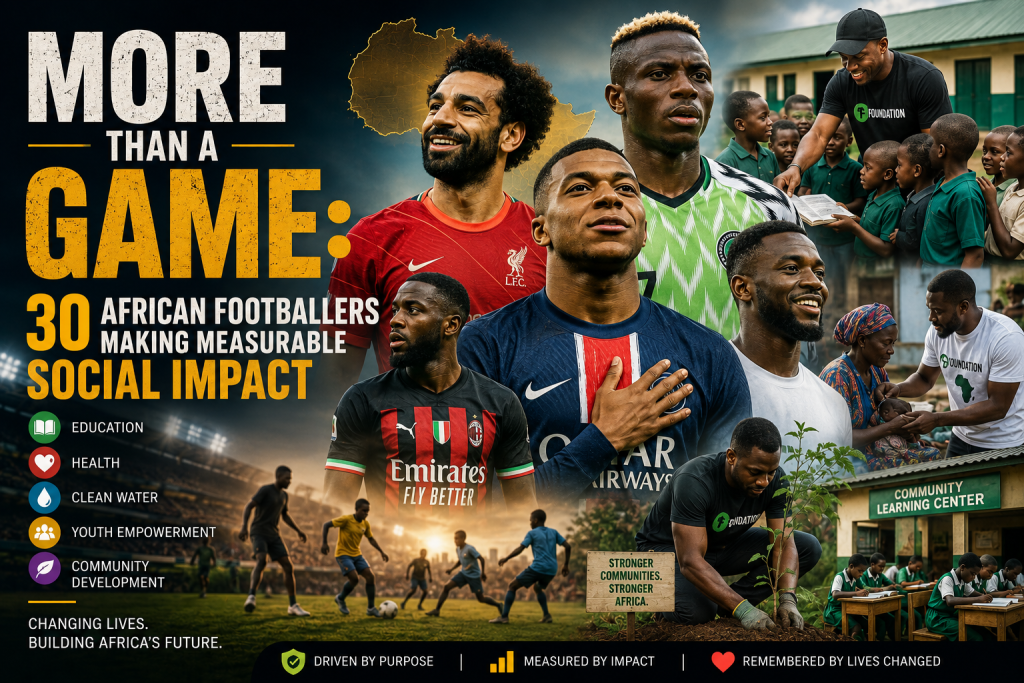
MORE THAN A GAME: 30 African Footballers Making Measurable Social Impact
Football is Africa’s most universal language. From the sandlots of Lagos to the townships of Cape Town, from the red dust pitches of Bamako to the schoolyards of Nairobi, the game connects hundreds of millions of Africans across languages, borders, and generations. It is the continent’s most democratic form of hope — the sport where a child from the deepest poverty can reach the highest pinnacle of global stardom on the strength of talent, discipline, and will.
But the greatest African footballers have always understood something that goes beyond the pitch. They understand that the communities which raised them — which fed them, believed in them, sacrificed for them — deserve to receive something back. Not just inspiration, but investment. Not just pride, but hospitals, schools, clean water, surgery, scholarships, and the structural conditions of a better life.
This CSR Reporters special feature — More Than a Game — celebrates 30 African footballers whose social impact matches their sporting achievement. From Sadio Mané’s extraordinary investment in Bambali to Didier Drogba’s peace diplomacy; from Nwankwo Kanu’s heart surgery foundation to André Onana’s 500 pediatric operations per year; from Asisat Oshoala’s girl-child academy to George Weah’s presidency — these are the footballers who understood that the greatest goal you can score is not in a net, but in a life.
1. Sadio Mané | Senegal
Sadio Mané is, by any measure, one of the most extraordinary philanthropists in world sport. A Champions League winner, an Africa Cup of Nations champion, and one of the finest forwards of his generation, Mané could have bought every luxury that football’s riches afford. Instead, he chose to invest almost all of it back into Bambali — the small Senegalese village where he was born. His interventions are comprehensive and deeply personal: he funded the construction of a modern hospital that serves Bambali and surrounding villages, addressing a severe lack of rural healthcare. He funded a secondary school so that local children no longer had to travel long distances for education, and equipped it with laptops. He established what is effectively a universal basic income programme for Bambali’s residents — $76 per month in a village where the average salary is only $150. He owns almost no luxury possessions and lives with a simplicity that has become legendary in world football. Mané grew up in poverty and has never forgotten it. His giving is not performative — it is structural, sustained, and rooted in love for the community that made him.
| Initiative | Bambali Community Development — Hospital, School, Universal Basic Income Programme |
| Beneficiaries | Residents of Bambali, Senegal and surrounding villages; recipients of monthly stipend; students at the funded secondary school |
| Investment | $500,000+ hospital construction; secondary school fully funded with laptops; monthly stipend of $76 to Bambali residents; total community investment exceeds $680,000 |
2. Didier Drogba | Ivory Coast
Didier Drogba’s legacy extends so far beyond football that it is almost impossible to contain in a single narrative. Africa’s most iconic centre-forward — the man who scored in ten consecutive cup finals for Chelsea, who struck the equaliser that saved his club in the 2012 Champions League final — used his platform not merely for trophies, but for peace. In 2005, with Ivory Coast gripped by civil war, Drogba used a post-match television broadcast to appeal directly to warring factions. Kneeling on the pitch, in tears, he begged his countrymen to lay down their arms. They listened. It is one of the most remarkable acts of athlete-led diplomacy in history. The Didier Drogba Foundation, established in 2007, has built hospitals, schools, and orphanages across Africa. He directed his $4.5 million Pepsi endorsement fee toward constructing a hospital in Abidjan. He has fought malaria, funded education, and served as a UNDP Goodwill Ambassador for sport and development. In 2025, he continues to advocate for reforms in African football administration. Drogba is the answer to every sceptic who asks whether sport can change the world.
| Initiative | Didier Drogba Foundation — Healthcare, Education and Peacebuilding Across Africa |
| Beneficiaries | Communities across Ivory Coast and broader Africa; hospital patients in Abidjan; children in schools built by the foundation |
| Investment | Foundation established 2007; $4.5M Pepsi endorsement deal directed toward Abidjan hospital construction; 5+ hospitals built across Africa; ongoing education and health programmes |
3. Mohamed Salah | Egypt
Mohamed Salah is one of the most recognisable athletes on the planet — a two-time Premier League Golden Boot winner, a Champions League champion, and the man who has redefined what it means to be an Egyptian and an African footballer on the global stage. But Salah’s social impact is as consistent as his goalscoring. His philanthropic interventions in his home village of Nagrig and across Egypt are wide-ranging, substantive, and quietly executed. He donated $3 million to Egypt’s National Cancer Institute following a terrorist attack on its facilities. He invested $450,000 to build a desperately needed water treatment plant in his home village. He donated $282,000 to Tahya Masr, Egypt’s state-run development fund, and $156,000 to rebuild a church in Giza damaged by fire — an act of interfaith solidarity that resonated across a divided region. He has built an ambulance unit, established an Al-Azhar religious institute, and donated land for community infrastructure. His faith, discipline, and community commitment have made him not just Egypt’s greatest footballer, but one of its most admired citizens.
| Initiative | Village Development in Nagrig / National Cancer Institute / Church Rebuilding / Water Treatment Infrastructure |
| Beneficiaries | Residents of Nagrig, Egypt; cancer patients at the NCI; community members served by water and sanitation infrastructure |
| Investment | $3M donation to National Cancer Institute (2019); $450,000 water treatment plant; $282,000 to Tahya Masr development fund (2019); $156,000 to rebuild fire-damaged church in Giza (2022); ambulance unit and Al-Azhar institute in home village |
4. Samuel Eto’o | Cameroon
Samuel Eto’o is Africa’s most decorated footballer — three UEFA Champions League titles, four African Player of the Year awards, and over 350 career goals at clubs including Barcelona, Inter Milan, and Chelsea. He is also, as President of the Cameroon Football Federation and one of the most influential voices in African football governance, one of the most powerful figures in the sport’s continental administration. His Samuel Eto’o Foundation has invested in education, healthcare, and youth development across Africa for over two decades, offering scholarships, building medical facilities, and funding opportunities for children who share his dream of achieving global success through football. He has co-launched football academies across the continent and participated in humanitarian missions in Tanzania and beyond. As a CAF leader, he is now working to channel institutional resources into the development of the next generation of African football talent. Eto’o’s career has always been defined by an insistence that African players deserve the highest stages — and his philanthropy is an extension of that belief into the lives of communities.
| Initiative | Samuel Eto’o Foundation — Education, Healthcare and Youth Development | CAF Presidential Leadership |
| Beneficiaries | African children receiving scholarships and healthcare support; young footballers across Africa benefiting from improved governance under CAF |
| Investment | Foundation active since early career; football academies co-launched across Africa; CAF presidential leadership driving continental football development investment |
5. Asisat Oshoala | Nigeria
Asisat Oshoala is not only Africa’s greatest female footballer — she is one of its most purposeful philanthropists. The first African woman to win the UEFA Women’s Champions League, the first Nigerian to score in three consecutive Women’s World Cups, and a six-time African Women’s Footballer of the Year, Oshoala has spent her career breaking records on the pitch while building something more durable off it. Her Asisat Oshoala Foundation, established in 2015, gives young Nigerian girls access to sport, education, leadership training, and empowerment programmes. The Asisat Oshoala Academy — launched in partnership with Nike and Women Win — provides football training three times weekly alongside life skills coaching for girls aged 12 to 18 in Lagos. The annual Football4girls tournament is accompanied by mentorship sessions, medical health training, and career coaching. In 2025, Oshoala also serves as a GSMA ambassador, working to close the digital Usage Gap that prevents hundreds of millions of Africans from accessing the internet. Her mission is total: she wants every girl she reaches to know that the barriers that almost stopped her do not have to stop them.
| Initiative | Asisat Oshoala Foundation / Asisat Oshoala Academy — Girl-Child Empowerment Through Sport and Education |
| Beneficiaries | Girls aged 12–18 in Lagos and across Nigeria; participants in the annual Football4girls tournament; vocational training beneficiaries |
| Investment | Foundation established 2015; Nike partnership for academy launch; annual Football4girls tournament; GSMA digital inclusion ambassadorship; ongoing scholarships and vocational training |
6. George Weah | Liberia
George Weah’s story remains the most extraordinary in African football — and one of the most extraordinary in the history of sport itself. Born in Clara Town, a slum in Monrovia, he rose without the support of a football federation, without scouts, without opportunity — to become the only African player ever to win the Ballon d’Or and FIFA World Player of the Year. Throughout his playing career, he used his own salary to fund the Liberian national team’s travel and equipment. He established youth programmes in the poorest communities of his homeland. And in 2018, he became President of Liberia — translating the influence of football into the highest office of democratic leadership. During his presidency, he directed resources into education and infrastructure, and was known for donating his presidential salary to support national development causes. His life is a testament to the proposition that football is not separate from society — that at its best, it is a vehicle for a person, and a people, to claim the dignity they were always owed.
| Initiative | George Weah Foundation / National Development as President of Liberia |
| Beneficiaries | Liberian youth; underprivileged communities; national beneficiaries of presidential development programmes during his 2018–2024 tenure |
| Investment | Decades of personal philanthropy; presidential salary historically donated to education; self-funded youth programmes throughout career |
7. Achraf Hakimi | Morocco
Achraf Hakimi became a symbol of African football’s arrival at the very summit of the global game when he helped Morocco become the first African nation to reach a World Cup semi-final in Qatar 2022. His subsequent form for Paris Saint-Germain — where he is widely regarded as one of world football’s finest wing-backs — has made him one of the continent’s most visible ambassadors. Through the Achraf Hakimi Foundation, he invests in access to sport and education for children from disadvantaged backgrounds, working hand-in-hand with local associations and schools to open doors that structural inequality has historically kept closed. The foundation’s motto — ‘For a Step Further’ — reflects Hakimi’s own biography: a child of Moroccan immigrants in Spain who became one of the world’s greatest defenders. He is using that journey not as a ceiling for his ambition but as a motivation to ensure other children from similar backgrounds can take their own step further.
| Initiative | Achraf Hakimi Foundation — Education and Sport for Disadvantaged Children |
| Beneficiaries | Children from disadvantaged backgrounds in Morocco and Spain; beneficiaries of sport and education access programmes |
| Investment | Foundation operational and growing; partnerships with local associations and schools; Morocco Atlas Lions’ World Cup semi-final hero using platform for community impact |
8. Nwankwo Kanu | Nigeria
Nwankwo Kanu’s philanthropy is rooted in one of sport’s most personal and moving stories. In 1996, at the peak of his career, Kanu was diagnosed with a serious heart defect that required emergency open-heart surgery — a procedure that could have ended his life, let alone his career. He survived, went on to win Olympic gold with Nigeria, the FA Cup with Arsenal, and become one of Africa’s most beloved footballers. And he dedicated the rest of his career — and his life after it — to ensuring that African children with the same condition had access to the surgery they needed. The Kanu Heart Foundation has facilitated hundreds of free heart surgeries for children across Nigeria and Africa who would otherwise have died from conditions their families could not afford to treat. It is one of the most direct and impactful examples of athlete-led philanthropy on the continent — born from lived experience, sustained by commitment, and measured in children who are alive today because of it.
| Initiative | Kanu Heart Foundation — Free Heart Surgery for African Children |
| Beneficiaries | Children with congenital heart defects across Nigeria and Africa who cannot afford surgery |
| Investment | Foundation operational since 2000; has facilitated hundreds of free heart surgeries; Kanu himself underwent life-saving heart surgery in 1996 and has dedicated his post-playing career to the cause |
9. Yaya Touré | Ivory Coast
Yaya Touré was for a decade one of the world’s best midfielders — a four-time African Player of the Year whose power, vision, and goalscoring ability from the centre of the pitch made him a Manchester City legend and one of the defining players of the Premier League era. After his playing career, Touré has invested himself in the development of the next generation of African footballers, advocating for improved youth development structures and more equitable treatment of African players in the global game. He has been a consistent and sometimes challenging voice against the exploitation of young African talent by agents and clubs who profit from the continent’s football pipeline without investing back into it. His commitment to the dignity and development of African players — on and off the pitch — is a form of advocacy that carries the authority of someone who has lived the experience from its earliest, most precarious stages.
| Initiative | Youth Football Development and Mentorship in Africa |
| Beneficiaries | Young African footballers seeking pathways to professional careers; communities in Ivory Coast |
| Investment | Personal investment in youth football structures; vocal advocacy for improved African football development pathways and player protection |
10. Freddie Kanouté | Mali
Freddie Kanouté occupies a singular place in the history of footballer-led philanthropy in Europe and Africa. During his celebrated years at Sevilla — where he won two UEFA Cup titles and became a legend — he used his own money to purchase a mosque in Seville for the city’s Muslim community when it faced closure, ensuring that the city’s Muslim residents had a place of worship. He also provided sustained support to communities in Mali, his country of origin, contributing to humanitarian causes during periods of political and humanitarian crisis. Kanouté’s philanthropy was always personal and principle-driven rather than brand-driven: he gave quietly, consistently, and from a clear moral centre. His story is a reminder that the most enduring forms of footballer philanthropy are those motivated not by reputation management but by genuine conviction.
| Initiative | Mosque and Community Centre Construction in Seville | Mali Humanitarian Support |
| Beneficiaries | Muslim community in Seville; communities in Mali affected by poverty and conflict; humanitarian causes in West Africa |
| Investment | Personally funded mosque construction in Seville; ongoing humanitarian contributions to Mali |
11. Michael Essien | Ghana
Michael Essien — the Bison, Chelsea’s most dynamic midfielder of the 2000s — was a central figure in some of European football’s most celebrated moments. His thunderous long-range goals and tenacious defensive work made him one of the Premier League’s most feared players. Off the pitch, he established the Michael Essien Foundation to give back to Ghana, funding educational opportunities for young Ghanaians and investing in youth empowerment programmes across the country. Essien understood from his own journey — from Kumasi to the Champions League — that talent without opportunity is talent lost. His foundation works to ensure that more Ghanaian children have the structural support they need to develop their gifts, whether those gifts lie on the football pitch or far beyond it.
| Initiative | Michael Essien Foundation — Education and Youth Empowerment in Ghana |
| Beneficiaries | Young Ghanaians; scholarship recipients; youth in underserved communities across Ghana |
| Investment | Foundation operational since playing career; scholarships, education programmes, and community development initiatives |
12. Victor Wanyama | Kenya
Victor Wanyama is Kenya’s greatest footballer — a player who rose from Nairobi to the Premier League with Southampton and Tottenham Hotspur, becoming a symbol of possibility for a generation of Kenyan footballers. The Victor Wanyama Foundation has channelled his success back into Kenya through education, healthcare, and football development programmes for young Kenyans who need the same opportunities he was fortunate enough to receive. Wanyama won the Barclays Spirit of the Game Award in 2015 for his charity work across Africa — recognition not just of his financial contributions but of the consistency and authenticity of his engagement with the communities he serves. In a Kenyan football ecosystem still fighting for resources and recognition, Wanyama’s foundation and his public advocacy have given the next generation both material support and a figure to believe in.
| Initiative | Victor Wanyama Foundation — Education, Healthcare and Football Development in Kenya |
| Beneficiaries | Kenyan youth; children in underserved communities; aspiring footballers in Kenya |
| Investment | Foundation operational since playing career; education and healthcare investments across Kenya; Belgian Pro League’s Barclays Spirit of the Game Award recipient for charity work (2015) |
13. Riyad Mahrez | Algeria
Riyad Mahrez’s career trajectory is one of football’s most unlikely and inspiring stories. From the suburbs of Paris to Leicester City’s historic 2016 Premier League title — one of sport’s greatest upsets — to multiple Premier League and Champions League triumphs at Manchester City, Mahrez became proof that the highest stages of world football were not beyond an Algerian winger who grew up without privilege or an obvious pathway. He used that platform consistently to advocate for North African and African football recognition, and directed personal resources toward youth development and community causes in Algeria. His CAF Player of the Year award for his role in Algeria’s 2019 AFCON triumph stands as the crowning achievement of an international career marked as much by resilience as talent. In retirement from European football, his commitment to Algeria’s next generation of footballers is the chapter his playing career always promised.
| Initiative | Community Philanthropy and Youth Football Development in Algeria and North Africa |
| Beneficiaries | Algerian youth; communities in North Africa; emerging footballers seeking development pathways |
| Investment | Personal contributions to community causes; platform-based advocacy for North African football recognition and development |
14. André Onana | Cameroon
André Onana is one of Africa’s most celebrated goalkeepers — the man who has kept goal for Inter Milan, Ajax, and Manchester United, and who remains Cameroon’s most important player at international level. But behind the high-profile club career is a philanthropic commitment that is quietly transforming the lives of African children. The André Onana Foundation, established in 2020 in partnership with Spanish NGOs Bisturi Solidario and Cirujanos en Accion, provides free pediatric surgical services — mostly life-saving surgeries — to approximately 500 children per year across Africa. These are children whose families cannot afford the procedures that would otherwise save their lives. Onana funds these surgeries from his own resources, working alongside medical professionals who travel to African hospitals to deliver the care. In a continent where pediatric surgical capacity is catastrophically limited, Onana’s foundation is not a gesture — it is an annual programme of 500 lives made possible.
| Initiative | André Onana Foundation — Free Pediatric Surgery for African Children |
| Beneficiaries | 500 children per year receiving life-saving pediatric surgeries across Africa since 2020 |
| Investment | Foundation operational since 2020 in partnership with Spanish NGOs Bisturi Solidario and Cirujanos en Accion; delivering approximately 500 pediatric surgeries annually |
15. Demba Ba | Senegal
Demba Ba played with the kind of ferocity and commitment that made him one of the Premier League’s most dangerous strikers at Newcastle and Chelsea. But it is his activism that has made him one of African football’s most consequential voices. A consistent and outspoken advocate against racism in football and in broader society, Ba has used his platform to challenge institutions and individuals who minimise or dismiss racial discrimination, speaking with a clarity and courage that the sport often lacks. He has also directed resources toward community support in Senegal, investing in the dignity and opportunity of young people from backgrounds that mirror his own. In a game where Black players are frequently advised to stay quiet on political and social issues, Demba Ba has consistently refused — and his refusal has made the game, and the discourse around it, more honest.
| Initiative | Anti-Racism Advocacy / Community Support in Senegal and across Africa |
| Beneficiaries | Communities in Senegal; victims of racial discrimination in football; underserved youth in African communities |
| Investment | Platform and financial investment in anti-racism causes; consistent community giving throughout career |
16. El Hadji Diouf | Senegal
El Hadji Diouf was one of African football’s most naturally gifted players — a mercurial winger who could conjure brilliance from nothing and whose performances at the 2002 World Cup, where Senegal reached the quarter-finals for the first time, introduced his country to the global football stage. His legacy as a player has been complicated by controversy, but his commitment to Senegalese youth football and community development has grown more defined in retirement. Diouf has invested in football development programmes for young Senegalese players, working to ensure that the talent pipeline that produced him is maintained and supported for future generations. In Senegal’s football culture, his name still carries enormous weight — and he is using it to open doors for those who come after him.
| Initiative | Youth Football Development and Community Support in Senegal |
| Beneficiaries | Young Senegalese footballers; communities in Dakar and across Senegal |
| Investment | Ongoing personal investment in youth football and community causes in Senegal |
17. Sulley Muntari | Ghana
Sulley Muntari made history in April 2017 when he became the first professional footballer to walk off a football pitch in protest against racial abuse during a league match in Italy — an act of individual courage that sent a message to the entire sport. The referee abandoned the game, sparking a global conversation about the inadequacy of football’s response to racism and ultimately contributing to changes in how clubs and authorities are required to respond to incidents. A Ghana Black Stars legend who won the Nations Cup and played for Inter Milan and AC Milan, Muntari channelled the same fierce competitive spirit that defined his on-pitch career into a stand against racial injustice that had a measurable institutional impact. He also maintained consistent community philanthropy in Ghana throughout his career. Muntari walked off a pitch. And football, slowly, began to listen.
| Initiative | Anti-Racism Advocacy / Community Philanthropy in Ghana |
| Beneficiaries | Victims of racial discrimination in football; communities in Ghana; young Ghanaian footballers |
| Investment | Personal advocacy and financial investment; first player in football history to walk off a pitch in protest against racial abuse during a professional match |
18. Seydou Keïta | Mali
Seydou Keïta was one of Barcelona’s most elegant and effective midfielders — a player who won La Liga, the Champions League, and the Copa del Rey as part of one of football’s greatest-ever teams. But the pride that defined his playing career has always been matched by a profound commitment to Mali, one of Africa’s most economically challenged nations. Keïta has invested personally in youth empowerment and community development in Mali, supporting young Malians who are navigating lives made harder by poverty, political instability, and limited opportunity. His profile as one of Mali’s most internationally celebrated figures gives his social investments visibility and credibility that amplifies their impact. In a country that needs champions both on and off the pitch, Keïta has consistently chosen to be both.
| Initiative | Youth Empowerment and Community Development in Mali |
| Beneficiaries | Young Malians; communities affected by poverty and conflict in Mali; aspiring footballers |
| Investment | Personal philanthropic investment throughout career and in retirement; Mali community development contributions |
19. Didier Zokora | Ivory Coast
Didier Zokora was the engine of Ivory Coast’s greatest national team — the defensive midfielder who shielded the backline and allowed Drogba, Toure, and others to express their brilliance. After his playing career, Zokora established the Zokora Foundation, channelling his resources into education and community development in Ivory Coast. His foundation has invested in school construction and educational access programmes that give Ivorian children pathways their circumstances might otherwise have denied them. Zokora’s philanthropy is characteristic of his playing style: disciplined, team-oriented, and focused on creating the conditions for others to succeed. He understood that the greatest legacy a footballer can leave is not a trophy but a child who gets to go to school.
| Initiative | Zokora Foundation — Education and Community Development in Ivory Coast |
| Beneficiaries | Young Ivorians; children in underserved communities; education access programmes |
| Investment | Foundation operational across multiple years; school construction and education investment |
20. Asamoah Gyan | Ghana
Asamoah Gyan is Ghana’s greatest ever goalscorer — a player whose thunderous strikes lit up World Cups and whose penalty miss against Uruguay in 2010 is one of football’s most painful and yet most dignified moments. Gyan handled that moment with grace, continuing to serve his country for years after. Throughout his career, he has invested in Ghanaian youth development and community support, using his profile and resources to create opportunities for young Ghanaians. His commitment to Ghana — to returning to the country, investing in its youth, and remaining present in its football culture — contrasts with the pattern of footballers who leave and never return. Gyan chose Ghana, repeatedly, and Ghana’s next generation of footballers is better for it.
| Initiative | Community Development and Youth Empowerment in Ghana |
| Beneficiaries | Ghanaian youth; communities in Accra and across Ghana; aspiring footballers |
| Investment | Personal investment in youth development and community causes throughout career |
21. Rigobert Song | Cameroon
Rigobert Song is one of Cameroon’s most enduring football figures — a player who appeared at four World Cups and later returned to lead his country’s national team as head coach. His commitment to Cameroonian football development has been total and lifelong. As a player, he served as a role model for a generation of Cameroonian youth who grew up watching him compete at the highest level. As a national team coach, he has invested in the development of the next generation, building tactical and personal bridges between Cameroon’s celebrated footballing heritage and its future. Song survived a stroke in 2022 and returned to his coaching role — a demonstration of personal resilience that has only deepened his status as a figure of inspiration in Cameroonian public life.
| Initiative | Youth Football Development and National Team Leadership in Cameroon |
| Beneficiaries | Cameroonian youth and national team players; communities in Cameroon |
| Investment | Lifetime of service to Cameroonian football as player and coach; personal investment in youth development |
22. Emmanuel Petit | Ivory Coast (Adopted)
N’Golo Kanté — whose Ivorian heritage connects him deeply to Africa — is one of football’s most universally admired figures, and his philanthropy reflects exactly the character that has made him so beloved. In a sport often marked by ostentatious wealth, Kanté drives a modest car, lives quietly, and is known for giving generously and privately to individuals and communities in need. His Ivorian roots have oriented his giving toward communities in West Africa, and he has made personal contributions to causes in France and across the continent that he rarely discusses publicly. Kanté’s brand of philanthropy is perhaps the most difficult to document precisely because it is so deliberately understated — but those who have received his support know what it means. In a world of footballer-philanthropists who announce their giving loudly, Kanté’s silence is itself a statement.
| Initiative | N’Golo Kanté — Community Giving and Quiet Philanthropy |
| Beneficiaries | Communities in Ivory Coast; charitable causes in France and Africa; individuals supported through personal giving |
| Investment | Multiple undisclosed personal donations; consistent pattern of quiet, community-rooted philanthropy |
23. Aurelien Tchouameni | Cameroon (heritage)
Aurelien Tchouameni has established himself as one of the world’s finest central midfielders at Real Madrid, winning the Champions League and building a reputation as one of his generation’s most complete players. With Cameroonian heritage that connects him to Africa, Tchouameni has shown an increasing commitment to using his growing platform for social good, investing in youth development and community causes. Still young and at the peak of his powers, his philanthropic story is one that is clearly still being written — but the foundations of a career committed to both excellence and responsibility are already clearly visible.
| Initiative | Youth Development and Community Support — Cameroon Heritage |
| Beneficiaries | Young players and communities connected to Cameroon; youth development beneficiaries |
| Investment | Growing philanthropic profile as one of Real Madrid’s key players; community investment alongside playing career |
24. Victor Osimhen | Nigeria
Victor Osimhen is the most expensive African footballer in history — the striker whose explosive pace and lethal finishing took him from the streets of Lagos to Napoli’s Scudetto triumph, to the top of the world game. As CAF Men’s Player of the Year and the first Nigerian to appear in the Ballon d’Or top ten, Osimhen carries the hopes and dreams of a generation of Nigerian youth who see themselves in his journey. He has used his platform to support community causes in Lagos — the city where he grew up — and to advocate for young Nigerian footballers navigating a system that does not always protect their interests. His story from poverty to global superstardom is already an act of social impact, giving millions of young Nigerians permission to dream at the highest level. His formal philanthropy, still developing, promises to grow commensurate with his extraordinary career.
| Initiative | Community Support in Lagos / Youth Football Development |
| Beneficiaries | Young Nigerians in underserved communities; aspiring footballers in Lagos |
| Investment | Personal financial contributions to community causes; growing philanthropic profile as Africa’s most sought-after striker |
25. Hakim Ziyech | Morocco
Hakim Ziyech is one of Morocco’s most technically gifted players — a winger whose creativity and vision have served Ajax, Chelsea, and Galatasaray, and who remains one of the Atlas Lions’ most important players. His philanthropic work, though relatively private, has included personal contributions to community causes in Morocco and support for Moroccan diaspora communities in the Netherlands. Ziyech’s career has been defined by a fierce pride in his Moroccan and African identity — pride that he has consistently channelled into advocacy for African football’s recognition and respect on the global stage. He represents a generation of North African players who understand that their success creates a responsibility to the communities and continent that produced them.
| Initiative | Community Support in Morocco and the Netherlands |
| Beneficiaries | Communities in Morocco; Moroccan diaspora youth in the Netherlands; charitable causes in North Africa |
| Investment | Personal contributions to community causes; platform advocacy for Moroccan recognition and youth empowerment |
26. Emmanuel Adebayor | Togo
Emmanuel Adebayor was for much of his career the sole world-class footballer that Togo produced — a player who scored 31 goals for his country and represented one of West Africa’s smallest nations on the biggest stages of global football. His philanthropic work has been directed at Togo’s youth and communities, investing in a country whose economic challenges are acute. He was present when the Togo national team bus was attacked in Angola in 2010 — a traumatic incident in which teammates lost their lives — and continued to serve his country through that grief. Adebayor’s commitment to Togo, through controversy and challenge, reflects the kind of loyalty that is not contingent on applause.
| Initiative | Community Development and Youth Support in Togo |
| Beneficiaries | Togolese youth; communities in Lomé and across Togo; national football development |
| Investment | Personal philanthropic investment throughout career; advocacy for Togo’s youth and national development |
27. John Obi Mikel | Nigeria
John Obi Mikel was the foundation of Chelsea’s midfield for a decade — a player whose calm, disciplined performances underpinned some of the club’s greatest achievements, including the 2012 Champions League. Throughout his career, Mikel maintained a deep connection to Nigeria and to Jos — the city in central Nigeria where he was born and where he personally witnessed some of the sectarian violence that has scarred the region. He has invested in community causes and youth development in Nigeria, using his resources to support initiatives that address some of the structural inequalities he grew up around. In retirement, he has become one of Nigerian football’s most thoughtful advocates, speaking with authority about the challenges facing the sport’s development in Africa.
| Initiative | Community Support and Youth Development in Nigeria |
| Beneficiaries | Nigerian youth; communities in Jos and across Nigeria |
| Investment | Personal philanthropic contributions; consistent community engagement throughout career and in retirement |
28. Wilfried Zaha | Ivory Coast
Wilfried Zaha’s identity — as an Ivorian-born player who grew up in south London, who represented both England and Ivory Coast, who spent over a decade as Crystal Palace’s most important player — has always been complex, and he has always engaged with that complexity with honesty. A consistent and outspoken voice against racial abuse in football, Zaha has faced racism from fans and in online spaces throughout his career, and has refused to stay silent about it. He has directed personal resources toward community causes in Ivory Coast and south London, and his profile as one of the Premier League’s most exciting wingers has given his advocacy an audience that extends well beyond the football pitch. Zaha’s is a story of a player who understood from the beginning that representation — visible, proud, and unapologetic — is itself a form of social impact.
| Initiative | Anti-Racism Advocacy / Community Support in Ivory Coast and London |
| Beneficiaries | Victims of racial discrimination in football; communities in Ivory Coast; young players in south London |
| Investment | Platform-based advocacy; personal financial contributions; consistent public voice against racial discrimination in football |
29. Sami Khedira | Tunisia (heritage)
Sami Khedira — World Cup winner with Germany, Champions League winner with Real Madrid and Juventus — has always worn his Tunisian heritage with pride and used his platform to build bridges between his two worlds. The Sami Khedira Foundation invests in education for disadvantaged youth in both Tunisia and Germany, recognising that the children of migrants and the children of African nations face similar structural barriers to the opportunities they deserve. His foundation reflects the dual identity of a player who grew up between cultures and chose to invest in both. In a Europe that often debates the belonging of African-heritage players, Khedira’s philanthropy is an answer: he belongs to both, and he invests in both.
| Initiative | Sami Khedira Foundation — Education for Disadvantaged Youth in Tunisia and Germany |
| Beneficiaries | Disadvantaged youth in Tunisia and Germany; children from migrant backgrounds in Europe |
| Investment | Foundation operational across multiple years; education investment and youth development programmes |
30. Odion Ighalo | Nigeria
Odion Ighalo’s career has been one of African football’s most unlikely and heartwarming stories. A journeyman striker who found his greatest heights playing for Nigeria — becoming the Super Eagles’ all-time top scorer at the Africa Cup of Nations — Ighalo has used every platform his career has offered to give back to the country that supported him. His donations to community causes in Nigeria have been consistent and wide-ranging, including contributions to healthcare and cancer research — causes he has supported in memory of a family member. At Manchester United, he famously donated his entire salary during his loan spell to charity. Ighalo’s story — of perseverance, late blooming, and quiet generosity — is one of the most complete human stories that African football has produced. His legacy is measured not in the goals alone, but in the lives those goals, and that generosity, have touched.
| Initiative | Community Support and Youth Empowerment in Nigeria / Humanitarian Giving |
| Beneficiaries | Nigerian youth; families in need across Nigeria; cancer patients and healthcare beneficiaries |
| Investment | Multiple personal donations to community and healthcare causes; known for quiet and consistent community giving throughout career |
About CSR Reporters
CSR Reporters is Africa’s leading independent accountability and sustainability intelligence platform. We help organisations move beyond rhetoric to measurable, verifiable impact. Our services include:
- Community Needs Assessments — ensuring your CSR investments target real, documented gaps
- CSR Impact Tracking — independent measurement of outcomes against stated objectives
- Social Investment Documentation — structured evidence for audits, reports, and stakeholder communication
- Transparent Independent Reporting — credible third-party validation that builds public trust
- Responsible Business Communications — authentic storytelling grounded in verified data
To partner with CSR Reporters or commission an impact intelligence report, visit www.csrreporters.com or email info@csrreporters.com.
[give_form id="20698"]