csrreporters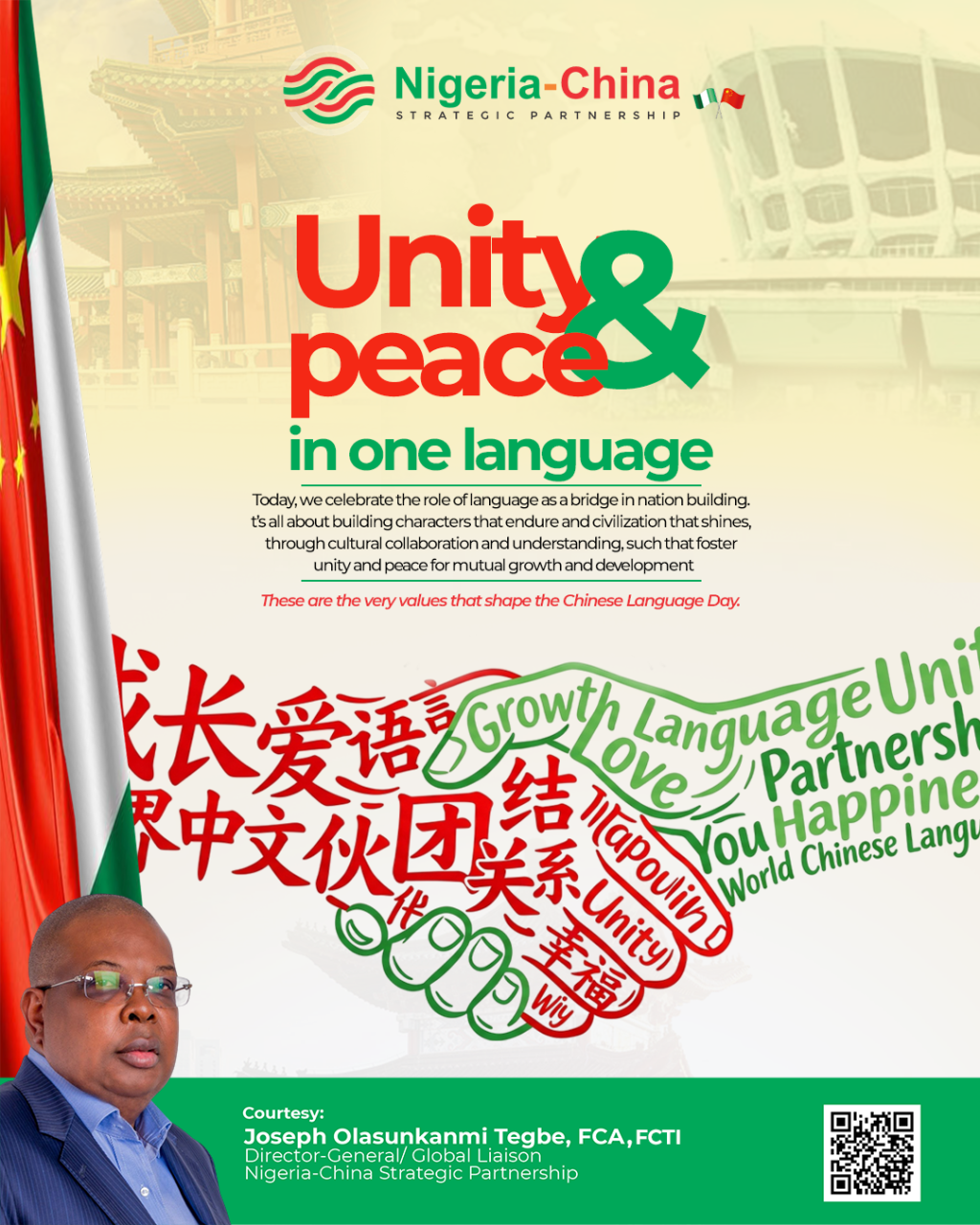
Why Language Matters in Today’s Economy
As the world marked Chinese Language Day 2026, the Nigeria–China Strategic Partnership (NCSP) emphasized that language is more than culture, it is a strategic tool for innovation, growth, and sustainable development. In a global economy where communication defines collaboration, NCSP is positioning cultural literacy as a foundation for Nigeria’s competitiveness.
Chinese Language Day: More Than a Celebration
Created by the United Nations in 2010 to promote multilingualism and cultural diversity, Chinese Language Day carries deep significance. This year’s theme, “Characters Endure, Civilization Shines,” highlights how language preserves heritage while enabling diplomacy. For NCSP, the observance is a reminder that language is infrastructure shaping institutions, partnerships, and economies.
Tegbe’s Perspective: Lessons in Discipline and Vision
In his statement, Joseph Olasunkanmi Tegbe, Director‑General of NCSP, described the Chinese language as a mirror of discipline, structure, and long‑term vision. These qualities, he noted, have powered China’s transformation and remain highly relevant to Nigeria’s development journey.
“Chinese characters are more than symbols; they embody history, discipline, and philosophy. For Nigeria, embracing structured learning including language is not optional; it is strategic,” Tegbe said.
By linking language to institutional development, Tegbe underscored the direct relationship between communication and nation building. Precision in language, he argued, translates into precision in planning, execution, and scaling of industrial systems.
Building Bridges Through Language
As Nigeria deepens ties with China, language and cultural literacy are becoming essential for collaboration in trade, technology transfer, and industrialisation. NCSP sees language as the bridge that allows Nigerian businesses to negotiate better, access markets more easily, and build trust with international partners.
What Nigeria Can Learn from China’s Model
Tegbe pointed out that China’s development story offers practical lessons for Nigerian enterprises:
1.Focus on core strengths instead of spreading resources thin.
2.Build scalable models that can grow across industries.
3.Drive incremental innovation within structured ecosystems.
4.Practice cost discipline and reinvestment for long‑term sustainability.
These lessons, he argued, can help Nigerian businesses strengthen resilience and align with global best practices.
NCSP’s Work Beyond Agreements
The NCSP stressed that its role goes beyond signing bilateral deals. Earlier this year, CSR Reporters highlighted NCSP’s talks with China Exim Bank and China Development Bank, underscoring the Partnership’s focus on financing and institutional collaboration. Its programs are designed to deliver real economic value by:
1.Supporting SMEs with training and market access.
2.Opening doors to Chinese markets, including zero‑tariff frameworks.
3.Promoting knowledge exchange in industrial clustering, technology transfer, and sustainable agriculture.
Equipping Entrepreneurs for Global Competition
Tegbe urged Nigerian entrepreneurs to adopt systems driven growth models, inspired by China’s emphasis on reinvestment and industrial clustering. He stressed that language is the entry point, but deeper understanding is the real advantage.
“Language is the entry point, but understanding is the advantage. As we strengthen Nigeria–China relations, we must equip our people especially young entrepreneurs with the tools to engage, compete, and collaborate effectively on a global scale,” he said.
By embedding cultural literacy into entrepreneurship, NCSP aims to cultivate a new generation of Nigerian business leaders who can thrive in international markets.
Language as Social Impact
From a CSR perspective, NCSP’s focus on language is about more than business. It delivers social value by:
1.Expanding education and capacity building.
2.Preserving cultural identity while embracing global collaboration.
3.Creating pathways for SMEs to join global trade.
4.Aligning growth with sustainable development goals.
Historical Context: Language in Global Partnerships
Around the world, language has often been the foundation of successful partnerships. The European Union’s multilingual framework, for example, has enabled smoother trade and policy alignment across diverse nations. Similarly, Japan’s investment in English literacy has supported its global technology exports. For Nigeria, embracing Chinese language education is part of a broader strategy to embed itself in global value chains.
Local Impact: Universities, SMEs, and Youth Engagement
Already, Nigerian universities like UNILAG are expanding Chinese language programs, while SMEs are beginning to see the benefits of cultural literacy in negotiations and market access. Youth initiatives supported by NCSP are equipping young Nigerians with language skills that open doors to scholarships, internships, and cross‑border collaborations. These efforts ensure that the benefits of the Nigeria–China partnership are not limited to large corporations but extend to communities and individuals.
Looking Ahead: The Next Decade of Nigeria–China Relations
Chinese Language Day 2026 is not just a commemoration; it is a strategic signal. Over the next decade, NCSP envisions a Nigeria where cultural literacy strengthens industrialisation, supports SME growth, and enhances global relevance. By embedding language into its CSR agenda, NCSP is laying the groundwork for a partnership that is not transactional but transformational.
Conclusion: Shared Growth, Shared Future
The NCSP closed by reaffirming its commitment to a structured, results‑driven partnership between Nigeria and China, built on mutual respect, shared growth, and long‑term value creation. By elevating language as a strategic driver, NCSP is not only strengthening bilateral ties but also laying the foundation for Nigeria’s sustainable economic future.