Nigeria CSR Impact Ranking 2026: 5 Questions Every Company Should Be Able To Answer About Its CSR Governance
 CSR Reporters Editorial Team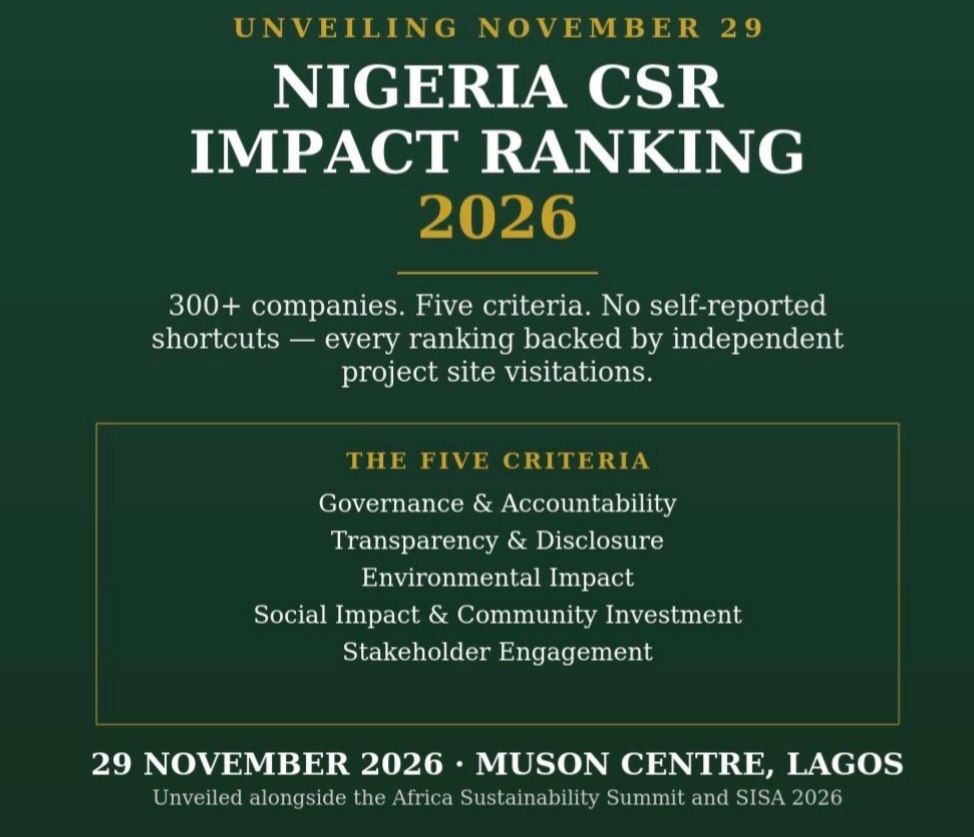
Nigeria CSR Impact Ranking 2026: 5 Questions Every Company Should Be Able To Answer About Its CSR Governance
Every year, thousands of companies publish sustainability reports, sponsor community projects, and announce CSR initiatives with confidence. Fewer can answer, under scrutiny, what any of it actually changed.
That gap — between the language of responsibility and the evidence of it — is the space CSR Reporters exists to close. It is not enough for a company to say it is governed responsibly, that it is transparent, that its environmental record is sound, that its community investment matters, or that it listens to stakeholders. Those are claims. Governance is what turns a claim into something that can be tested.
Below are five questions. They are simple to ask and, for most companies, surprisingly difficult to answer with evidence rather than adjectives.
1. What does good CSR governance look like?
Good governance is structural, not decorative. It means a board — not a communications team — owns sustainability oversight; that CSR spending is authorised, tracked, and auditable the same way capital expenditure is; and that a company can name who is accountable when a stated commitment is missed. A CSR policy without an accountable owner is a document, not a governance system.
Ranking pillar: Governance & Accountability
2. Can a company claim sustainability without transparency?
It can claim it. It cannot substantiate it. Sustainability without transparency is a narrative maintained by the company telling it. Disclosure against a named, recognised framework — and ideally independent assurance over that disclosure — is what allows an outside party to separate a genuine sustainability position from a well-written one. Absent that, “sustainable” is simply a word the company has chosen to use.
Ranking pillar: Transparency & Disclosure
3. What does environmental impact actually mean?
It means measured outcomes, not stated intentions. Emissions reduced against a baseline, waste diverted and verified, water usage tracked over time, remediation completed where harm occurred — these are impacts. Tree-planting counts, biodegradable packaging claims, and one-off clean-up events are activities, and activities are not evidence of impact unless they are measured, sustained, and reported honestly, including when the numbers are unflattering.
Ranking pillar: Environmental Impact
4. Is community investment creating measurable change?
Community investment is often reported by input — funds disbursed, projects launched, beneficiaries claimed. Impact is a different measurement: did the school stay open, did the clinic remain staffed, did the community’s own account of its situation change. Spend is not impact. A company that can only report what it gave, and not what changed because of it, has not yet answered this question.
Ranking pillar: Social Impact & Community Investment
5. Are companies actually listening to their stakeholders?
Listening is not the same as informing. A newsletter, a town hall, or a press statement moves information outward; it does not confirm that anything moved back. Genuine stakeholder engagement shows up in decisions that changed because a community, a regulator, an employee body, or an investor said something — and in a company’s willingness to disclose grievances raised against it, not only the ones it resolved quietly.
Ranking pillar: Stakeholder Engagement
These are the questions behind the Nigeria CSR Impact Ranking 2026.
They are not five separate concerns. They are one framework — five ways of asking a single question: when a company says it is responsible, what is the evidence, and who has checked it? The Nigeria CSR Impact Ranking was built to apply that framework consistently, independently, and at scale — across more than 300 companies, evaluated against these same five pillars, with independent project site visitations where claims can be tested against reality.
The unveiling is coming. The framework is already here.
[give_form id="20698"]