csrreporters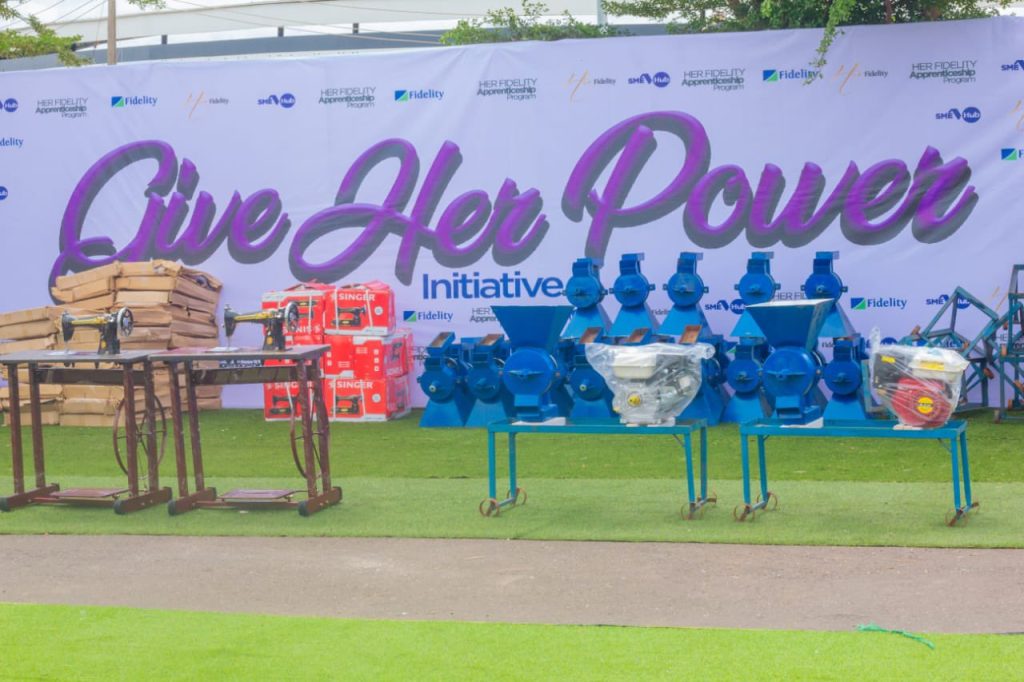
Image from @fidelitybankplc on X
Fidelity Bank’s “Give Her Power” initiative reached its third phase this week, expanding into underserved communities in Ikorodu, Lagos. Behind the headline lies a programme architecture that most Nigerian banks have yet to attempt.
A Programme Built Around Tangible Delivery
On April 29, 2026, Fidelity Bank extended its flagship women empowerment programme, “Give Her Power,” into Ikorodu, Lagos State. The outreach was the third phase of a nationwide rollout. Beneficiaries drawn from Ikorodu Central, Ikorodu West, and Ikorodu North received vocational tools, including sewing machines, grinding machines, and business support resources. The event represented the latest step in a programme that launched formally on March 5, 2026, coinciding with International Women’s Day, and has been expanding methodically since.
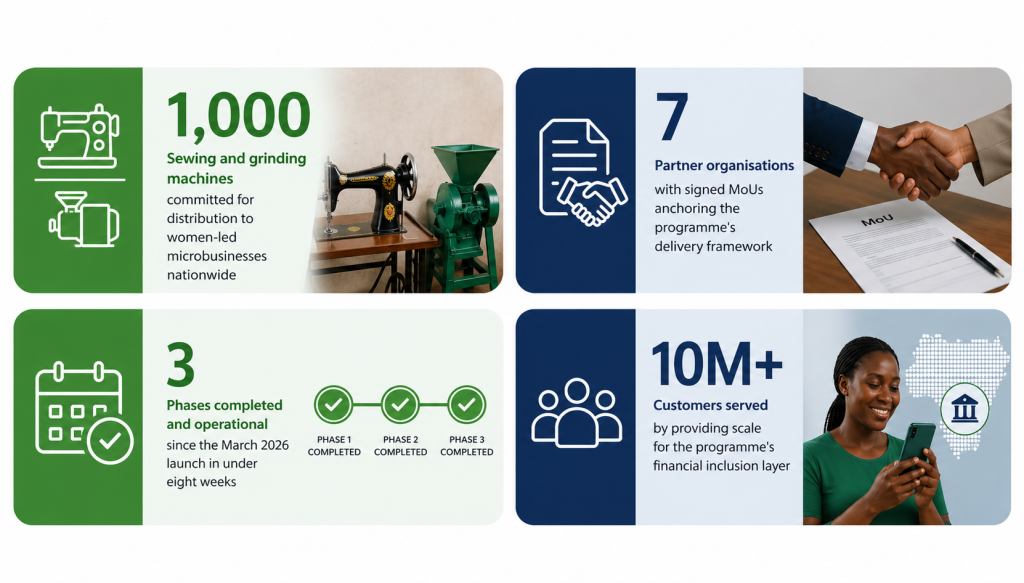
What makes this notable in Nigeria’s CSR landscape is not the act of distributing machines. It is the architecture surrounding that act. The “Give Her Power” initiative operates through the bank’s HerFidelity Apprenticeship Programme, a structured platform designed to deliver vocational training, mentorship, business support, and enterprise development. It is anchored by formal Memoranda of Understanding with seven partner organizations spanning hair care, barbering, shoemaking, construction training, automobile manufacturing, credit guaranty, and business development. That partner ecosystem is not incidental. It is the delivery mechanism that separates this initiative from a one-day outreach event.
The Design Philosophy: Beyond Symbolic Gestures
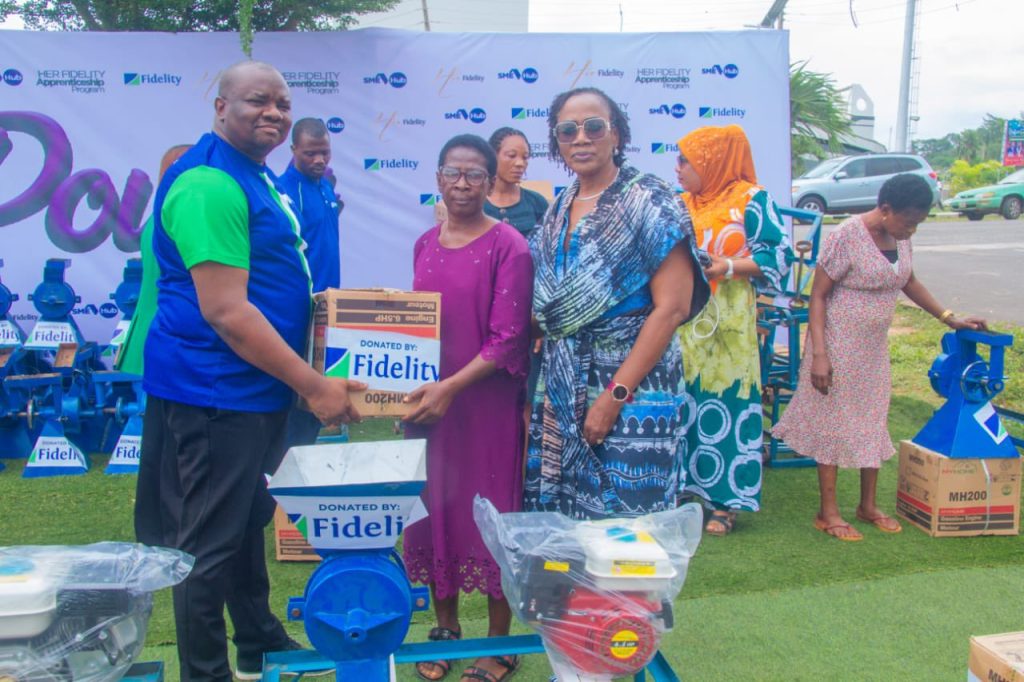
The “Give Her Power” initiative covers a deliberately broad range of interventions. Alongside physical tool distribution, the programme delivers vocational training in automobile mechanics, interior decoration, barbing, hair styling, and shoemaking.
Additionally, it includes professional development sessions in public speaking and personal branding. Mentorship engagements with established female entrepreneurs form a further strand. Therefore, the programme treats women’s empowerment not as a single transaction but as a pipeline with multiple entry points.
Notably, the initiative reaches into communities that mainstream banking programmes rarely prioritize. Ikorodu, for instance, is a densely populated area on Lagos’s northeastern fringe. It is home to millions of low-income residents who generate significant informal economic activity but are consistently underserved by formal financial and corporate institutions.
Furthermore, the programme’s design ensures that participation does not require prior banking relationships or formal employment. Consequently, it reaches women who sit furthest from conventional empowerment pathways.
“Empowering women economically is not only a social responsibility. It is a powerful economic strategy with ripple effects across families, communities, and the national economy.”
A Phased Rollout That Signals Long-Term Intent
The initiative’s three-phase structure within its first eight weeks of existence is itself a meaningful signal. Many Nigerian corporate CSR programmes launch with a single high-visibility event and do not proceed further. In contrast, Fidelity Bank has sequenced its rollout with increasing geographic reach, moving from Lagos Island to Ikorodu and signaling future expansion into the South-East, South-South, and Northern Nigeria.
Phase 1
Programme launch and MoU signing at bank headquarters, Lagos; formal partnerships established; 1,000 machines committed to distribution across Nigeria.
Phase 2
Skills and Support Series deployed throughout March 2026; training sessions across Lagos covering vocational and professional development; mentorship activations.
Phase 3
Ikorodu community outreach, April 29, 2026; distribution of sewing and grinding machines to beneficiaries from three Ikorodu local government areas; government officials in attendance.
The presence of Lagos State commissioners for both Women Affairs and Commerce at the launch further reinforces the programme’s credibility. Government endorsement of this kind signals alignment with broader public policy rather than isolated corporate goodwill. Moreover, it creates a degree of institutional accountability that self-reported CSR programmes typically lack.
The ESG Case for Women’s Economic Inclusion
The “Give Her Power” initiative addresses one of the most persistent structural gaps in Nigeria’s development agenda. Women represent approximately 49 percent of Nigeria’s population. However, they account for a disproportionately small share of formal credit access, vocational skills support, and enterprise financing.
The World Bank and various multilateral bodies have repeatedly cited women’s financial exclusion as a primary constraint on Nigerian economic growth. Therefore, a bank that deliberately designs programmes to close this gap is doing more than good optics. It is addressing a systemic ESG risk in its own lending and customer ecosystem.
The initiative also aligns cleanly with SDG 5 on gender equality, SDG 8 on decent work and economic growth, and SDG 10 on reduced inequalities. Importantly, those alignments are not incidental to the programme’s design. The vocational training components directly build earning capacity. The machine distribution creates productive assets. The mentorship layer builds long-term entrepreneurial resilience. Each strand serves a measurable development objective.
The Challenges That Deserve Honest Scrutiny
Nevertheless, several legitimate questions surround the programme at this stage. The initiative is still new. Its long-term monitoring framework has not been publicly disclosed. Outcome data, specifically income changes for beneficiaries and business survival rates, are not yet available.
Furthermore, the commitment to reach underserved regions in the North and South-South raises execution questions. These are geographically and logistically complex territories. Replicating the Ikorodu model in them will require sustained investment, not a single outreach event.
Additionally, the programme’s current reach, while meaningful, remains modest relative to Nigeria’s scale of women’s economic exclusion. Thirty beneficiaries per community phase cannot, by itself, shift systemic inequality. However, if the bank honours its stated nationwide expansion, maintains its partnership infrastructure, and publishes outcome data annually, the programme could evolve into one of the more credible women’s empowerment platforms in Nigerian banking.
Why It Merits Attention Now
Fidelity Bank’s “Give Her Power” initiative earns this week’s recognition not because it has already delivered transformative scale, but because its structural design is more serious than what most Nigerian corporate CSR programmes attempt.
It has a named programme with a formal platform beneath it. The programme has signed partner agreements rather than informal collaborations. It has a phased geographic rollout rather than a single-city event. It has government engagement that creates policy alignment. Furthermore, it expanded its reach this week, making it a live, active programme rather than a quarterly press release.
In a market where CSR too often means a cheque presented at a charity gala, Fidelity Bank is attempting something more durable. Whether the programme delivers on its ambitions depends entirely on whether the bank commits to publishing outcomes with the same energy it commits to publishing launches. That, ultimately, is the test that separates structured ESG investment from well-intentioned spectacle.
Want your impact to be seen and ranked? Submit your CSR projects to CSR Reporters Nigeria CSR Impact Ranking 2026 and get recognized for the difference you’re making across communities.
[give_form id="20698"]