csrreporters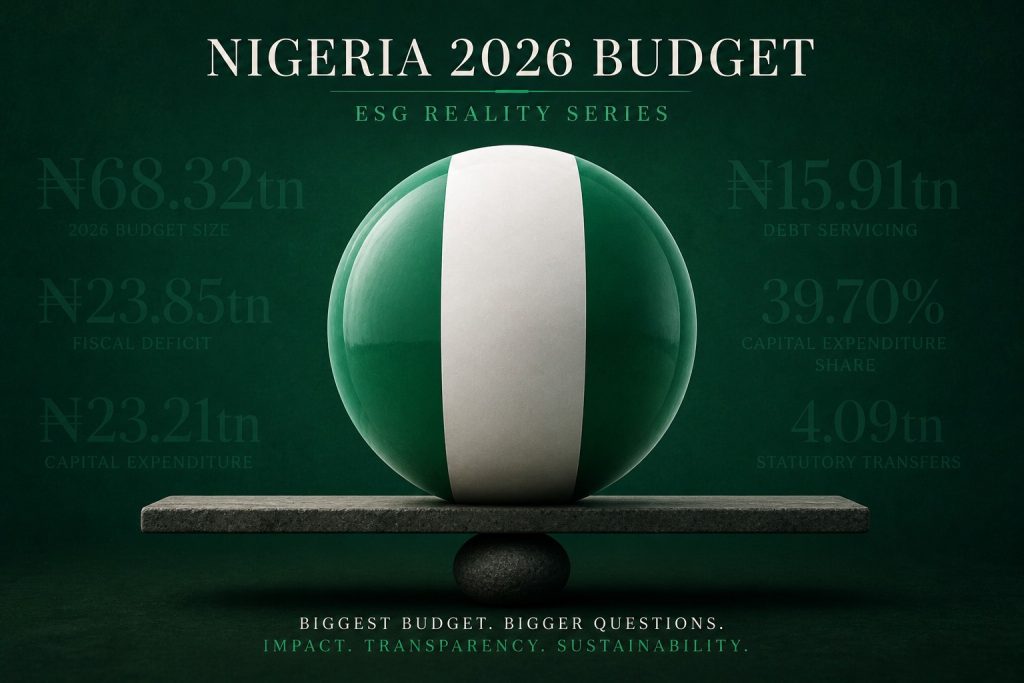
As ₦15.8 trillion disappears into debt servicing, the real cost is measured not in naira but in schools unbuilt, clinics unstaffed, and a sustainability future deferred.
Nigeria’s numbers tell a story that demands attention. President Bola Ahmed Tinubu signed the 2026 Appropriation Bill into law on April 17, 2026, formalising the largest budget in Nigeria’s history at ₦68.32 trillion. Embedded within that figure, however, is a detail that deserves far more scrutiny than it has received: ₦15.8 trillion earmarked for debt servicing alone.
This is the third installment in CSR Reporters’ ongoing ESG analysis of the 2026 budget. In previous articles, CSR Reporters examined the broad ESG implications of the budget’s overall structure, and then followed with a detailed look at how revenue projection failures undermine sustainability and governance. Now, this analysis turns to the question that underpins both: what does an ever-expanding debt burden mean for Nigeria’s long-term development, its sustainability credibility, and its governance standing?
The answer, as CSR Reporters’ review of the 2026 budget shows, is deeply unsettling.
Nigeria’s Growing Debt Reality
According to an analysis by CSR Reporters, Nigeria’s debt servicing obligations have grown sharply over the past five years, consuming a disproportionate share of public resources. Out of a total budget of ₦68.32 trillion, ₦15.8 trillion goes directly to debt servicing, while ₦32.2 trillion is allocated for capital expenditure. On paper, that ratio looks manageable. In practice, however, the pressure is mounting fast.
Total public debt already stood at ₦159.28 trillion as of early 2026. Furthermore, a record deficit of ₦23.85 trillion means the Federal Government will largely finance this year’s budget with fresh borrowing. Each naira borrowed today becomes a future debt repayment, tightening the fiscal space available for actual development.
Meanwhile, the Federal Government is in advanced talks with the World Bank for a fresh $1.25 billion loan facility, titled ‘Nigeria Actions for Investment and Jobs Acceleration.’ If approved by the World Bank Board on June 26, 2026, it will become the second-largest single World Bank loan secured under President Tinubu, behind only the $1.5 billion facility approved in June 2024. According to recent reports, Nigeria’s World Bank exposure climbed to $19.89 billion as of December 2025, an 11.7 percent increase in just one year. Since June 2023, the Tinubu administration has secured approximately $9.35 billion in World Bank approvals across multiple sectors.
Government officials argue that external financing remains necessary to sustain reforms and drive development spending. Critics, however, are asking harder questions about whether this pace of borrowing is sustainable, or whether it simply defers a much harder reckoning.
Why Debt Is Now an ESG Issue
For a long time, Nigeria’s debt conversation stayed inside fiscal policy circles. That era is over. Rising debt is no longer just a balance sheet problem; it is an ESG and sustainability crisis in the making.
In a study accessed by CSR Reporters, the Nigerian Economic Summit Group warned that Nigeria’s Debt Burden Index remained elevated throughout 2025, fluctuating within what the group described as a ‘high-risk fiscal band.’ The index declined slightly from 83.6 points in 2023 to 70.9 points in 2024, but the NESG noted that the improvement reflected temporary easing rather than genuine structural strengthening. Their conclusion was pointed: Nigeria has not yet made a decisive shift toward debt sustainability.
ESG frameworks evaluate governments and economies on three interconnected dimensions: environmental stewardship, social responsibility, and governance quality. When debt servicing consumes a growing share of public revenue, all three dimensions suffer. Climate investment stalls, social programmes weaken, and governance credibility erodes. That is not a future risk; it is Nigeria’s present reality.
Governance and Fiscal Credibility Concerns
Sound governance demands fiscal discipline. It also requires transparency about how money is borrowed, how it is spent, and how it will be repaid. Earlier analyses by CSR Reporters highlighted a persistent pattern in Nigeria’s budgeting: revenue projections consistently overshoot actual performance. In eight of the last nine years, actual revenue fell short of approved targets, sometimes by as much as half.
Read: The Revenue Shortfall Problem in The 2026 Budget
That credibility gap matters enormously in ESG evaluations. When a government projects ₦33.19 trillion in revenue while carrying a ₦23.85 trillion deficit, and simultaneously pursues fresh multilateral loans, institutional investors and development finance partners take notice. Debt transparency becomes a governance issue. So does the growing dependence on multilateral financing as a structural feature of the budget rather than an occasional supplement.
Experts that CSR Reporters spoke to, warn that excessive foreign borrowing could increase pressure on Nigeria’s foreign reserves and exchange rate stability. Loan-funded projects must directly contribute to economic productivity and repayment capacity. Otherwise, Nigeria risks borrowing to service existing debts rather than to generate new national value.
Social Costs of Rising Debt Repayments
The cost of Nigeria’s debt burden does not fall on spreadsheets. It falls on people.
CSR Reporters’ review of the 2026 budget shows that while debt servicing claims ₦15.8 trillion, allocations for health and education remain thin against the scale of national need. Nigeria’s public health system struggles with chronic underfunding. Millions of children remain out of school. Poverty reduction efforts require sustained investment, yet fiscal space keeps shrinking under the weight of debt obligations.

When a government spends more on servicing debt than on educating or healing its citizens, ordinary Nigerians absorb the consequences. Declining public services, rising unemployment, and widening inequality are not abstract outcomes. They are the direct downstream effects of fiscal choices that prioritise debt obligations over human development.
The social dimension of ESG is fundamentally about people. That means healthcare, education, poverty reduction, and employment are not just development metrics; they are ESG metrics. Nigeria’s growing debt burden makes all four harder to deliver and even harder to sustain.
Sustainability and Infrastructure Trade-offs
One of the clearest casualties of debt pressure is Nigeria’s climate financing capacity. According to recent reports, Nigeria’s environment ministry received only a fraction of the total capital expenditure in the 2026 budget. The result is climate-related projects funded at levels that analysts consider inadequate for a country battling severe desertification, flooding, and deepening food insecurity.
Sustainability requires fiscal breathing room. Countries that want to attract green finance, meet climate commitments, or build resilient infrastructure need the ability to allocate resources predictably. That capacity diminishes steadily when debt repayments crowd out everything else.
In a study accessed by CSR Reporters, analysts flagged that Nigeria’s climate adaptation capacity remains severely constrained by fiscal fragility. Infrastructure investment, though nominally at ₦32.2 trillion in capital expenditure, faces implementation risks when revenue underperforms and deficit financing expands. Projects stall. Contractors go unpaid. Communities wait. Meanwhile, climate change does not wait for anyone.
Investor Confidence and ESG Implications
International investors increasingly use ESG frameworks to assess sovereign and market risk. For Nigeria, the trajectory is concerning. Governance scores reflect how well institutions manage public resources. Social scores reflect outcomes for citizens. Environmental scores reflect whether sustainability is more than carefully worded rhetoric.
All three dimensions face pressure from Nigeria’s current fiscal trajectory. Debt sustainability concerns are growing among analysts and the public alike, and the fresh World Bank loan discussions have only intensified that conversation. Investors are watching closely whether the Tinubu administration can generate enough revenue to reduce its dependence on external debt, while sustaining the reforms already underway.
Fiscal instability also affects domestic business confidence directly. Companies operating in Nigeria factor sovereign risk into every investment decision they make. Rising debt levels, currency volatility, and uncertain reform timelines all raise that risk premium. Consequently, the ESG and fiscal conversations are no longer separate; they are the same conversation.
Why the Private Sector Matters More Now
As government capacity to fund social and environmental investment weakens, the private sector increasingly fills critical gaps. In practice, that means more companies are stepping into education, healthcare, and environmental programmes that government should ideally lead and finance.
Corporate social responsibility is evolving rapidly in this context. CSR is no longer purely philanthropic; it is becoming structurally necessary. Public-private partnerships are expanding not just because they make economic sense but because fiscal pressure leaves government with few alternatives. The rise of ESG-driven investing accelerates this trend further, with institutional investors requiring evidence that companies operating in Nigeria are managing both their own sustainability risks and the development gaps their communities face.
In previous articles, CSR Reporters examined how Nigeria’s fiscal vulnerabilities create conditions where corporate sustainability leadership becomes a form of national infrastructure. That analysis holds, and deepens, as the debt burden grows heavier. The private sector is not stepping up out of generosity alone. It is responding to a structural reality that fiscal overstretch has created.
Debt, Destiny, and the Path Forward
Can Nigeria build a sustainable future while debt repayments consume a growing share of public resources? That is the defining question of this budget cycle, and the honest answer is: not easily.
The 2026 budget is historic in size. The ambition it reflects is genuine. Yet ambition without fiscal sustainability is fragile. Debt is no longer just a finance ministry problem; it is a threat to Nigeria’s ESG standing, its governance credibility, its social development capacity, and its environmental commitments.
The fresh World Bank loan talks, the record deficit, and the persistent revenue underperformance all point in the same direction. Nigeria stands at a crossroads. The country can either build the fiscal discipline needed to fund its own development or continue borrowing to service existing borrowing. One path leads to resilience. The other leads somewhere Nigerians, ordinary and otherwise, cannot afford to go.
Recently, the NESG has warned that Nigeria remains in a high-risk fiscal environment despite apparent stabilisation in conventional indicators. That warning carries weight. It should carry urgency too.
[give_form id="20698"]