CHUKS OLUIGBO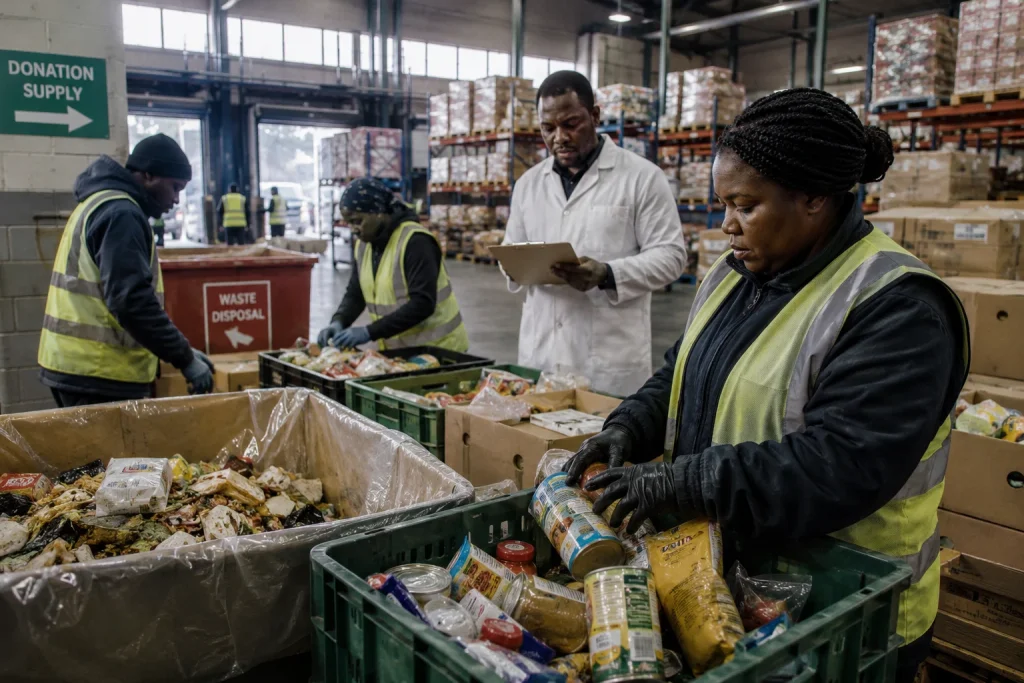
Photo credit: ESG Now Digital
The South African Bureau of Standards (SABS) has unveiled a draft framework aimed at tackling the country’s food waste crisis, indicating that the country is starting to rethink how it defines food safety, food quality, and waste, ESG Now reports.
The draft framework comes amid the loss or waste of more than 10 million tonnes of largely edible food every year in South Africa despite 63.5 per cent of households being food-insecure, according to FoodForward SA.
Statistics South Africa’s General Household Survey shows high levels of food insecurity in the country, with approximately 2.1 million households (11.6 per cent) reporting episodes of hunger and around 2.6 million households (15 per cent) experiencing inadequate access to food in 2021.
The SANS 2088, South Africa’s first national standard for food donation and redistribution, is the first serious attempt to change that.
The draft, published in April 2026, was open for public comment until 16 June 2026, leaving stakeholders only a narrow window to influence what has been described as one of the most significant proposed overhauls of South Africa’s food labelling system in years.
Where the Confusion Lies
The draft argues that a significant portion of the food waste is not the result of physical deterioration but of regulatory ambiguity and consumer misunderstanding, especially around “best before” dates.
According to the framework outlined in the draft published, “best before” labeling has increasingly been treated by both retailers and consumers as a strict safety cutoff, rather than an indicator of peak quality. This interpretation, the SABS warns, has contributed to unnecessary destruction of food that remains safe for consumption. In contrast, “use by” dates are intended to signal genuine safety risks, yet the distinction between the two remains poorly communicated across the system.
Varying Sets of Requirements for Food Donors
Before the standard was introduced, food donors operated under varying sets of requirements, leading to uneven and inconsistent practices across the sector.
Divisional Head of Standards at SABS, Dr. Sadhvir Bissoon, noted that the standard is not mandatory, and compliance is voluntary, with no current formal discussions underway to make it legally binding.
The standard aims to “support a more structured, consistent and effective approach to food donation and redistribution across South Africa,” according to Bissoon.
Andy du Plessis, Managing Director of FoodForward SA, one of the organisations that spent years advocating for the standard, also emphasised uneven and inconsistent practices by food donors before the standard.
“Industry partners were not clear on what can be donated or how to navigate date labelling issues,” said Du Plessis.
SABS officials argue that retailers seeking to avoid liability and reputational risk often resort to conservative disposal policies. Manufacturers similarly build waste into their forecasting models, while redistribution networks struggle to recover surplus food at scale due to inconsistent standards and logistical gaps. The result is a system where food that could have been consumed is instead redirected to landfill.
Draft Framework Seeks Harmonised Guidance
The draft plan proposes a recalibration of national standards, with a stronger emphasis on harmonised guidance for manufacturers, retailers, and consumers.
Importantly, this approach seeks a clearer legal and technical distinction between quality-based and safety-based labelling. By standardising interpretation, the SABS aims to reduce the over-application of precautionary disposal practices that currently remove edible food from circulation. The framework also places renewed emphasis on food redistribution systems, encouraging structured donation pathways for surplus stock that remains safe for consumption.
What Led to the Standard
The standard did not emerge as a government-driven initiative, but instead originated from a proposal put forward by FoodForward SA. Du Plessis first engaged SABS in June 2023, presenting research on food loss, waste, and food insecurity to build the case for a dedicated national standard.
In October 2023, a vote among industry stakeholders resulted in unanimous support for the proposal. The technical committee responsible for developing the standard over subsequent months included 14 participating members, among them FoodForward SA, the Harvard Law School Food Law and Policy Clinic, the Consumer Goods Council of South Africa, Woolworths, Famous Brands, and the National Consumer Commission.
What’s Changing, What’s Not
FoodForward SA reported that it was already observing a 17 percent year-on-year rise in food donations, as supply chain partners involved in consultations began increasing contributions of short-dated stock ahead of the standard’s formal publication. Du Plessis estimates that the framework could ultimately unlock as much as one million tonnes of surplus food for redistribution.
However, the SABS draft acknowledges that logistical limitations, storage constraints, and regulatory uncertainty continue to limit the scale of such interventions. The SABS position reflects growing recognition that regulatory frameworks originally designed to protect consumers may, in practice, be contributing to avoidable environmental and economic loss.
[give_form id="20698"]