State Launches Free Fertilizer and Tractor Support for 150,000 Farmers in Major Food Security Drive
 ONYINYECHI NWAIGBA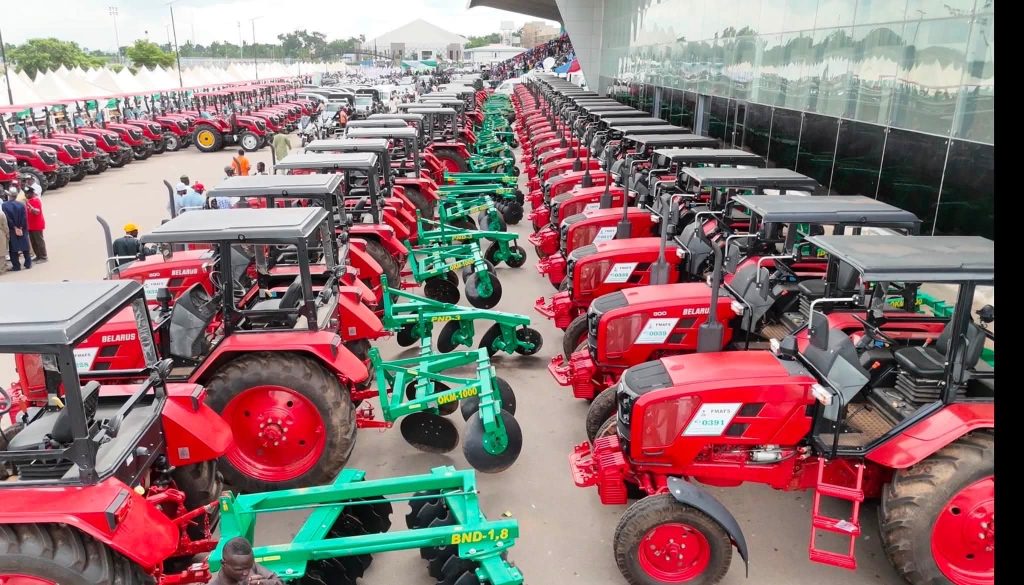
Kaduna State has launched one of its most ambitious agricultural support programs yet, beginning the distribution of free fertilizer and tractors to 150,000 smallholder farmers across all 23 local government areas.
The initiative, unveiled by Governor Uba Sani in Kaduna, is part of a broader effort to strengthen food production, reduce the financial burden on farmers, and build a more resilient agricultural sector. While fertiliser distribution has become a familiar intervention in many parts of Nigeria, the scale of Kaduna’s programme, coupled with its long-term investments in mechanisation, irrigation, financing and agricultural infrastructure, signals a strategy that extends beyond seasonal support.
For many smallholder farmers, the cost of agricultural inputs has become one of the biggest barriers to productivity. A bag of fertiliser currently sells for about ₦56,000, placing it beyond the reach of thousands of rural farmers already grappling with rising production costs.
Governor Sani explained that the state deliberately chose to distribute the fertiliser free of charge rather than offer it at a subsidised price.
According to him, even a subsidised cost of ₦20,000 per bag would remain unaffordable for many farmers. He also noted that selling fertiliser at a reduced price could create opportunities for diversion by middlemen, preventing the intended beneficiaries from accessing the support.
The program marks the third consecutive year Kaduna State has provided free fertilizer to farmers.
In 2025, the government distributed 400 trucks of fertiliser to support about 100,000 farmers following similar interventions carried out during both the wet and dry farming seasons in 2024. This year’s expansion to 500 trucks and 150,000 beneficiaries reflects the state’s growing investment in agriculture as a driver of economic development.
Agriculture remains one of Kaduna State’s most important economic sectors.
According to the governor, the sector contributes about 43 per cent of the state’s Gross Domestic Product (GDP) and provides employment for between 60 and 80 per cent of the workforce. These figures highlight agriculture’s central role not only in feeding communities but also in sustaining livelihoods and supporting the state’s economy.
Beyond input distribution, Kaduna says it is investing across the entire agricultural value chain to improve productivity and strengthen resilience.
The government has increased funding for agriculture significantly over the past three years. Budgetary allocation to the sector rose from ₦1.48 billion in 2023 to ₦74.02 billion in 2025, while more than ₦100 billion has been proposed for agriculture in the 2026 budget.
The investment covers improved seeds, mechanisation, irrigation infrastructure, extension services, agricultural financing and crop insurance for more than 100,000 farmers.
These interventions are designed to tackle some of the structural challenges that continue to limit agricultural productivity across Nigeria. Access to quality seeds, modern equipment, technical knowledge and financial protection remains limited for many smallholder farmers, leaving them vulnerable to climate risks, rising production costs and fluctuating market conditions.
Mechanisation, in particular, has become increasingly important as states seek to improve efficiency and reduce dependence on manual farming practices. Access to tractors and modern equipment can help farmers cultivate larger areas of land, reduce labour costs and improve harvest yields.
The programme also comes at a time when improving security has begun to restore farming activities in parts of Kaduna that were previously affected by insecurity.
Governor Sani disclosed that improved security across the state has enabled farmers to reclaim more than 5,000 hectares of abandoned farmland.
For years, insecurity disrupted agricultural activities in several farming communities, forcing many farmers to leave their land uncultivated. Restoring access to these farmlands not only increases food production but also helps revive rural economies that depend heavily on agriculture.
Kaduna’s agricultural strategy also extends beyond production to processing and market competitiveness.
The state is implementing a Special Agro-Industrial Processing Zone in partnership with the Federal Government and the African Development Bank. The initiative aims to strengthen agricultural value chains by improving processing capacity, reducing post-harvest losses and creating opportunities for agro-industrial development.
In addition, Kaduna is establishing the Africa Quality Assurance Centre, an initiative expected to improve the quality and competitiveness of agricultural products traded under the African Continental Free Trade Area (AfCFTA).
Quality assurance has become increasingly important as African countries seek to expand intra-African trade. Meeting regional quality standards can help farmers and agribusinesses access larger markets while increasing the value of locally produced goods.
The Kaduna initiative reflects a growing recognition that improving food security requires more than increasing food production alone. It demands investments that address affordability, productivity, infrastructure, financing, security and market access simultaneously.
Across Nigeria, rising food prices continue to place pressure on households, while farmers face increasing costs associated with fertiliser, transportation, labour and climate-related risks. Supporting smallholder farmers who produce a significant share of the country’s food—remains one of the most practical pathways toward strengthening national food security.
The programme also aligns with several Sustainable Development Goals (SDGs), including SDG 1 (No Poverty), SDG 2 (Zero Hunger), SDG 8 (Decent Work and Economic Growth), and SDG 13 (Climate Action) through investments that promote resilient agricultural systems and sustainable rural livelihoods.
As Kaduna expands its agricultural investment, the effectiveness of the program will ultimately depend on transparent distribution, timely implementation and measurable outcomes for the farmers it is intended to serve.
If successfully implemented, the initiative could not only improve productivity for thousands of farmers but also offer lessons for how state governments can combine targeted support with long-term agricultural development strategies to build stronger, more resilient food systems.
[give_form id="20698"]