THE $63 BILLION EXIT: As Western Aid Collapses, Can African Corporations Step Into the Breach — Or Are They Still Playing at CSR?
 csrreporters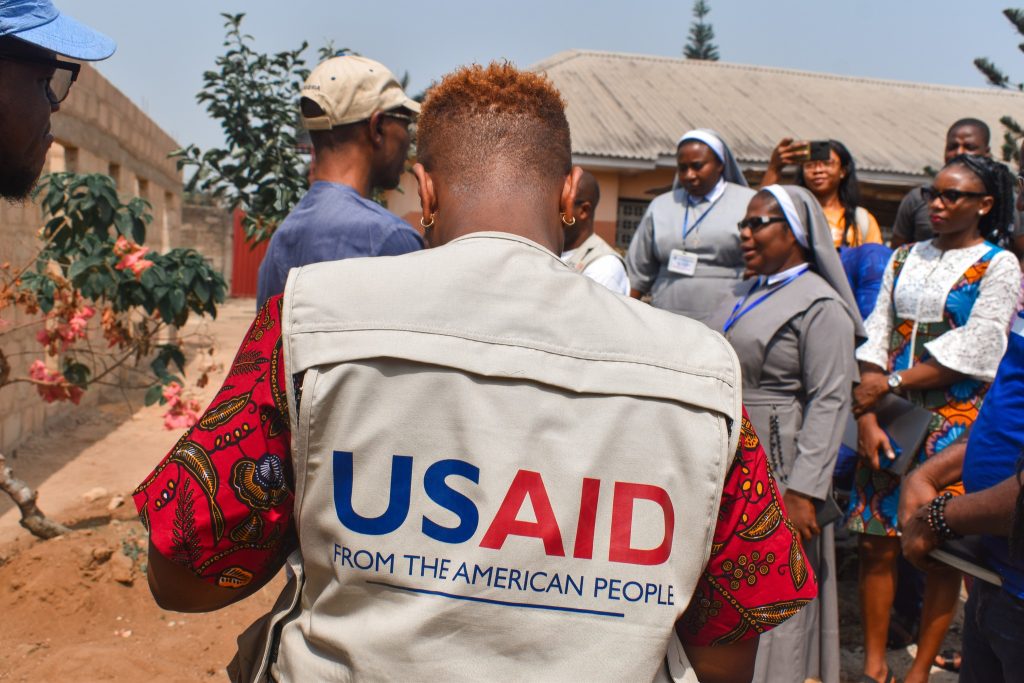
THE $63 BILLION EXIT: As Western Aid Collapses, Can African Corporations Step Into the Breach — Or Are They Still Playing at CSR?
By CSR Reporters Editorial Team
In 2024, the United States contributed approximately $63 billion in official development assistance — making it the single largest provider of humanitarian aid on the planet, responsible for funding nearly half of the entire global humanitarian appeal. By 2025, that figure had been cut to just under $29 billion. A 57 percent reduction in a single year.
This was not a budget adjustment. It was a structural rupture.
The dismantling of the U.S. Agency for International Development (USAID) — followed by sympathetic cuts from the United Kingdom, Germany, Canada, and others — has triggered what the OECD now describes as a historic collapse in global development financing. For Africa, a continent disproportionately dependent on external humanitarian architecture, the consequences are not abstract projections. They are already being counted in clinic closures, food ration cuts, and disease surveillance gaps that stretch from the Sahel to the Great Lakes.
And in the middle of this crisis, a question that African corporate leaders have not been forced to answer — until now — sits waiting:
If the architecture of external benevolence is collapsing, what does the African private sector actually owe the continent it profits from?
THE SCALE OF THE COLLAPSE
The numbers are arresting. According to preliminary OECD data, international development aid from member nations declined by approximately 23 percent from 2024 to 2025. The United States, which once anchored the system, drove much of that decline. The UN’s Office for the Coordination of Humanitarian Affairs (OCHA) reports that in 2025, humanitarian responders faced a shortfall exceeding $3 billion even after prioritising only the most critical needs.
14M+ projected deaths by 2030 linked to USAID dismantling, per expert estimates (including 4M+ children under 5)
57% drop in US foreign aid from 2024 to 2025 — from $63B to under $29B
20% projected reduction in UNICEF’s 2026 budget compared to 2024
In East and West Africa, the consequences are direct and documented. In Uganda, the UN suspended food assistance for one million refugees and cut general food rations by up to 80 percent. In Kenya, the minimum food basket was reduced by 40 percent for nearly 800,000 refugees — triggering unrest in camps and documented deaths. In the Democratic Republic of Congo, cholera deaths increased by 361 percent between 2024 and 2025 as the collapse of US-funded health infrastructure stalled outbreak response.
Nigeria is not insulated. West Africa’s disease surveillance network — long underwritten by US global health programs — now operates with significantly depleted capacity. The ongoing Ebola outbreak in the DRC has exposed precisely how quickly health security gaps spread when American funding disappears. USAID teams with institutional knowledge of outbreak management have been disbanded. Their successors, if any, are still being assembled.
THE AID-DEPENDENCY PARADOX
Africa’s development trajectory has been shaped — and distorted — by decades of dependence on external humanitarian finance. This is not a controversial observation; it is a structural reality that African leaders, civil society actors, and development economists have acknowledged for years. What is new is the speed with which that external floor has been pulled away.
For Nigerian corporations in particular, the aid-dependency debate has historically been someone else’s conversation. Nigeria’s private sector — its banks, telecoms giants, conglomerates, and oil majors — has operated in a development ecosystem where government and international donors were presumed to be the default providers of social infrastructure. Corporate CSR, in this context, was supplementary: a scholarship here, a borehole there, a hospital wing with a company logo on the door.
The world has shifted. Supplementary CSR was designed for a world where someone else was doing the heavy lifting. That world no longer exists.
The Global Humanitarian Overview 2026 published by OCHA is explicit in its assessment: 239 million people worldwide need humanitarian assistance, needs are accelerating, and the resources available for principled humanitarian response are under acute strain. UNICEF has projected its 2026 budget to shrink by at least 20 percent compared to 2024. The UN’s $4 trillion SDG financing gap — the shortfall between what is needed and what is committed to achieve the Sustainable Development Goals by 2030 — now falls disproportionately on the shoulders of actors who have not historically been asked to carry it.
Policymakers and development specialists increasingly point to the private sector as the necessary bridge. But the private sector alone cannot fill a $4 trillion gap through philanthropy. The question is whether African corporations are prepared to move from charity to architecture — from one-off giving to structural investment in social resilience.
WHAT AFRICAN CORPORATIONS ARE — AND ARE NOT — DOING
To be clear: the Nigerian and broader African private sector is not inactive on social investment. Nigeria’s largest companies collectively spend billions of naira annually on community development, education, healthcare, and environmental initiatives. The SEPLAT Foundation, the Access Bank Plc sustainability framework, MTN Nigeria’s investment in digital inclusion, and Dangote Foundation’s nutrition and emergency response programs represent genuine commitments that should be acknowledged.
But genuine commitment and structural adequacy are two different things.
The dominant model of Nigerian corporate social responsibility remains reactive, project-based, and reputationally motivated. Companies give in response to visibility opportunities — a national disaster, a government directive, a regulatory expectation. They rarely give in response to systemic need that carries no reputational dividend. And they almost never give in ways that build institutional capacity independent of their own brand.
The European Commission — the world’s largest humanitarian donor — has acknowledged this moment of reckoning directly. At Davos in January 2026, Commissioner Hadja Lahbib convened a forum with the World Economic Forum titled ‘New Alliances in Aid and Development,’ stating explicitly: ‘The humanitarian system is under unprecedented strain, and public funding alone will not meet the scale of the crisis.’ The EU is actively mobilising private sector finance and innovation as complements to public funding.
African corporate actors have not had this conversation at scale. There is no continental equivalent of that Davos table. There is no coordinated African private sector humanitarian financing framework. There is no corporate commitment architecture that positions Nigerian or African companies as systemic responders rather than periodic donors.
Nigeria’s largest companies collectively hold the financial capacity to transform humanitarian response in West Africa. The question is whether they have the institutional will.
THE CASE FOR STRUCTURAL CORPORATE RESPONSIBILITY
This is not an argument for corporate heroism. It is an argument for enlightened self-interest grounded in accountability.
African corporations — particularly in Nigeria — operate in environments where social instability, public health collapse, food insecurity, and institutional failure are not distant risks. They are proximate business risks. The collapse of health surveillance in West Africa is a supply chain risk. The erosion of food security is a workforce productivity risk. The breakdown of social cohesion is a security and operating environment risk.
Every major Nigerian bank with a retail footprint in the north is exposed to the consequences of humanitarian failure in the Lake Chad Basin. Every manufacturer dependent on labour markets in the south-south is exposed to the long-term effects of nutrition insecurity. Every telecom company building out rural infrastructure is operating in communities whose resilience — or lack of it — is directly shaped by the withdrawal of international social investment.
The argument for structural corporate responsibility is, at its core, an argument for corporations to finally read their own risk registers honestly.
Beyond self-interest, there is a simpler accountability argument. Nigerian corporations extract value from communities, ecosystems, and labour forces across the continent. The social licence to do so — even when it is not formally articulated — has always been implicitly contingent on some form of reciprocal investment in the communities that make that extraction possible. As external humanitarian actors withdraw, the implicit social contract between the African private sector and African society becomes more visible, and more demanding.
WHAT RESPONSIBLE LEADERSHIP REQUIRES NOW
The ICRC’s Humanitarian Outlook 2026 warns of four converging trends pushing the world toward deeper instability and human suffering — and identifies a stark paradox: as needs rise rapidly, the resources available for principled humanitarian action are shrinking. For African corporate leaders reading this moment correctly, that paradox defines the strategic environment in which they will operate for the rest of this decade.
The question is not whether to respond. The question is whether corporations will respond with the same sophistication they apply to their commercial strategies.
Localisation — the shift from externally directed to locally led humanitarian response — is gaining traction globally. AidEx Nairobi 2026 placed it at the centre of its agenda, examining how locally led solutions and multi-stakeholder partnerships can reshape humanitarian and development assistance. The African private sector is uniquely positioned to accelerate localisation by doing what it does best: deploying capital, logistics capacity, institutional networks, and operational expertise at scale.
This is not a call for corporations to become NGOs. It is a call for corporations to be what they already are — structured, resourced, and capable institutions — and to direct a meaningful proportion of that capacity toward the social and humanitarian infrastructure that their own long-term viability depends on.
A Direct Challenge to Nigerian Corporate Leaders
CSR Reporters issues this challenge plainly: if your company’s CSR budget has not been reviewed in light of the global humanitarian financing collapse of 2025–2026, it has not been reviewed at all.
Review your CSR framework for structural adequacy. A scholarship fund and a tree-planting initiative are not a humanitarian strategy. If your company operates in communities exposed to food insecurity, health system failure, or conflict-adjacent instability, your social investment must reflect that reality.
Commit to multi-year, measurable humanitarian investments — not annual donations. Systemic need requires systemic response. One-off giving does not build resilience. Partnerships with vetted local organisations, sustained over three to five years, with transparent impact measurement, do.
Join or build the conversation. There is no coordinated African private sector humanitarian financing table. Build one. Convene one. Demand that the Nigerian Economic Summit Group, the Lagos Chamber of Commerce, and the Manufacturers Association of Nigeria put humanitarian co-financing on their 2026 agenda.
Disclose what you are actually doing. CSR Reporters’ Nigeria CSR Impact Ranking exists precisely to hold this standard. Companies that cannot account for where their social investments went, what they changed, and who verified it should not expect to be celebrated for spending money. Accountability begins with disclosure.
THE MOMENT IS NOW
History will record 2025–2026 as the year the Western humanitarian architecture fractured. It will also record what African institutions — governments, civil society, and corporations — chose to do in response.
Nigerian corporate leaders have an opportunity that is also a responsibility: to move from the margins of Africa’s social contract to its centre. Not out of charity. Not for a press release. But because the continent from which they derive their wealth, their markets, and their licence to operate is counting the cost of their ambivalence in lives.
The $63 billion exit has left a gap. The only honest question now is: who is responsible for what comes next?
About CSR Reporters
CSR Reporters is Africa’s independent accountability and sustainability intelligence platform. We report, measure, and help build responsible corporate practice across the continent. Our work spans editorial publishing, ESG advisory, impact intelligence, executive convenings, and the annual SISA and Nigeria CSR Impact Ranking.
[give_form id="20698"]