csrreporters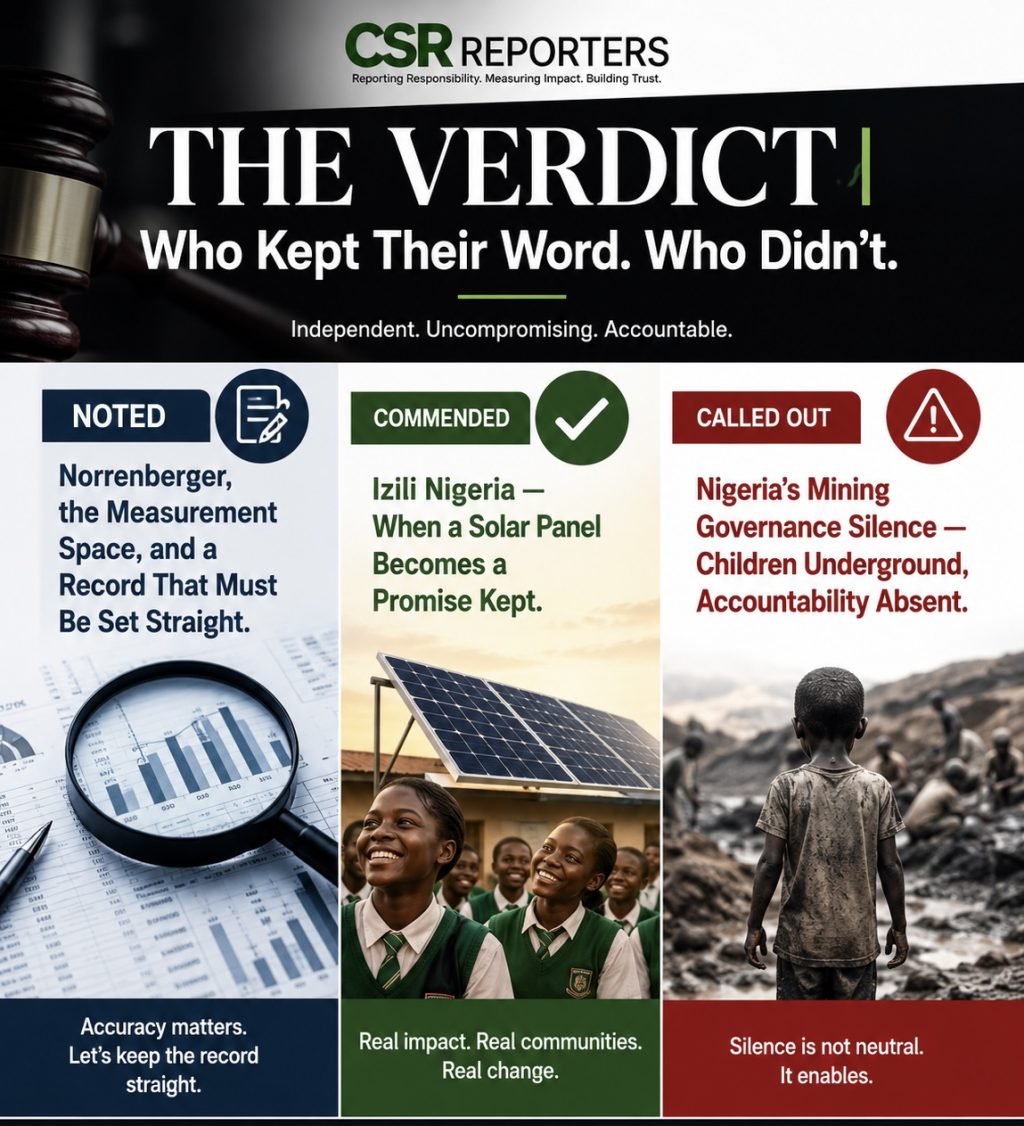
THE VERDICT Who Kept Their Word. Who Didn't.
THIS EDITION
NOTED: Norrenberger, the Measurement Space, and a Record That Must Be Set Straight
COMMENDED: Izili Nigeria — When a Solar Panel Becomes a Promise Kept
CALLED OUT: Nigeria’s Mining Governance Silence — Children Underground, Accountability Absent
NOTED!
Norrenberger, the Measurement Space, and a Record That Must Be Set Straight
A new entrant into Nigeria’s corporate sustainability benchmarking space is welcome. But “first-of-its-kind” is a claim that requires evidence — and the evidence does not hold.
On 5 May 2026, Norrenberger Research unveiled the Nigerian Corporate Sustainability Report (NCSR) at Transcorp Hilton, Abuja. The launch brought together senior executives, regulators, investors, and policymakers. The accompanying narrative was bold: a first-of-its-kind benchmarking framework, a defining moment, the beginning of structured measurement in Nigeria’s corporate sustainability space.
The initiative is, in substance, a serious one. The NCSR evaluates publicly listed companies across five pillars — environmental stewardship, corporate governance, social impact, stakeholder accountability, and responsible business conduct. It aims to establish a baseline for year-on-year tracking and to provide investors and institutions with a standardised tool for evaluating ESG performance across Nigeria’s corporate sector.
The spirit of the effort aligns with where the country needs to go. Nigeria cannot continue to host sustainability summits and ESG workshops while leaving corporate performance fundamentally unmeasurable. Norrenberger’s entry into this space is therefore a contribution worth acknowledging.
But a contribution and a beginning are not the same thing. And accuracy matters in accountability work.
The Record
In April 2026, CSR Reporters — Nigeria’s leading independent platform for corporate responsibility accountability — launched the Nigeria CSR Impact Ranking 2026. The Ranking is not a new idea. It is the product of years of methodology development, editorial scrutiny, field engagement, and independent verification infrastructure built specifically for the Nigerian and African context.
As of the time of writing, over 30 companies have already submitted entries and are actively being verified through the Ranking’s independent assessment process. These are not self-reported declarations dropped into a database. They are entries undergoing structured verification — the kind of accountability architecture that distinguishes ranking from recognition.
“Measurement without independence is just reporting. Independent verification is what makes accountability real.”
CSR Reporters has been building that architecture since 2019. The Nigeria CSR Impact Ranking is its most direct expression. It evaluates corporate social responsibility performance not through disclosure alone, but through the lens of community impact, transparency, and verifiable outcomes — criteria shaped by the realities of Nigeria’s social and governance environment, not imported wholesale from global frameworks designed for different contexts.
The Ranking is also structurally linked to the Social Impact and Sustainability Awards (SISA) — CSR Reporters’ annual recognition platform — creating an integrated pipeline from entry to verification to recognition that no other framework in Nigeria currently provides.
Why the “First” Framing Matters
The tendency to claim novelty in a space that already has participants is not unique to Norrenberger. It is a pattern across Nigeria’s ESG ecosystem, where institutional visibility too often substitutes for institutional memory. When a well-capitalised financial services group launches a product and calls it a first, the media ecosystem amplifies the claim without interrogation. That is how erasure becomes consensus.
CSR Reporters is not raising this issue defensively. We raise it because the integrity of Nigeria’s accountability infrastructure depends on accurate attribution. If the companies and institutions that have been building this space independently — without the balance sheet of an integrated financial services firm — are consistently written out of the narrative, the signal sent to the market is clear: resources matter more than rigour. Capital matters more than credibility.
That is a signal that accountability journalism exists to resist.
NOTE: The Nigerian Corporate Sustainability Report evaluates listed companies. The CSR Reporters Nigeria CSR Impact Ranking covers a broader corporate universe, including non-listed entities, and applies independent verification. They are complementary instruments. Neither replaces the other. But only one came first.
What We Want to See
To Norrenberger: the NCSR has genuine potential to contribute to Nigeria’s measurement ecosystem. Publish your methodology in full. Name your poor performers as clearly as your leaders. Maintain editorial independence from your own investment interests. Return with the report in 2027 and demonstrate that year-on-year tracking means something — that companies that declined in performance are identified, not shielded.
Do those things, and the “first” framing will matter less than the function.
To Nigeria’s corporate sector: the arrival of multiple measurement frameworks is not a distraction. It is pressure. Use it accordingly.
The Verdict’s position is simple: welcome every serious actor into this space. Correct the record when the record is wrong. And hold every ranking — including our own — to the standard of independent verification. That is what accountability looks like when it is applied consistently.
✔ COMMENDED:
When a Solar Panel Becomes a Promise Kept
Izili Nigeria did not issue a press release about what it plans to do. It went to a school in Ibadan, installed the lights, and let the students speak for themselves.
On 14 May 2026, at Oba Abass Aleshinloye Grammar School in Eleyele, Ibadan, something quietly significant happened. Izili Nigeria, a solar energy company, and its civil society partner JCI Ibadan Elite, installed multiple solar-powered systems on the school premises — a Biolite SolarHome 5000+ TV system, five SHS 620+ solar systems, and three solar lanterns.
For students at Oba Abass Aleshinloye Grammar School, this is not a metaphor. It is a light that was not there before and is there now. It is the ability to read after sunset. It is a safer school compound. It is access to a television system for educational content in a classroom that previously had none. These are small in the currency of annual reports. They are enormous in the currency of lived experience.
CSR Reporters commends Izili Nigeria. Not for the equipment. For the direction.
Why This Matters Beyond the Headlines
Nigeria’s education system operates, in large part, in energy poverty. Public secondary schools across the country hold classes in darkness, run examinations without reliable electricity, and lose students to the streets the moment the sun goes down. The Federal Government has made progress at the tertiary level — the Energising Education Project has reached 24 federal universities — but the secondary school layer, where the most vulnerable students study, remains largely unaddressed.
Into that gap, Izili Nigeria stepped — not with a pledge, not with a memorandum of understanding, not with a press conference announcing intentions. With hardware. Installed. Working.
“Providing energy to educational environments is more than just giving light; it is about empowering the future.”
Those are the words of Izili Nigeria’s CEO, Kolawole Oguntuase, at the launch event. CSR Reporters notes them not to applaud the rhetoric — we have seen enough of that — but because they reflect a philosophy that is visible in the action. The solar systems were not donated to a ministry office. They were installed at the school. The students received them, used them, and some were recognised with certificates and solar lights for academic excellence on the same day.
That is a chain of accountability from corporate intent to community receipt that most CSR programmes in Nigeria never complete.
The Continental Ambition
Izili Nigeria is not a local actor. The company currently operates across six African countries, and its model — purpose-driven, renewable energy-linked, community-targeted — positions it as exactly the kind of business that should be visible in Nigeria’s ESG conversation.
This is important context. A solar company that genuinely integrates community impact into its operational philosophy, rather than treating CSR as a reputational afterthought, represents a different model of corporate citizenship. It is one worth naming explicitly.
WHAT WE ARE WATCHING: CSR Reporters will monitor whether this school-based solar intervention is sustained, maintained, and expanded. Equipment that is installed but not serviced becomes a symbol of abandonment. The commend stands today. It must be earned again in 2027.
The Standard We Are Setting
The Verdict does not commend press releases. It does not commend pledges. It does not commend CSR budgets or award citations or sustainability reports produced by consultants. It commends action that is visible, verifiable, and connected to a named community with a named outcome.
Izili Nigeria met that standard on 14 May 2026 at Oba Abass Aleshinloye Grammar School.
We encourage other companies — particularly those operating in sectors with clear environmental and community footprints — to look at what was done here, not at the scale of the investment, but at the specificity of the commitment. You do not need a billion-naira foundation to keep your word to a community. You need a decision, a plan, and the discipline to execute.
That is responsible business. And it should begin the day a business starts.
⚠ CALLED OUT – Children Underground, Accountability Absent: Nigeria’s Mining Governance Crisis
While Nigeria’s government endorses ISSB frameworks and hosts ESG summits, children are mining lithium in illegal operations for less than one dollar a day. The silence from the institutions responsible for stopping this is no longer defensible.
There is a document somewhere in Abuja — a roadmap, a framework, perhaps a signed agreement — committing Nigeria to global sustainability standards. There are photographs of ministers at podiums, executives at roundtables, regulators endorsing disclosure timelines. Nigeria’s ESG narrative has never been more visible, more articulate, or more formally structured.
There are also six-year-olds mining lithium in Nigeria’s illegal mining operations, earning less than one dollar a day.
These two realities occupy the same country. They operate simultaneously. And the institutions whose mandate is to close the distance between them have, to date, produced almost nothing of substance.
The Verdict calls out Nigeria’s mining governance establishment — specifically, the Federal Ministry of Solid Minerals Development, relevant state-level mining agencies, and the broader regulatory apparatus that has permitted illegal mining operations employing child labour to operate with effective impunity. This is not a call-out based on a single incident. It is a call-out based on a documented pattern of institutional absence in the face of a known, ongoing crisis.
What Has Been Documented
Reports have confirmed that children, some as young as six years old, are working in illegal lithium mining operations in Nigeria run by Chinese nationals and companies. They work for less than one dollar a day in conditions that expose them to physical danger, chemical hazards, and the permanent disruption of their education and development. These are not fringe operations hidden from public knowledge. They have been documented, reported, and named.
This is not primarily a story about foreign actors. Foreign actors operate where governance fails to stop them. The story is about the governance failure.
“Nigeria cannot be a credible participant in global sustainability discourse while children dig the minerals that power global sustainability technology.”
Lithium is not an abstract commodity. It is the material inside the batteries that power the electric vehicles celebrated at climate summits, the devices on which sustainability reports are downloaded, and the phones through which ESG frameworks are discussed. The supply chain of Nigeria’s ESG future runs directly through the same ground where these children work.
That is not an irony. It is an indictment.
The Institutional Silence
The Federal Ministry of Solid Minerals Development has articulated ambitions for Nigeria’s mining sector — formalisation, revenue generation, international partnership. These ambitions have produced activity at the top of the value chain. They have not produced enforcement at the bottom, where the most vulnerable people in the sector live and work.
State-level mining agencies in the states where illegal lithium mining is concentrated have not, to the public record, mounted sustained enforcement operations against the operations employing child labour. Where enforcement has occurred, it has not been systematic, sustained, or connected to any accountability framework that would prevent recurrence.
This is a governance failure across multiple layers of the state. It is also a CSR failure of every company in Nigeria’s mining and minerals supply chain that has not interrogated where its inputs originate.
THE VERDICT’S QUESTION: To the Federal Ministry of Solid Minerals Development and the relevant state mining agencies: What is the current enforcement status in the known illegal lithium mining zones? What is the timeline for prosecution of operators employing child labour? And who, by name, is accountable for the answer?
The ESG Conversation Nigeria Is Not Having
Nigeria’s corporate sustainability discourse has matured significantly in recent years. The adoption of ISSB standards, the emergence of ESG benchmarking frameworks, the growing sophistication of investor dialogue around sustainability metrics — these are genuine developments that CSR Reporters has tracked and, where warranted, commended.
But ESG discourse that does not connect to the operational realities of extraction, labour, and community impact is not accountability. It is aesthetics. It is the performance of responsibility without the substance.
Every sustainability summit held in Abuja or Lagos this year that did not include a session on artisanal and small-scale mining governance, child labour in the minerals sector, or the human rights conditions in Nigeria’s extraction economy was incomplete. Not because those topics are obligatory agenda items, but because they are the precise terrain where Nigeria’s stated sustainability commitments are being tested in real time — and failing.
What Accountability Requires
CSR Reporters does not issue calls-out without a corresponding accountability standard. The standard here is straightforward.
The Federal Ministry of Solid Minerals Development should publish, within 90 days, a transparent report on the enforcement actions taken against illegal mining operations employing minors in the past 24 months. The report should name the operations, state the outcomes, and identify the responsible officers.
State governments in the affected regions should establish, or reactivate, functional child labour monitoring mechanisms in mining communities — and link them to the federal enforcement apparatus.
Every Nigerian company with operations or supply chain exposure in the solid minerals sector should conduct a child labour risk assessment and publish the results. The ISSB’s IFRS S1 framework, which Nigeria has endorsed, requires disclosure of material sustainability risks. Child labour in the minerals supply chain is a material sustainability risk.
And Nigeria’s ESG community — the think tanks, the consultants, the conference organisers, the award bodies — should stop treating this as someone else’s problem. The credibility of every sustainability claim made in this country is diminished by the gap between the podium and the pit.
The Verdict will return to this issue. The question is not whether Nigeria’s institutions will respond. It is whether they will respond before another year of documented harm passes without consequence.
Accountability is not a courtesy. It is a demand. And it is owed — first and most urgently — to the children underground.
ABOUT CSR REPORTERS
CSR Reporters helps organisations conduct community needs assessments, track and measure CSR impact, document and report social investments, and communicate CSR efforts transparently and independently. Responsible business should begin the day a business starts.
[give_form id="20698"]