ROSEMARY IMOBHIO
When a company turns ten, the temptation is to celebrate itself. Flutterwave chose to celebrate its people instead.
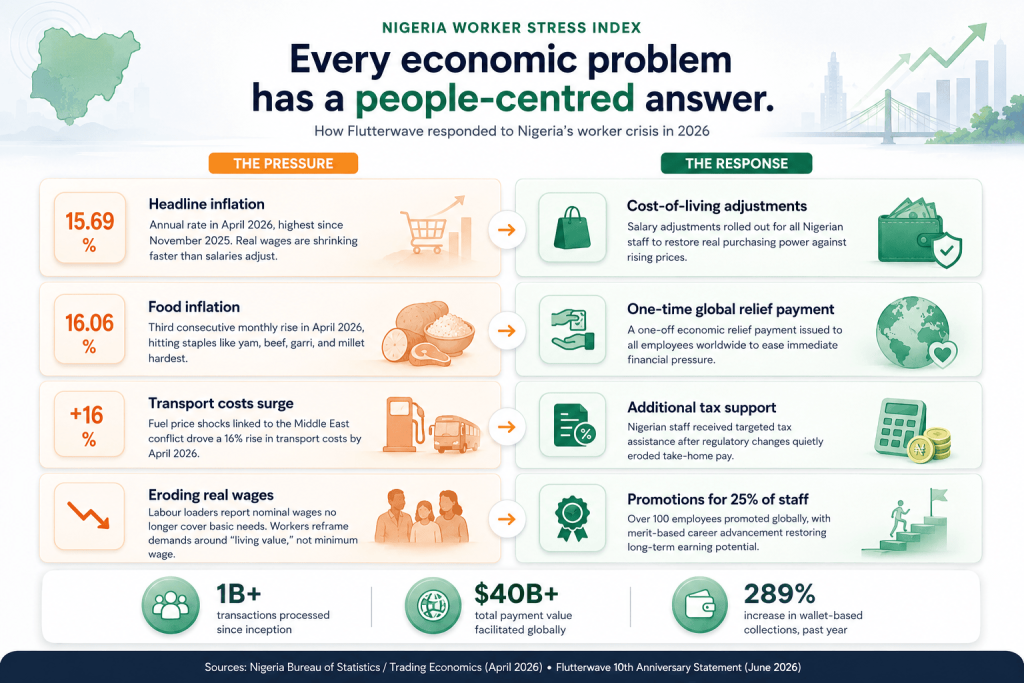
In early June 2026, African payments company Flutterwave launched a global employee support programme that includes promotions, cost-of-living adjustments, and one-time relief payments as the company marks its 10th anniversary and celebrates major growth milestones. Specifically, the initiative includes the promotion of 25% of its global employees, cost-of-living adjustments, tax support for employees in Nigeria, and a one-time economic relief payment for all employees worldwide.
That is not a small gesture. At a time when layoffs, wage freezes, and cost-cutting define much of the technology sector globally, this announcement deserves serious attention. It raises a question every Nigerian employer should be asking right now: what does it actually cost to neglect your people?
The Bigger Picture: Workers Under Pressure
Nigeria’s Economy Is Not Being Kind to Workers
Before unpacking what Flutterwave did, it helps to understand the environment in which it did it.
Nigeria’s annual inflation rate rose for a second straight month to 15.69% in April 2026, the highest since last November. Food inflation, the largest component of the inflation basket, quickened for the third month to 16.06%, while transportation prices rose by 16%. These are not abstract statistics. They represent shrinking grocery budgets, longer commutes with heavier fares, and workers choosing between rent and meals.
Furthermore, inflation, rising food prices, transport costs, and housing expenses have drastically eroded real wages across Nigeria. Labour leaders are no longer framing demands around statutory minimums. Instead, they are arguing about the “living value” of wages, because a nominal salary increase means nothing if it cannot cover the basics.
Nigerian workers across major cities, including Abuja and Lagos, marked International Workers’ Day 2026 with a mixture of reflection, frustration, and cautious hope, as rising inflation, insecurity, and weak labour protections continue to erode living standards. For employees in the private sector, particularly in knowledge-intensive industries like fintech, this economic climate creates a combustible mix: high stress, reduced purchasing power, and an active awareness of opportunities elsewhere.
Against this backdrop, the decision to reward rather than reduce becomes genuinely significant.
Why Flutterwave’s Move Matters
More Than 100 Promotions Is More Than a Number
The fintech company said more than 100 employees across its global operations had been promoted as part of efforts to reward performance and strengthen employee welfare. Beyond the headcount, what stands out is the structure of the package.
In Nigeria specifically, employees received cost-of-living adjustments, tax assistance for staff in Nigeria, and a one-off economic relief payment for workers across its international offices. The Nigeria-specific tax support is particularly thoughtful. Recent regulatory changes have quietly reduced take-home pay for many workers without any corresponding adjustment from employers. Flutterwave noticed and responded.
Founder and Chief Executive Officer Olugbenga Agboola described employees as central to the company’s growth, referring to them as the “secret sauce” behind its payment infrastructure and expansion across African markets. He also made clear that career advancement at Flutterwave is tied to meaningful contributions and impact on the business.
That framing matters. Promotions built on merit, rather than tenure or politics, send a message that performance is both seen and rewarded. For employees navigating economic uncertainty, that kind of clarity is itself a form of security.
“Our people are our secret sauce.” — Olugbenga Agboola, Founder and CEO, Flutterwave
A Contrast That Speaks Volumes
The announcement comes at a time when several African fintech firms have been trimming their workforces to reduce costs and improve efficiency. Companies such as Branch, Kuda, and Quidax have all undertaken job cuts in recent years, making Flutterwave’s latest move a notable contrast within the sector.
Moreover, Flutterwave’s latest employee investment is significant because it comes at a time when many technology companies globally have reduced costs, slowed hiring, or cut jobs. By choosing to invest in people precisely when the pressure to do otherwise is greatest, Flutterwave is not simply being generous. It is being strategic.
The CSR and ESG Connection
The “S” in ESG Finally Gets Its Moment
Corporate social responsibility conversations in Nigeria have long focused on community projects, education programmes, and environmental pledges. Far less attention flows toward what happens inside the organisation. That oversight is costly, and the evidence is growing.
Social indicators within ESG focus on how a company manages relationships with its workforce, communities, and wider society. Key measures include employee benefits, workplace health and safety standards, training and development, gender representation and pay equity, and investment in local community development initiatives.
Flutterwave employee benefits, in this context, are not separate from its CSR performance. They are a direct expression of it.
Global evidence increasingly shows that businesses that prioritise people, inclusion, employee wellbeing, community development, and equitable value chains consistently outperform peers in resilience, trust, and long-term profitability. Social equity is no longer charity. It is a competitive advantage.
Additionally, ESG-driven organisations are more attractive to skilled employees who value ethical leadership and social responsibility. In a talent market where engineers, product managers, and data scientists regularly receive competing offers, that reputational advantage translates directly into lower recruitment costs and higher retention rates.
Lessons for Nigerian Companies
What Every Employer Can Learn, Regardless of Size
Not every company is Flutterwave. However, the principles behind this initiative are scalable, and many of them cost less than the attrition they prevent.
Recognise performance visibly. Promotions do not require large headcounts to be meaningful. Even in SMEs, a structured internal promotion pathway signals to employees that growth is possible within the organisation. That signal alone can reduce the temptation to seek growth elsewhere.
Respond to economic realities. Leading organisations in 2026 are prioritising non-mandatory benefits such as housing and transport allowances, meal allowances, and enhanced HMO plans as core components of employee support. These are not luxuries. In Nigeria’s current economic climate, they are increasingly the difference between a retained employee and a departing one.
Tie welfare to strategy, not charity. Prioritising the well-being of employees as a strategic ESG pillar can help boost corporate success. Planning for employee wellbeing can result in gains in productivity and innovation, and organisations are more likely to attract better talent and retain them as a result.
Invest in career development alongside compensation. Both financial and developmental retention strategies significantly enhance employee productivity. Sustainable productivity cannot be achieved without deliberate investment in employee welfare and career growth. Companies that combine competitive pay with structured career pathways build teams that are not only retained but motivated.
Communicate transparently. One underrated element of Flutterwave’s approach is that the announcement was public and specific. Employees knew what was happening and why. That transparency builds trust in ways that quiet, piecemeal adjustments rarely do.
Expert Insight
What the Research and the Practitioners Are Saying
The modern workplace in Nigeria is increasingly shaped by technology-driven business models, evolving diversity and inclusion standards, increased regulatory oversight, and a renewed focus on workplace governance and employee well-being. Employers who treat these shifts as compliance burdens rather than strategic opportunities will find themselves consistently on the back foot.
The labour market evidence reinforces this. Economic fluctuations, rising living costs, and sustained inflationary pressures continue to affect workers’ purchasing power, driving demands that go well beyond headline wage increases to questions of adequacy, sustainability, and implementation.
Fintech peers on the continent are also reading the room. South Africa’s GoTyme Bank recently announced plans to introduce an employee ownership scheme aimed at aligning staff interests with the company’s long-term growth ambitions. From Lagos to Johannesburg, forward-looking companies are rewriting the implicit contract between employer and employee.
People First Is No Longer Optional
As Flutterwave enters its second decade, the combined promotion and welfare strategy signals a focus on retention and internal capability building at a time when parts of Africa’s fintech sector are undergoing restructuring.
Yet the deeper lesson here reaches far beyond fintech. In Nigeria’s evolving economy, where inflation bites, real wages contract, and skilled workers weigh their options with growing confidence, the companies that will lead are not necessarily those with the largest budgets. They will be the ones that make employees feel seen, supported, and valued.
Flutterwave’s 10th anniversary package is a reminder that celebrating a decade of growth means nothing if the people who built it are struggling. Investing in your workforce is not a cost to be managed. Increasingly, it is the most rational growth strategy available.
The question for every Nigerian employer is no longer whether to prioritise people. The question is how quickly they can start.
[give_form id="20698"]