CHUKS OLUIGBO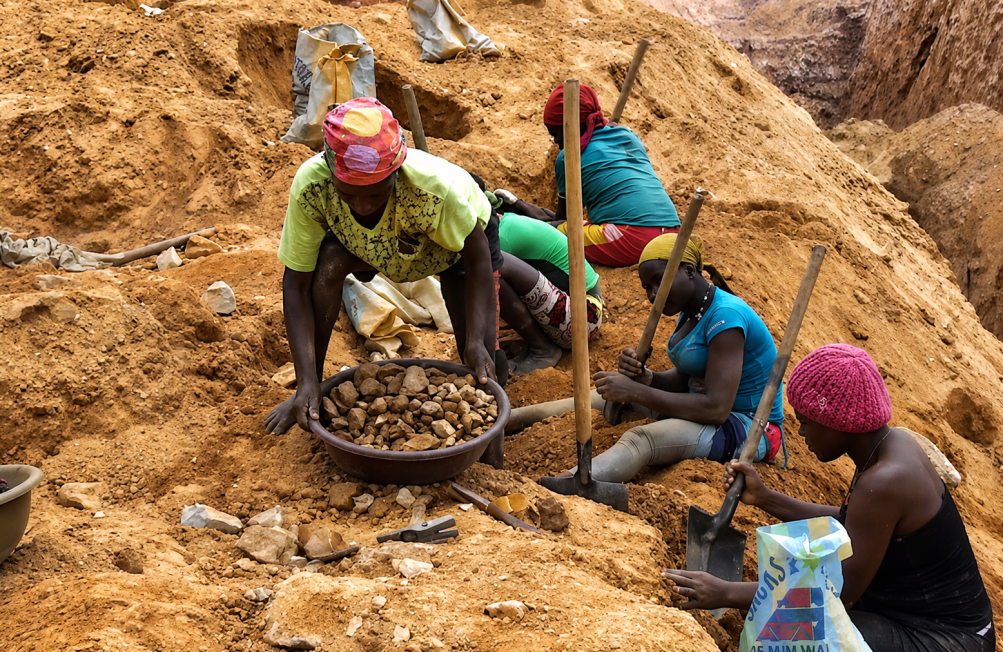
Image credit: CameroonOnline.org
The Government of Cameroon is following up its recent crackdown on the country’s gold mining sector with plans to launch a major operation on August 1 aimed at recovering an estimated US$524 million in unpaid taxes and customs duties linked to undeclared gold exports.
The moves are part of the broader efforts of the Central African country’s government to strengthen oversight of its extractive industry and improve revenue collection from its mineral resources.
The Ministry of Mines, Industry and Technological Development (MINMITD) said the nationwide exercise will target 51 mining companies and 33 newly identified mining sites accused of evading taxes and royalties between 2023 and 2025.
The ministry identified two main groups for action: 51 companies that carried out physical gold extraction with traditional methods but reported lower output than they produced, and 33 newly discovered sites using newer extraction systems whose production has never been declared or taxed.
“These adjustments will allow the state to recover, in the very short term, at least 300 billion CFA francs (about 524 million U.S. dollars),” the ministry said. “That would offset the revenue losses of about 165 billion CFA francs (about 288 million U.S. dollars) highlighted in the 2023 EITI report.”
The ministry had said earlier that there are more than 200 companies operating illegally in the country’s East and Adamawa regions, over 95 per cent of which are foreign enterprises.
Plugging a Huge Leak
These moves follow a recent revelation of a wide discrepancy between Cameroon’s national export records and international trade data, showing what the country may be losing to gold theft.
Data made public by the Director General of Cameroon’s National Mining Corporation (SONAMINES), Serge Hervé Boyogueno, in May showed that whereas an estimated 44,000 kilograms (44 tons) of gold left the country for Dubai between 2021 and 2025, Cameroon Customs declared only 148 kilograms for export.
In 2023, the Extractive Industries Transparency Initiative (EITI) reported that while Cameroon Customs declared 22 kilograms exported in that single year, the UN Comtrade international database registered 15,194 kilograms of Cameroonian-origin gold imports, primarily to the United Arab Emirates.
NGO Demands Immediate Freeze on New Gold Concessions
Following these revelations, Greenpeace Africa in June called on the Cameroonian government to immediately cancel the allocation of new mining exploitation titles and proceed with a structural reform of the sector to strengthen governance, protect Indigenous Peoples and Local Communities (IPLCs), and preserve ecosystems.
The independent environmental campaigning organisation said the 44,000 kilograms (44 tons) of gold stolen from Cameroon between 2021 and 2025, valued at nearly 2,000 billion CFA francs (approximately $3.4 billion), was equivalent to the annual budget of the country’s Ministry of Public Health for five consecutive years.
The organisation also highlighted the environmental cost of illegal gold mining in Cameroon. It quoted an April 2025 report by Forêt et Developpement Rural (FODER) revealing that the area of mining sites in the Batouri, Ketté, and Kenzou zones alone surged from 82 hectares in 2010 to over 4,600 hectares in 2024 – a 5,000 per cent explosion in 14 years – leading to destruction of agricultural lands of local communities and degradation of waterways.
“The losses already recorded are merely a warning sign that should command our attention. In the absence of effective and efficient control over operations in the mining sector, and as long as Cameroon continues to issue mining titles without traceability mechanisms, the 44,000 kg of gold stolen between 2021 and 2025 will just be another statistic,” said Stella Tchoukep, Forest Campaigner at Greenpeace Africa.
Government Wields the Big Stick
Last week, the Cameroonian government announced a crackdown on its gold mining sector over discrepancies between the volumes produced by companies and the volumes declared, potentially costing billions in lost tax revenue.
These operators, allegedly acting through front partnerships with small local cooperatives, exploit isolated forest areas and benefit from internal complicity to smuggle gold out of the territory without declaring it.
The government has ordered these companies to halt operations immediately and deployed military personnel to seal their heavy machinery as it tries to regain control of mining sites, clean up issues of licensing, introduce minimum gold delivery thresholds, improve monitoring of the various stages of ore recovery, and strengthen production traceability.
“The main problem does not necessarily lie in the disappearance of gold belonging to the state, but in the under-reporting of part of the production by certain private operators,” Acting Minister of Mining, Fuh Calistus Gentry, said.
Of just 57 semi-mechanised mining companies who held valid licences to operate in Cameroon prior to the crackdown, the government has permanently revoked 39 licences due to non-compliance and site abandonment, while 110 suspended corporate entities are facing legal battles.
The government also plans to crack down on the improper use of exploration permits for mining operations.
“An exploration permit is intended for conducting exploration works aimed at identifying and assessing a deposit,” Gentry said.
One Solution Creates Another Problem
The sudden shutdown of the mines has halted widespread environmental destruction, said Louvier Kindo Tombe in an article for Fair Planet. But it has triggered an immediate local economic crisis.
“While the Ministry of Mines frames the suspension as a necessary step to clean up the sector, the sudden withdrawal of corporate machinery has cut off the precarious livelihoods of thousands of local labourers who depend on corporate waste to find gold,” said Tombe.
He quoted 18-year-old Jérémie Nathan, who used to clear gravel lines for Zhenguo Sarl, a foreign-owned semi-mechanised mining company operating in Kambélé, an artisanal mining hub in Cameroon’s East region, as saying that the move by the ministers are not “only punishing the big companies, but they are starving us”.
Nathan told Fair Planet that they “used to live off the scraps the excavators brought to the surface. Now no new dirt is coming up.”
Additionally, the absence of alternative income source for the local population is pushing desperate villagers, denied artisanal permits, into “the hazardous, unrestored corporate craters left behind by the suspended firms”, said Tombe.
Highlighting the direct human consequences of this regulatory vacuum, he quoted local civil society organisations such as Forêts et Développement Rural as estimating that over 200 young miners have lost their lives in water-logged mining pits across the East region over the last few years, due to landslides and a lack of site restoration.
“We know the pits are unstable, but hunger is an immediate threat, while a landslide is just a possibility,” Angeline Ngono, a local mother living near an excavation site where an 18-year-old miner was buried alive, told FairPlanet. “The government has sealed the excavators, but left the open graves behind.”
The Road Ahead
The moves by Cameroon, without question, are in order. Allowing itself to be cheated out of the maximum benefit from the mining of one of its most valuable mineral resources is not desirable. Regaining control over this vital sector will help the country to transform gold mining from a poorly regulated free-for-all into a reliable pillar of economic growth.
That said, the government must also quickly find a way of balancing reform with restoring the livelihoods of local populations in the mining regions.
[give_form id="20698"]