


 ROSEMARY IMOBHIO
Nigeria’s economy grew by 4.43 percent in the second quarter of 2026, its fastest pace since the third quarter of 2024. The Federal Government wants Nigerians to feel good about that number. The Ministry of Finance has framed it as proof that years of reform are finally bearing fruit.
That optimism is not unreasonable. It points to a broader base of growth, a firmer naira and a path toward a trillion-dollar economy by 2030. Growth did accelerate. More sectors participated in it and despite where it is, the currency did stabilise.
A different set of numbers sits alongside the celebration, though. Food inflation climbed to 20.31 percent in July, its sixth straight monthly rise. Petrol, which sold for roughly ₦617 a litre in July 2023, now trades above ₦1,300 in several cities.
The World Bank estimates that 63 percent of Nigerians lived in poverty in 2025 (1). So the real question raised by Q2’s growth figure is not whether Nigeria’s economy is expanding. It clearly is. The question is whether that expansion is reaching the households and businesses the economy exists to serve.
A Number That Looks Better Than It Feels
Growth accelerated from 3.89 percent in the first quarter to 4.43 percent in the second, lifting first-half growth to 4.16 percent, according to the National Bureau of Statistics. That compares favourably with 3.68 percent recorded a year earlier. The data accessed by CSR Reporters, also showed twenty-seven subsectors grew by more than 3.0 percent in Q2, up from 23 in Q2 2025.
The Finance Ministry cites this spread as evidence that expansion is no longer confined to a handful of industries. However, CSR Reporters closer analysis offers useful context.
Nigeria’s population is growing at roughly 2.1 percent a year. An economy expanding at 4.43 percent is still adding real output per person, even if the margin is thin. Still, compared with the 6 percent-plus growth rates of the early 2010s, the current recovery remains modest.
Additionally, Nigeria’s estimated potential growth rate sits near 4 percent. That suggests the economy is growing roughly in line with its existing capacity rather than beyond it. That is information to note as an economy growing at its potential is not necessarily an economy building new capacity. It may simply be keeping pace with itself.
Growth Can Be Real And Still Feel Distant
So, why then the recent outrage everywhere? Nigerians are not disputing that the economy grew. What many are questioning is when that growth will show up in their budgets.
Headline inflation eased to 15.43 percent in July, down from 15.91 percent in June and well below the 24.94 percent recorded a year earlier. On paper, that looks like relief. In practice, a falling inflation rate only means prices are rising more slowly. It does not mean prices have come down.
Food tells a sharper story. Food inflation rose to 20.31 percent in July from 17.52 percent in June, driven by higher prices for rice, garri, tomatoes, beef and plantain. Month-on-month, food prices jumped 5.56 percent in July alone, up from 3.75 percent in June.
Poorer households spend between 60 and 70 percent of their income on food, according to data from CSR Reporters research. That gap between a moderating headline figure and an accelerating food figure is not a technical footnote. It is the daily experience of millions of families.
The World Bank’s latest Nigeria Development Update captured the disconnect plainly. Poverty rose from 56 percent of the population in 2023 to 63 percent in 2025. This, even as headline inflation fell from 34.8 percent to 15.15 percent over the same period.
“Household incomes have not grown fast enough to offset still-elevated inflation, and poverty has yet to begin declining,” the bank stated. Disinflation, in other words, is not the same as recovery. Prices climbed so steeply in earlier years that a slower climb now still leaves households behind.
The Manufacturing Warning Complicates The Story
If the inflation numbers raise questions about timing, the industrial numbers raise questions about structure. The Manufacturers Association of Nigeria warns that Q2’s headline growth conceals a deepening weakness in the productive economy. According to MAN, the broader industrial sector contributed just 17.23 percent of GDP in the quarter. It grew by only 3.96 percent, nearly half its 7.46 percent pace a year earlier.
Electricity, gas, steam and air-conditioning supply, a segment manufacturers depend on daily, contracted by 10.63 percent during the quarter. Manufacturing’s own share of real GDP slipped from 9.57 percent in Q1 to 7.72 percent in Q2, even though its growth rate held roughly steady at 3.24 percent. MAN attributes the pressure to a familiar mix: high production costs, currency volatility, expensive credit and rising electricity tariffs.
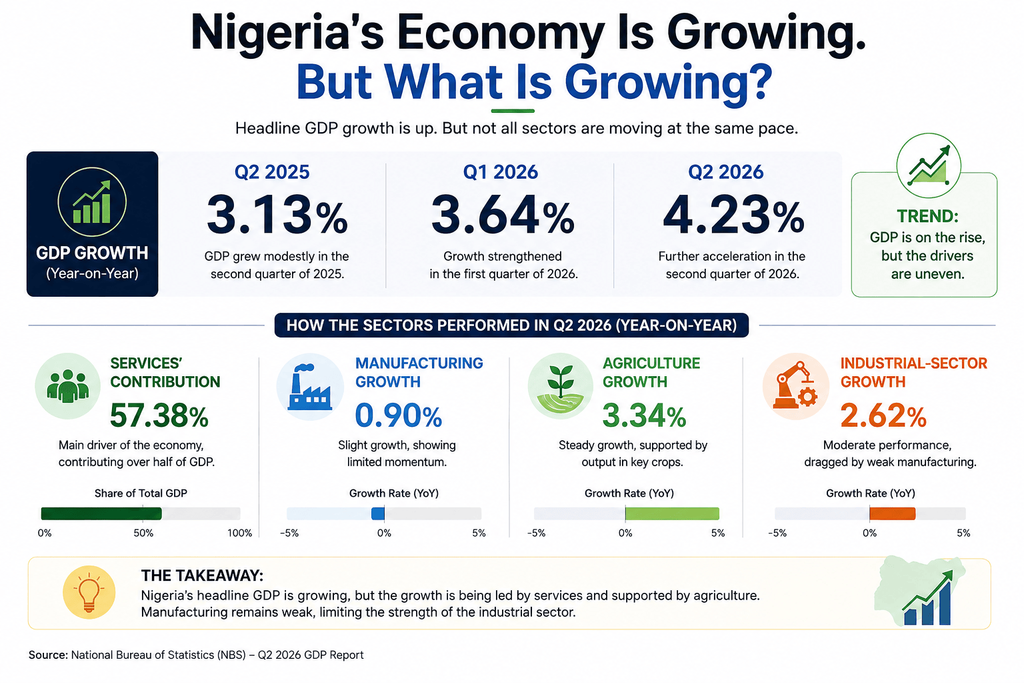
The sharpest warning in this situation concerns the character of the growth itself. Services now account for 56.62 percent of GDP, comfortably the largest share of the economy. A nation that increasingly trades and consumes what it does not produce, builds prosperity on an unstable foundation. That foundation stays vulnerable to external shocks and generates fewer of the mass industrial jobs a young population needs.
This is not simply manufacturers complaining about hard times, nor is it government inventing good news. Both readings of the data are accurate. Growth is happening. Its productive base is thinning. Untangling those two facts is the real analytical task facing anyone assessing Nigeria’s recovery.
Services Are Driving Growth. Is That Enough?
A services-led economy is not inherently a problem. Telecommunications, financial services, ICT and professional services can generate real value, attract investment and create skilled jobs. Nigeria’s services sector grew by 4.60 percent in Q2, much of it from genuinely productive segments.
The harder question is whether services alone can absorb Nigeria’s expanding working-age population. Can that growth stay linked to what happens on farms and factory floors? Can a fintech platform lower the cost of raw materials a food processor needs? Largely, no. Services and manufacturing are not rivals. A resilient economy needs both reinforcing each other, so growth in one sector expands opportunity in the next.
Who Absorbs The Cost Of Nigeria’s Weak Points
When public infrastructure falls short, someone still pays for the gap. Businesses buy diesel generators because grid electricity is unreliable. Households pay for private security, private clinics and private transport because public alternatives are inconsistent.
None of this counts as failure in GDP statistics. If anything, it inflates the numbers, since spending on generators, guards and boreholes registers as economic activity, even though it exists only to compensate for something the state has not delivered.
This is a genuine sustainability concern. An economy that grows partly because households and firms are quietly absorbing costs that stronger public systems would otherwise carry is not becoming more efficient. It is redistributing the burden downward, onto balance sheets less able to bear it.
Security Is Economic Infrastructure
Nigeria cannot build a strong economy without security, just as it cannot sustain lasting security without a strong economy. Senator Gbenga Daniel of Ogun East expanded on this recently. His questions were pointed: can a young Nigerian find decent work, can a farmer reach the farm safely, can a small business survive the cost of power and transport, can investors commit capital with confidence?
The economic channel here is straightforward. Farmers who cannot safely access land produce less food, adding pressure to already elevated food inflation. Insecurity along transport corridors raises the cost of moving goods, feeding into retail prices wherever those goods are sold.
Communities under threat attract less investment and businesses in unstable areas spend more on protection instead of production. Security, in this framing, is part of the infrastructure that determines how efficiently growth travels.
Nigeria’s Reform Dividend Has A Transmission Problem
Put together, the evidence points less to a false recovery than to an incomplete one. Reforms appear to be producing genuine macroeconomic gains. A more stable exchange rate, moderating headline inflation, stronger government revenue and a broader spread of sectoral growth.
States collected roughly ₦15.5 trillion in revenue in 2025, up from ₦4.8 trillion in 2022. Yet inflation, currency depreciation and rising debt service have all eaten into what that additional revenue can actually buy.
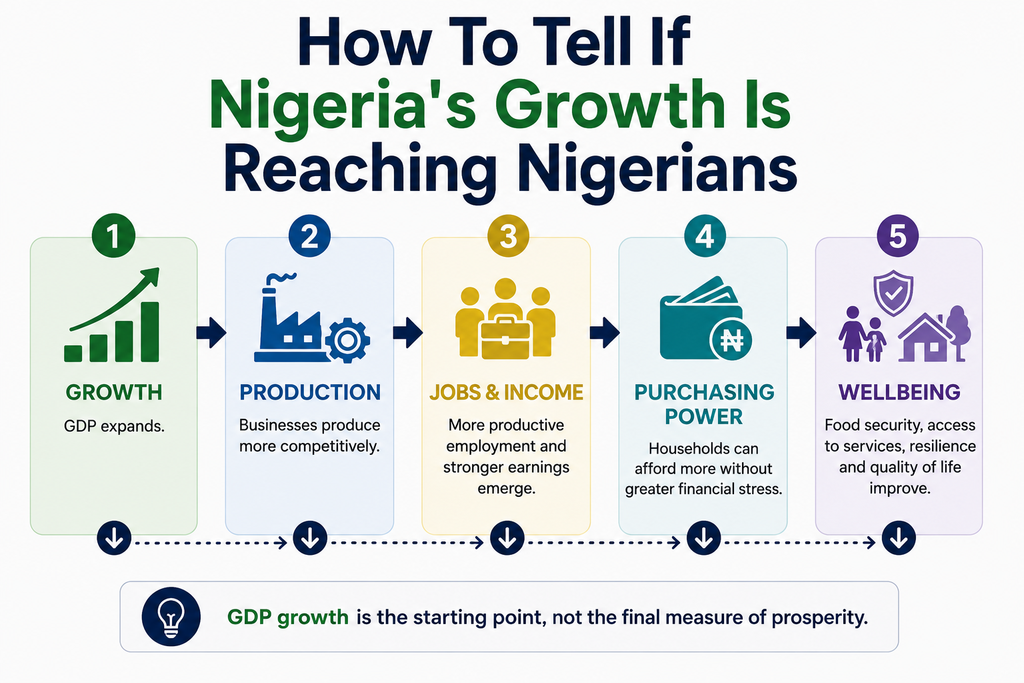
The chain that should carry these gains into everyday life runs from reform to macroeconomic stability, then to investment, production, jobs and income, and finally to household purchasing power. Nigeria’s data suggest that chain is breaking at several links rather than one.
Elevated food prices erode income gains before they can be felt. High electricity tariffs absorb whatever productivity gains manufacturers manage to achieve. Interest rates near 26.5 percent keep credit expensive and restrict investment.
Insecurity disrupts agricultural production before it reaches the market. Weak public services push households toward costly private alternatives. Each break helps explain why macroeconomic improvement and lived improvement continue to move at different speeds.
What a genuine growth dividend would look like
A meaningful dividend from Nigeria’s reforms would eventually show up as higher real household incomes and food that becomes truly affordable, not merely less expensive at a slower rate. It would mean more decent jobs, lower business operating costs, more reliable electricity, a stronger manufacturing base and safer agricultural production. It would also mean greater resilience against the next shock, whether a currency swing, a fuel price spike or a security incident.
None of this means GDP should be discarded as a measure. It remains a useful gauge of aggregate activity and a legitimate signal that policy is moving in a defensible direction. What it cannot do alone is tell Nigerians whether their circumstances are improving. That requires tracking income, prices, jobs and security together, and being honest when the picture each one paints diverges from the others.
The government’s optimism about 4.43 percent growth is not unreasonable. Neither is MAN’s alarm about a thinning industrial base, nor the common Nigerian’s insistence that lived experience is the truer test. All three views describe the same economy from different vantage points.
The gap between them is precisely where the real story of Nigeria’s recovery is being written. Nigeria’s growth dividend will become credible not when economic reports announce that Nigerians are better off, but when households and businesses no longer need an economic report to convince them that they are.
References
- World Bank. Poverty and Equity Brief : October 2025 (English). Poverty and Equity Brief Washington, D.C. : World Bank Group. http://documents.worldbank.org/curated/en/099253204222517873
What does Nigeria’s economic growth mean for you, your business or your community? Follow CSR Reporters for deeper analysis on the policies, businesses and sustainability issues shaping Nigeria’s future, beyond the headline numbers.
[give_form id="20698"]

1 thought on “Nigeria’s GDP Is Growing. Where Is the Dividend?”