ONYINYECHI NWAIGBA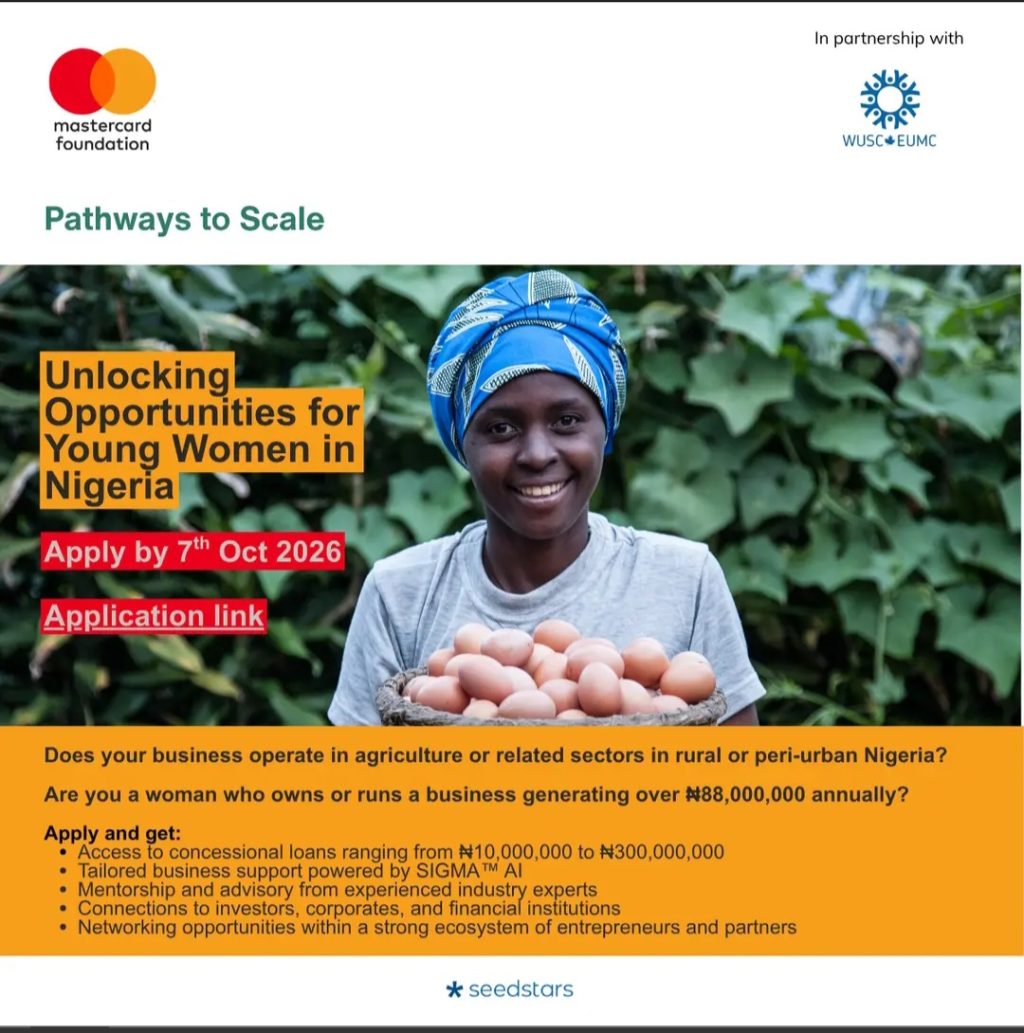
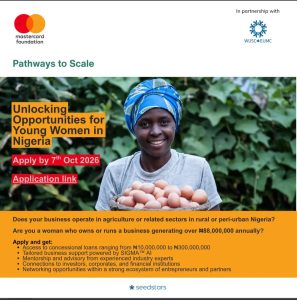
A new Pathways to Scale opportunity is opening access to concessional loans of up to ₦300 million for eligible women-owned and women-led businesses in Nigeria’s agriculture and related sectors.
For many women entrepreneurs, the challenge is not always knowing what business to build.
Sometimes, it is having enough capital to take an existing business to the next level.
A business may already have customers, employees and a proven product, but expansion can remain out of reach when the financing available is too small, too expensive or difficult to access.
That is one of the challenges the Pathways to Scale programme is attempting to address in Nigeria.
The programme has opened applications for its second cohort, targeting women-owned and women-led businesses operating in agriculture and related sectors, particularly those serving rural and peri-urban communities.
Eligible businesses can access concessional loans ranging from ₦10 million to ₦300 million, alongside business support, mentorship and opportunities to connect with investors, financial institutions and other ecosystem partners. Applications for the current cohort close on October 7, 2026.
But the bigger story is not simply the amount of money available.
It is the question of what happens when women who have already built businesses are given the resources and support needed to scale them.
Capital Can Change the Size of a Business
Access to finance can determine whether a growing business remains small or expands into something capable of employing more people and reaching new markets.
For an agricultural business, additional financing could potentially support the purchase of equipment, expansion of production, improved storage, processing capacity, transportation or access to larger markets.
For an agribusiness involved in distribution, it could mean reaching more farmers.
For a processing company, it could mean increasing the volume of raw materials it can handle.
And for a business providing agricultural services or technology, it could mean reaching more customers.
This is why financing for established businesses can have effects beyond the business owner.
When a business expands, its suppliers, workers, customers and surrounding communities can also become part of that growth.
The Pathways to Scale programme is designed around this broader idea of enterprise growth and employment.
The five-year programme, led by World University Service of Canada (WUSC) in partnership with the Mastercard Foundation, aims to support 13,000 women-owned and women-led enterprises across Nigeria, Ghana, Ethiopia and Rwanda, with a target of creating or sustaining 108,000 work opportunities for young women.
This Is a Loan, Not a Grant
One of the most important things potential applicants need to understand is the nature of the financing.
The current Nigerian opportunity provides concessional loans, not grants.
That distinction matters.
A grant does not generally have to be repaid, while a loan creates a repayment obligation.
The programme’s concessional financing is intended to make capital more accessible to businesses that are ready to grow, but entrepreneurs still need to consider whether the financing fits their business model, cash flow and ability to repay.
The opportunity is therefore not simply about receiving money.
It is about whether the money can be used productively to generate enough additional value for the business to grow sustainably.
Who Is the Programme Looking For?
The current Cohort 2 opportunity is not designed for every business owned by a woman.
It is focused on women entrepreneurs whose businesses operate in agriculture or agriculture-related sectors and are located in or serve rural and peri-urban communities in Nigeria.
The application information covers a broad range of businesses, including crop production, livestock and poultry, aquaculture, agricultural inputs, processing and value addition, aggregation and storage, distribution, agricultural marketing, exports, AgriTech and other related services.
There is also a significant revenue requirement.
The current call states that eligible businesses should generate more than ₦88 million in annual sales.
That means this is primarily an opportunity for businesses that have already moved beyond the earliest stages and are looking for support to scale.
Applicants also need to demonstrate that their businesses are actively operating and ready for growth.
Why Focus on Women in Agriculture?
Agriculture remains an important part of Nigeria’s economy and a major source of livelihoods.
Yet women entrepreneurs can face additional barriers when trying to access capital, markets, networks and business support.
The issue is not necessarily a lack of entrepreneurial activity.
Women are already participating across agriculture and agribusiness — as farmers, processors, traders, distributors, service providers and business owners.
The challenge is often how to help businesses with existing potential move from operating to scaling.
That is where programmes such as Pathways to Scale are attempting to intervene.
Instead of focusing only on entrepreneurship training, the programme combines financing with technical assistance, mentorship and connections to markets and other business networks.
Money Alone May Not Be Enough
One of the more interesting parts of the programme is that financing is only one component.
Selected businesses can also receive tailored business support, mentorship and advisory services.
They can be connected with investors, financial institutions, corporates and other ecosystem partners.
That matters because business growth can be complicated.
An entrepreneur may have enough demand to expand but lack the financial systems required to manage a larger operation.
Another may have the right product but struggle to access larger buyers.
Someone else may have funding but need help understanding how to structure the business for long-term growth.
Capital can address one problem while leaving another untouched.
Business support can therefore help entrepreneurs make better use of whatever financing they receive.
The Importance of Investment Readiness
The application process itself reflects this emphasis on business readiness.
Applicants are asked to provide detailed information about their businesses, including ownership structure, revenue, profit, employees, costs, existing loans, previous funding, customers, financing needs and their impact on women and young people.
This information is not simply administrative paperwork.
It helps demonstrate whether a business understands its own operations.
A business seeking significant financing needs to know how much it earns, where its money goes, how much it costs to operate and what additional capital would actually achieve.
Investment readiness therefore becomes an important part of growth.
A business cannot simply say, “I need ₦100 million.”
It needs to explain what the money will be used for, what that investment is expected to change and how the business will manage the additional financial responsibility.
Rural and Peri-Urban Businesses Are Part of the Story
The programme’s focus on rural and peri-urban communities is also significant.
Economic opportunities are often concentrated around major cities, while businesses operating outside those centres can face additional challenges accessing finance, professional networks, markets and business support.
Supporting businesses that operate in or serve these communities can potentially create effects beyond the entrepreneurs themselves.
An agricultural processor may buy from local farmers.
A distributor may employ people in a rural community.
A storage company may help reduce losses for producers.
An agricultural technology company may provide services to farmers who would otherwise have limited access to them.
In this way, enterprise growth can become connected to wider community economic activity.
Building Businesses That Create More Opportunities
The broader Pathways to Scale programme is ultimately focused on economic opportunities for young women.
According to the Mastercard Foundation, the programme aims to support 13,000 women-owned and women-led enterprises and create or sustain 108,000 work opportunities for young women across its four participating countries.
That means the intended impact is larger than the number of entrepreneurs receiving financing.
The hope is that stronger businesses can become employers, suppliers, buyers and economic anchors within their communities.
A woman who grows a processing company, for example, may eventually employ more young women.
A larger agricultural distribution business may need additional drivers, sales staff, warehouse workers and administrative employees.
An expanding farm may require more labour during production and harvesting.
The growth of one enterprise can therefore create a chain of economic activity around it.
What Should Success Look Like?
The number of businesses receiving loans is an easy figure to report.
But it should not be the only measure of success.
A more meaningful assessment would ask what happens after the financing.
Do businesses increase their revenues?
Do they expand into new markets?
Do they create or sustain more jobs?
Do women gain greater control over business decisions?
Do businesses become more resilient when faced with economic shocks?
Are more young women able to find meaningful employment as these enterprises grow?
These are the kinds of outcomes that can show whether access to finance is translating into lasting economic opportunity.
The Pathways to Scale programme itself has identified enterprise growth, revenue increases, employment and improved access to capital among the areas it intends to track.
Financing Is Only One Piece of the Puzzle
There is a tendency to describe funding as though it automatically solves the problems facing entrepreneurs.
It does not.
A business can receive capital and still struggle because of poor infrastructure, high operating costs, limited markets, unreliable power, inadequate skills or economic uncertainty.
For agricultural businesses, there are additional risks, including weather, crop losses, transportation challenges, storage and market volatility.
This makes the support surrounding the financing important.
Mentorship, technical assistance, market access and professional networks can help entrepreneurs make decisions that strengthen the businesses receiving capital.
The combination is what makes the programme particularly relevant from a development perspective.
What This Means for Women’s Economic Participation
Women’s economic empowerment is often discussed in terms of getting more women into business.
But participation is only the beginning.
The bigger question is whether women-owned businesses have the opportunity to become stronger, more profitable and more sustainable.
A woman running a business that employs two people is contributing to her community.
If that business grows and employs 20 or 50 people, the scale of that contribution changes.
That is why access to growth capital matters.
It can potentially move entrepreneurship from survival to expansion.
And when those businesses operate in sectors such as agriculture, their growth can affect entire supply chains.
The Bigger Question Is What Happens After the Money
The ₦300 million figure will naturally attract attention.
But the more important part of this opportunity may be what comes after the financing.
Will entrepreneurs have the support to manage growth?
Will they be able to access larger markets?
Will their businesses become more resilient?
Will expansion create meaningful jobs for other women?
And will the businesses still be operating and growing several years from now?
Those questions matter because sustainable economic empowerment is not simply about putting capital into a business.
It is about creating the conditions that allow the business to use that capital well.
For women entrepreneurs already building businesses across Nigeria’s agricultural value chains, the opportunity to access finance alongside mentorship, technical support and business networks could provide another pathway to scale.
The real measure, however, will not be how much money is disbursed.
It will be how many businesses become stronger because of it and how many other people gain opportunities as those businesses grow.
[give_form id="20698"]