ROSEMARY IMOBHIO
Yesterday, former Chief Justice David Maraga was arrested on a Nairobi street while holding a placard. His crime, according to activists, was exercising a constitutional right. His cause was protecting a national park from a parking lot.
That scene was captured on mobile phones and shared across the world. It reveals something deeper than one protest. It captures a pattern that has been building across Kenya for years. The is a steady, incremental erosion of protected green spaces. One driven by infrastructure ambitions, commercial interests, and a governance framework that too often fails to keep pace.
This is Kenya’s growing Kenya deforestation ESG crisis. And it demands serious attention from governments, investors, corporations, and sustainability leaders alike.
A Pattern, Not an Isolated Incident
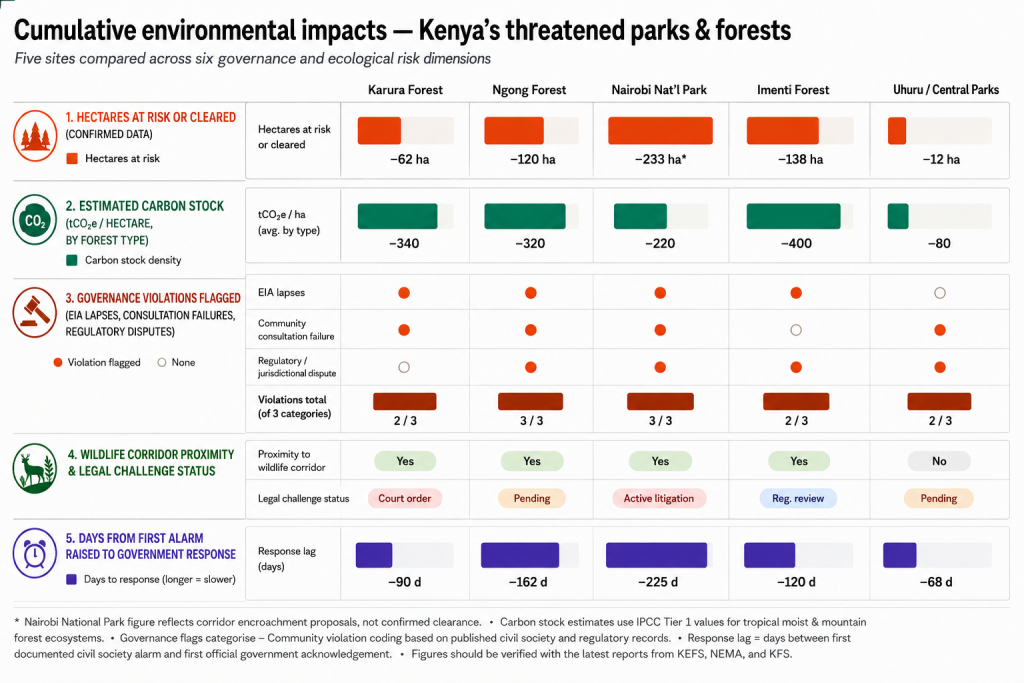
The cases are multiplying faster than they can be resolved. In February 2026, chainsaws arrived at Karura Forest without warning. Workers felled indigenous trees to clear space for National Youth Service accommodation linked to Kenya’s tree-planting campaign.
In March and April, environmental groups raised alarms over forest destruction inside Nairobi National Park. The clearing was linked to a Sh41.9 billion convention centre expansion and a 1,300-vehicle parking facility.
In May 2025, a luxury hotel appeared inside Ngong Forest without the required environmental licence. In September 2025, reports emerged of plans to excise 50 acres of Imenti Forest in Meru County for a state lodge, golf course, and airstrip. And just this month, the Green Belt Movement (GBM) raised fresh alarms. Survey beacons had appeared inside Uhuru Park and Central Park, suggesting possible land excision for Uhuru Highway expansion.
Individually, officials can frame each of these cases as a unique circumstance. Together, however, they form a pattern of shrinking green space that demands an honest environmental sustainability reckoning.
E: The Environmental Ledger
Kenya’s Forests Are Already Under Severe Pressure
Kenya’s Forest Status Report 2024 documented that the country loses an average of 84,716 hectares of forest annually to deforestation (1). A further 14,934 hectares is degraded each year. That translates to roughly Sh534 billion in annual economic losses, equivalent to at least three percent of GDP.
Since independence in 1963, forest cover has declined from approximately 10 percent of land area to around 7 percent today. This is well below the constitutional target of 10 percent. From 2001 to 2024, satellite data from Global Forest Watch recorded a loss of 400,000 hectares of tree cover. That loss released an estimated 200 million metric tons of CO₂ equivalent into the atmosphere.
Against this backdrop, the incremental loss of protected urban and peri-urban forests carries significance that goes well beyond the acreage alone.
Carbon Sinks, Cooling, and Cascading Risks
Forests function as complex ecological systems, not just scenery. Nairobi’s urban forests regulate city temperatures, absorb stormwater, recharge aquifers, and sequester carbon. That group includes Karura, Ngong, and the woodlands inside Nairobi National Park.
As Nairobi continues to grow, the urban heat island effect intensifies. Without these green buffers, the city faces greater flooding risks during the long rains and higher temperatures during dry seasons. The World Bank estimates that nature-based solutions, including urban forests, reduce flood and heat-related infrastructure costs by billions of dollars over a city’s lifetime.
Imenti Forest, meanwhile, is more than a landscape feature. It serves as a critical water catchment area for parts of Meru County, supporting agriculture, local livelihoods, and community water systems. Former environment minister Peter Munya described it as “a very fragile ecosystem and a critical water catchment.” It cannot be traded away for tourism infrastructure.
Biodiversity Loss and Habitat Fragmentation
Nairobi National Park occupies a globally rare position: a functioning wildlife reserve on the edge of a capital city. The park supports lions, leopards, cheetahs, rhinos, and over 400 bird species. Critically, it depends on wildlife corridors connecting it to the broader Athi-Kaputiei ecosystem to the south.

Any infrastructure development that fragments these corridors does not merely reduce habitat. It disrupts migration patterns, reduces genetic diversity, and weakens long-term species resilience. Experts CSR Reporters spoke to warn that losing up to 100 acres of upland forest to the Bomas expansion would “undermine the integrity of this critical ecosystem.”
S: The Social Stakes
Green Spaces Are Not Luxuries
Urban parks and forests provide measurable public health benefits. Research consistently links access to green space with lower rates of anxiety, depression, and stress-related illness (2). For low-income communities in particular, public parks like Uhuru Park and Karura Forest often serve as the only accessible recreational space in dense urban environments.
Experts note this dimension explicitly when raising the Uhuru Park alarm. They point out that both parks are “protected public land under Article 62 of the Constitution.” They are also gazetted recreational facilities held in trust for present and future generations. This language of trusteeship matters. It frames green space not as a discretionary asset that governments may trade away. Rather, they are a public good with intergenerational obligations.
Tourism, Livelihoods, and Kenya’s Brand
Kenya’s economy depends substantially on wildlife tourism, which generates billions in foreign exchange annually. Nairobi National Park alone attracts over 100,000 visitors a year. It anchors Kenya’s unique proposition as a safari destination where visitors can see lions at sunrise with a city skyline behind them.
That proposition is fragile. Incremental degradation of the park’s integrity erodes the very product that tourism depends on. Whether the cause is infrastructure inside its boundaries or the loss of wildlife corridors.
The Legacy That Demands Acknowledgment
It is impossible to discuss any of these sites without invoking the legacy of Wangari Maathai. She is Kenya’s Nobel Peace Prize laureate and founder of the Green Belt Movement.
Maathai physically blocked bulldozers at Uhuru Park in 1989. This was when the government planned a 62-storey office complex on the site. She later led citizens into Karura Forest in 1999 to resist illegal land grabs. Her protesters were beaten by hired thugs in scenes that drew international condemnation.
The GBM’s June 2026 statement on Uhuru Park stated directly: “Uhuru Park remains a powerful symbol of environmental justice and democratic participation. It was preserved through the courage and determination of citizens led by Professor Wangari Maathai.”
Thirty-five years after Maathai’s Uhuru Park stand, survey beacons have reappeared in the same ground she defended. That continuity of threat is both striking and instructive.
G: The Governance Gap
Environmental Impact Assessments Under Scrutiny
At the heart of nearly every controversy examined here lies a governance failure around the Environmental Impact Assessment (EIA) process.
In the Ngong Forest hotel case, NEMA stated explicitly that it had not issued any licence for the project. Even as KFS confirmed construction was underway. At Nairobi National Park, FoNNaP stated that no EIA document was distributed or mentioned at the public participation meeting. Nor was the completed report posted online for public review before the licence was quietly issued after.
There are also consistent calls on NEMA to disclose whether assessments have been submitted and reviewed for the proposed Uhuru Park highway works.
These are not isolated paperwork failures. They reflect a systemic pattern in which environmental oversight arrives after, not before, development activity has begun.
Public Participation: Form Without Substance
Kenya’s Constitution enshrines public participation as a fundamental requirement for decisions involving public land. In practice, however, conservationists have repeatedly characterised the process as procedural theatre.
For example, at Karura Forest, there was a Joint Management Committee meeting in February. It discussed all projects concerning the forest without any mention of the impending tree clearance. Workers arrived with chainsaws just days later.
An expert stated, “All projects concerning Karura forest are supposed to be discussed with the CFA first. Nothing like that was mentioned.”
Meanwhile, Parliament itself has struggled to obtain accountability. A parliamentary environment committee ordered the suspension of the Ngong Forest hotel in June 2025. That order came only after KFS initially dismissed concerns and the Environment Cabinet Secretary’s office sent a letter explaining the PS was “out of the country” and unavailable to attend hearings. MPs warned both the CS and PS that they risked impeachment if they continued to dodge Parliament.
Regulatory Credibility and the Rule of Law
The cumulative effect of these governance failures carries significant consequences for Kenya’s environmental sustainability credibility. Kenya has made ambitious climate commitments, including a target to raise forest cover from roughly 12 percent to 30 percent. The government’s flagship 15 billion tree campaign is central to its climate narrative.
Yet the same government cleared indigenous forest inside Karura. It said this was to support that campaign’s nursery infrastructure, a move conservationists describe as deeply contradictory.
For ESG analysts, this signals what governance specialists call a “policy coherence failure.” Climate ambitions proclaimed at one level of government are undermined by actions taken at another. That incoherence increases the nature-related financial risks for any investor relying on Kenya’s environmental governance framework.
Lessons for Governments, Investors, and Sustainability Leaders
The Compounding Cost of Incremental Loss
Every individual encroachment appears small in isolation. Three acres here. Seventy-six acres there. A hotel in a forest sanctuary. Survey beacons in a park.
But biodiversity loss and carbon sink degradation are not linear. Ecosystems have tipping points. Wildlife corridors, once fragmented, do not simply function at reduced capacity. They stop functioning altogether. Urban forests, once cleared and built upon, are effectively lost permanently. Therefore, the cumulative environmental impact of repeated encroachment is far larger than any single project assessment suggests.
ESG Risk Is Not Theoretical
For international investors, development finance institutions, and corporations operating in Kenya, these events carry direct ESG governance implications. The World Bank’s Horn of Africa Gateway Development Project has been cited in connection with the Imenti Forest land concurrence. Greenpeace Africa has called on the Bank to “urgently review its due diligence obligations.” Any institution with environmental and social safeguard commitments must examine whether those commitments extend fully to project-linked activities at the national implementation level.
Development and Conservation Can Coexist — But Only With Discipline
None of the cases examined here represents an argument against infrastructure development per se. Kenya needs highways, convention facilities, housing, and tourism investment. However, legitimate development does not require protected forests. It does not require national parks. It does not require the erosion of public green spaces that communities have fought, and in some cases bled, to defend. The argument is not development versus conservation. It is whether Kenya’s governance institutions have the discipline to identify and enforce the boundary between the two.
Building for the Future Without Eroding It
The question is not academic. Can Kenya continue building for the future without steadily eroding the natural assets that support that future?
The honest answer, based on current evidence, is: not at this rate.
Kenya’s forests sequester carbon, regulate water, cool cities, and protect biodiversity. They also underpin tourism revenues the economy cannot afford to lose. Its urban parks provide public health benefits, cultural heritage, and constitutional entitlements that citizens cannot afford to surrender. And its governance institutions, while capable of delivering ambitious goals, are demonstrating a recurring tendency to let development pressure override environmental accountability.
The cases at Karura, Nairobi National Park, Ngong, Imenti, Uhuru Park, and Central Park are not merely environmental stories. They are ESG governance stories. They show what happens when climate commitments collide with development ambitions, when regulatory oversight arrives too late. And when the rule of law is tested by the beep of a chainsaw or the placement of a survey beacon.
Wangari Maathai understood that protecting a tree was an act of democracy. The institutions she challenged in the 1980s and 1990s have changed. The pressure on the trees, however, has not. That continuity should trouble anyone who believes Kenya’s future depends on keeping its natural capital intact.
References
- Kenya Forest Service. (2024). Forest Status Report 2024, Kenya
- Chen, K., Zhang, T., Liu, F., Zhang, Y., & Song, Y. (2021). How Does Urban Green Space Impact Residents’ Mental Health: A Literature Review of Mediators. International journal of environmental research and public health, 18(22), 11746. https://doi.org/10.3390/ijerph182211746