CSR Reporters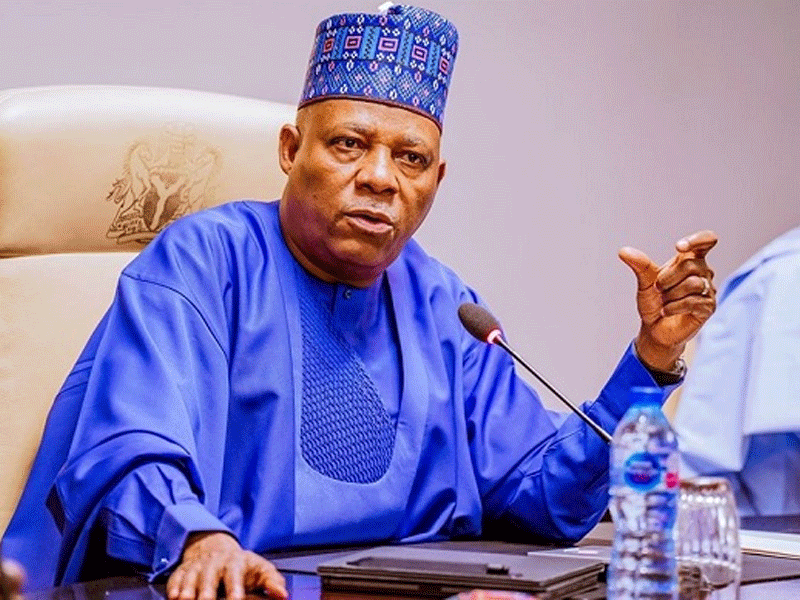
Nigeria has set its sights on a $1 trillion economy.
It is an ambitious target that will require more investment, stronger businesses, greater productivity, better infrastructure and millions of new economic opportunities.
But there is another question that deserves equal attention:
Who gets to participate in building that economy?
That question came into focus recently when Vice President Kashim Shettima called for greater inclusion of women in Nigeria’s push towards a $1 trillion economy.
The call is not simply about achieving better representation for women.
It is about recognizing that Nigeria cannot afford to leave a significant part of its population operating below its economic potential.
Women already contribute significantly to Nigeria’s economy. They run businesses, trade, farm, manufacture products, provide services, employ people and support households.
Yet many continue to face barriers that make it difficult to turn economic activity into sustainable growth.
And one of those barriers is access to formal finance.
The financial gap behind the ambition
Figures referenced during the discussion showed that only 47% of Nigerian women have formal financial accounts, compared with 58% of men.
Behind that gap are women who may be economically active but remain disconnected from the financial systems that could help them grow.
A woman selling food in a local market may have customers every day but struggle to secure a loan to expand.
A fashion entrepreneur may have built a loyal customer base but lack the capital to purchase equipment or move into a larger production space.
A small scale farmer may be producing consistently but have limited access to formal financing, insurance or markets.
The issue, therefore, is not whether women are participating in the economy.
They are.
The issue is whether the economic system is giving them enough room to scale that participation.
That distinction matters for a country pursuing a $1 trillion economic target.
An economy cannot maximise its productive capacity while large numbers of potential entrepreneurs and workers face barriers to finance, markets, technology, skills and business infrastructure.
Inclusion cannot stop at enrolment
Nigeria has introduced several programs aimed at improving women’s economic participation.
Among the initiatives highlighted is the Nigeria for Women Program Scale-Up, which is expected to reach 4.5 million women through 300,000 Women Affinity Groups.
There are also initiatives focused on income activation and women’s participation in sectors such as energy.
The scale of these programs is significant.
But scale alone does not guarantee impact.
A program can register thousands of women, conduct training sessions and distribute funding, yet the deeper question remains: what happens to those women afterwards?
Does the business survive?
Does revenue increase?
Are new jobs created?
Does the beneficiary move from a survival business to a growth oriented enterprise?
Can she access larger financing when the first intervention ends?
Can she enter formal supply chains?
Can she withstand the next economic shock?
These are the outcomes that should ultimately define whether women’s economic empowerment programmes are working.
Counting beneficiaries tells us how many people were reached.
It does not necessarily tell us how many lives changed.
From access to opportunity
Financial inclusion is an important part of the equation, but it is not the entire solution.
Giving women access to bank accounts without creating pathways to affordable capital will not suddenly transform their businesses.
Providing loans without access to markets can leave entrepreneurs struggling to generate enough revenue to repay them.
Offering training without infrastructure, technology or reliable electricity can limit the productivity gains that training is supposed to create.
This means women’s economic empowerment needs to be approached as a connected ecosystem.
Finance must meet skills.
Skills must meet markets.
Markets must meet infrastructure.
And all of these must be supported by policies that make it easier for women-owned businesses to formalise, compete and grow.
That is where the conversation moves from inclusion to economic opportunity.
What businesses can do
Government cannot carry this responsibility alone.
The private sector also has a major role to play.
For businesses, women’s economic inclusion can go beyond donations and empowerment programmes.
It can become part of how companies actually operate.
How many women-owned businesses are represented in a company’s supply chain?
How many receive procurement opportunities?
Are women entrepreneurs able to access products and services designed around their business realities?
Are companies deliberately creating pathways for women to move into leadership and higher-value roles?
These questions turn gender inclusion from a CSR activity into a business and ESG consideration.
When a company brings more women-owned businesses into its supply chain, for instance, it is not only supporting those businesses. It is also creating new suppliers, strengthening local economies and potentially improving the resilience of its own value chain.
Financial institutions have an equally important opportunity.
Products designed for women entrepreneurs need to consider more than simply whether a customer can repay a loan. They must reflect the realities of cash flow, collateral requirements, business size and the sectors in which many women operate.
The objective should be to create pathways that allow businesses to graduate from one level of financing to another as they grow.
Measuring what really changes
The most important shift may therefore be from activity to outcomes.
If Nigeria is serious about building an inclusive $1 trillion economy, empowerment programmes should be judged not only by how many women they reach but by what those women are able to build afterwards.
That means measuring business survival.
Revenue growth.
Jobs created.
Access to larger markets.
Formalisation.
Improved household income.
Access to finance.
And, importantly, whether women are moving into sectors and value chains where more economic value is being created.
This is also where the ESG conversation becomes more meaningful.
The social component of ESG is not simply about writing cheques or sponsoring programmes. It is about understanding whether an organisation’s activities are contributing to better economic and social outcomes.
For companies operating in Nigeria, supporting women’s economic participation can therefore become part of a broader strategy for inclusive growth.
The opportunity is enormous.
But so is the responsibility to make sure that inclusion is not reduced to a headline.
The real test of the $1 trillion ambition
Nigeria’s $1 trillion target will ultimately be measured in economic terms.
But the path towards it will be experienced by people.
By the entrepreneur trying to expand her shop.
By the woman trying to secure capital for a new business.
By the farmer looking for a larger market.
By the young woman trying to enter an industry where opportunities have traditionally been limited.
Their ability to participate, earn, invest and grow will help determine the strength of the economy Nigeria is trying to build.
That is why women cannot be treated simply as a group that needs to be “included” in the $1 trillion ambition.
They are already part of the economic engine.
The real challenge is removing the barriers that prevent that engine from operating at full capacity.
Nigeria does not need women to simply sit at the table while others build the economy.
It needs women to own businesses, create jobs, access capital, enter supply chains, lead companies and build wealth.
Because if the country reaches $1 trillion while millions of women remain unable to fully participate in the opportunities that created that wealth, the number may tell one story.
But the lives behind it may tell another.
The true measure of a $1 trillion economy should not only be how large Nigeria becomes, but how widely its opportunities are shared.
And if women make up roughly half the population, then leaving their economic potential underutilized is not just an inclusion problem.
It is a growth problem.
[give_form id="20698"]