admin
admin 
Bola Atta does not need a stage to command attention. As the Managing Director and Chief Executive Officer of UBA Foundation, she has spent years doing something far more demanding than public spectacle. She has been quietly changing lives at scale across an entire continent.
What makes her story particularly compelling is not just what she has built. It is how she built it. She started from a career that wound through banking, entertainment, publishing, and communications. Atta then arrived at the helm of one of Africa’s most active corporate social responsibility platforms at UBA Foundation. She was carrying more than three decades of experience and a conviction that purposeful leadership looks like action, not announcements.
From Storyteller to Social Architect
Before UBA Foundation, Bola Atta was already reshaping the African cultural landscape in ways that many people benefit from today without fully knowing it. As a Programme Manager at M-Net West Africa, she became one of the key voices pushing for dedicated channels for Nigerian and African film content. That advocacy led directly to the creation of the Africa Magic channels, which are now among the most-watched platforms across the continent.
Subsequently, she brought that same editorial instinct to True Love Magazine as Editor-in-Chief. Shaping how an entire generation of African women consumed media and saw themselves reflected in it. Furthermore, as the Executive Producer of REDTV, she championed premium African storytelling. She produced numerous award-winning series including The Men’s Club and Assistant Madams. This positioned the platform as a credible home for African creative excellence.
Therefore, by the time she took on the CEO role at UBA Foundation alongside her responsibilities as Group Director of Marketing and Corporate Communications at UBA, she was not stepping into CSR as a career detour. She was bringing a storyteller’s instinct and a strategist’s discipline to bear on Africa’s most urgent social challenges.
Building the Foundation: Education as the Core
UBA Foundation was established in January 2004 with a clear mandate: improve lives across the communities where UBA operates. It has a focus on education, economic empowerment, and the environment. Under Bola Atta’s leadership, those three pillars have grown from stated values into measurable programmes with real beneficiaries.
The National Essay Competition stands out as one of the Foundation’s most enduring education initiatives. The competition invites senior secondary school students across Nigeria to engage with critical national questions through writing, promoting reading culture and intellectual discipline simultaneously.
In 2025, the Foundation raised the stakes significantly. Prize grants totalling over N22.5 million were made available to winners. With the first place claiming N7.5 million, second place receiving N5 million, and third place taking N3.5 million.
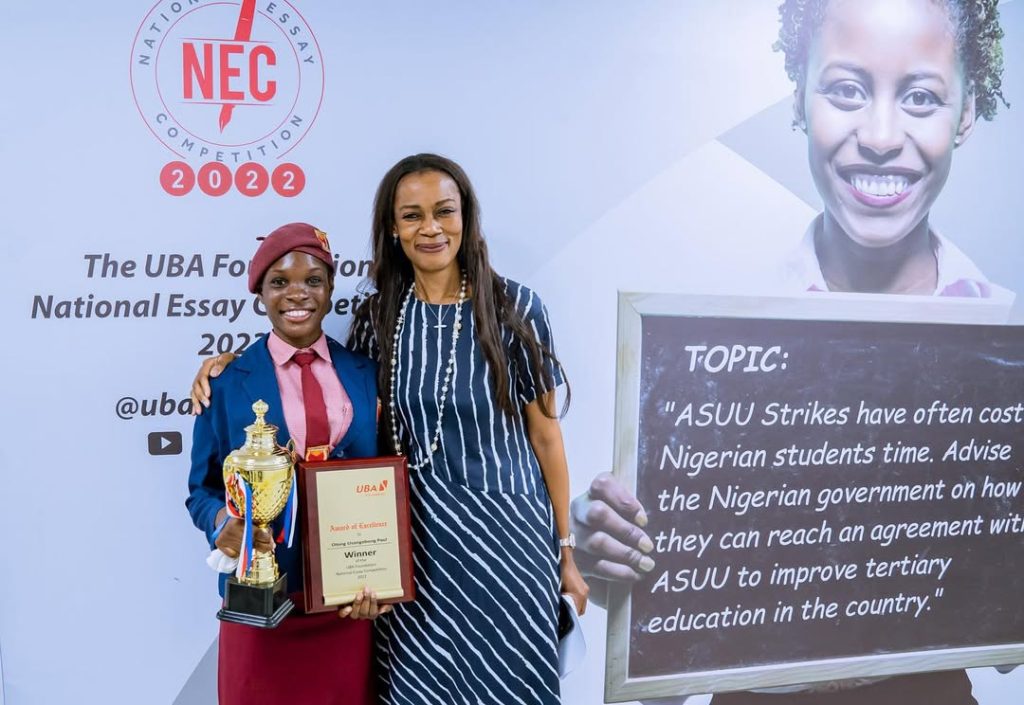
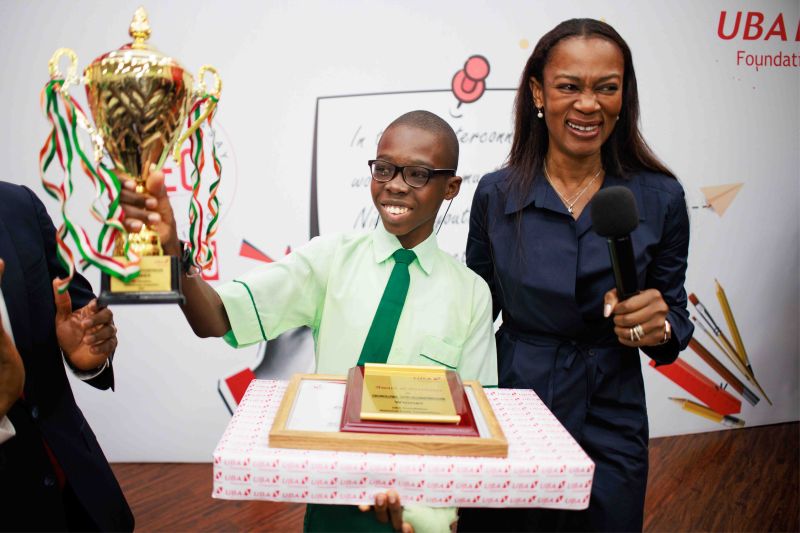
Atta has been clear about why that increase matters, particularly in the current economic climate. “The deliberate and significant increase in the value of these educational grants underscores our dedication to investing in academic excellence and alleviating the financial burden of higher education for Nigerian students and their families,” she explained.
Beyond prizes, the competition has grown into something larger than a contest. As Atta noted, it is part of the Foundation’s broader Read Africa programme. This programme has distributed hundreds of thousands of books to students across the continent. Together, the two initiatives form a consistent investment in what Atta calls “the intellectual capital that will shape Africa’s future.”
Reaching the Most Vulnerable: Food Bank and Community Giving
Between November 2025 and January 2026, UBA Foundation reached over 100,000 individuals across Nigeria and beyond through its Food Bank and Giving Back initiative. The programme targeted orphanages, IDP camps, schools, and communities stretched thin by the economic pressures of the year-end period.
Atta personally visited some of the beneficiary institutions during the outreach, including The Destitute Home in Okobaba, Lagos. There she distributed food items and school materials to adults and children alike. That kind of direct presence is characteristic of her leadership style. She does not manage philanthropy from a distance.


“At UBA Foundation, we believe that true development begins with compassion and action,” she said during the visits. “Through our Food Bank and Giving Back initiatives, we are not only providing nourishment and essential support, but also restoring hope and creating pathways for children and families to learn, grow, and thrive.”
Across Africa, the initiative extended its reach to UBA’s operating communities in more than 20 countries. As a result, the Foundation’s continental footprint became tangible in the lives of people who often sit furthest from the corridors of corporate power.
Rooting the Future: The 2026 Environment Day Initiative
Just two weeks ago, on World Environment Day 2026, Bola Atta and the UBA Foundation launched the fourth year of their Tree Planting for Sustainability Initiative. It was at two of Lagos’s most iconic secondary schools: King’s College, Lagos, and CMS Grammar School in Bariga.
The choice of schools was deliberate and symbolically loaded. CMS Grammar School is Nigeria’s oldest secondary school. King’s College has been producing national leaders for over a century.
Atta explained her reasoning plainly: “These are iconic institutions with deep historical significance. We wanted schools where these trees will be nurtured and allowed to flourish for generations to come.”
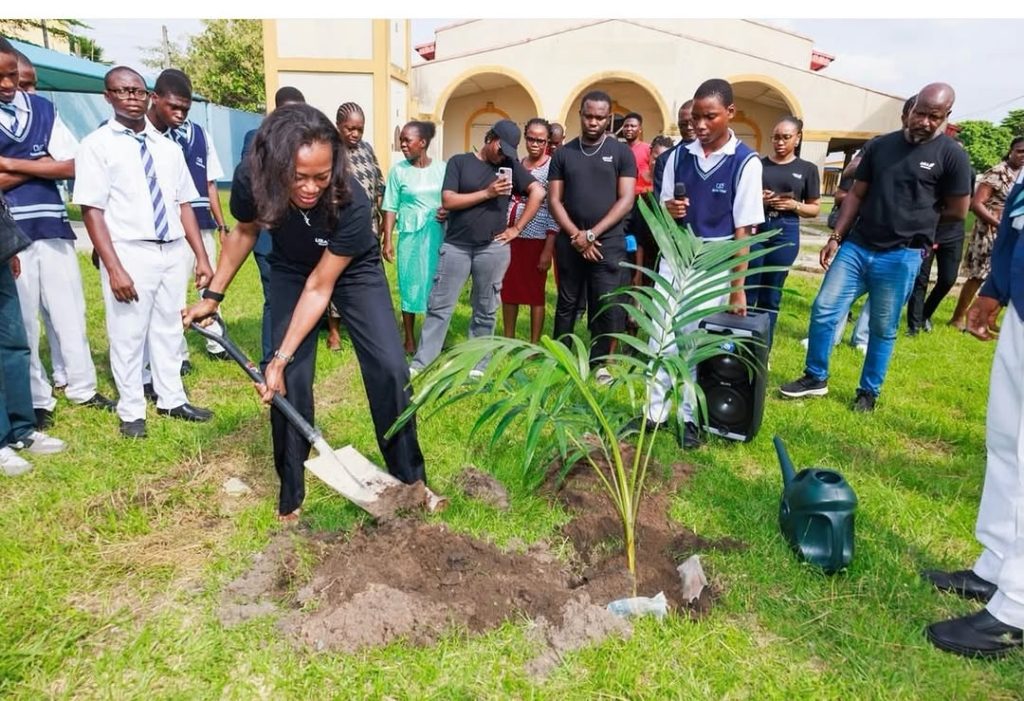
At the CMS Grammar School event, she invoked the words of Nobel Laureate and Kenyan environmentalist Wangari Maathai to frame the urgency of the moment. “The best time to plant a tree was twenty years ago,” she reminded the gathered students. “The second-best time is now.”
Moreover, the 2026 World Environment Day programme went well beyond planting saplings. Students were engaged in discussions on waste disposal, water conservation, recycling, and energy efficiency. UBA was also inaugurated as a member of the Finance Taskforce for Plastic Action in Nigeria. Sustainability Clubs were launched in schools. Green Talk sessions were held with customers across the bank’s branches nationwide.
Consequently, what could have been a single ceremonial event became a layered environmental engagement strategy. That integration of symbolic action with systemic follow-through is exactly what distinguishes Atta’s approach to the Foundation’s work.
The Three Pillars, Held Together by One Vision
Education. Environment. Economic empowerment. These are not abstract categories under Bola Atta’s leadership. They are active, rolling programmes that respond to real conditions on the ground.
On economic empowerment, the Foundation has consistently supported initiatives that equip individuals not just with resources but with tools to generate sustainable income. This dimension of the work is especially important in contexts where financial exclusion and youth unemployment remain structural problems across many of UBA’s African markets.
Additionally, the Foundation’s work in education reaches well beyond the essay competition. Scholarship grants have changed the trajectories of students who otherwise lacked access to higher education. The Read Africa programme has shifted how schools think about literacy. Together, these efforts form a coherent architecture of opportunity.
What holds all three pillars together is Atta’s long-held conviction that giving is not a seasonal act. “We believe in impacting lives all year round to create lasting effects, regardless of location or economic barriers,” she has said. That consistency, maintained across changing economic conditions, political seasons, and social crises, is what gives the Foundation its credibility.
An Exceptional Career That Found Its Full Purpose
Bola Atta graduated from the University of Sussex with a Bachelor of Economics degree. She later earned an MBA majoring in Marketing from Duquesne University. In the years that followed, she accumulated experience across banking, business, communications, publishing, and entertainment. These spanning more than 30 countries and operating in both English and French.
Along the way, she received recognition that speaks to how widely her influence has been felt. She was included among the 40 top Nigerians under 40 in 2008. In 2015, she was listed among the 100 most influential women in Nigeria.
In 2017, she was crowned Best Marketing Professional in West Africa. While in 2021 she was honoured as one of the world’s 100 most influential creatives of African descent. Additionally, she has also received the Outstanding Corporate Communications Personality of the Decade.
Nevertheless, none of those accolades fully capture what she has built at UBA Foundation. Because for Atta, as she has demonstrated repeatedly through her choices, the point was never personal recognition. The point was scope of impact. And in that regard, the numbers and the people behind them speak clearly.

What CSR Looks Like When It Is Done Right
There is a particular kind of institutional philanthropy that generates more press releases than outcomes. Bola Atta’s work at UBA Foundation is not that kind. The essay competition that changes how young people think shows it. So does the tree-planting initiative that roots environmental consciousness in Nigeria’s oldest schools. The Food Bank that reaches over 100,000 people in a single season does the same. Every pillar of the Foundation’s work is accountable, visible, and connected to an actual human life.
Furthermore, her background as a storyteller means she understands something many CSR leaders miss: the people the Foundation serves are not case studies. They are protagonists in their own stories, and the Foundation’s role is to give those stories better odds.
That is the philosophy behind her leadership. That is why, across more than two decades, the UBA Foundation under her stewardship has continued to grow in reach and relevance. And that is precisely why Bola Atta is this week’s CSR Personality of the Week.
[give_form id="20698"]