OPay’s ₦1.2bn Scholarship Expansion: What Does It Mean for Nigeria’s Future Workforce?
 ONYINYECHI NWAIGBA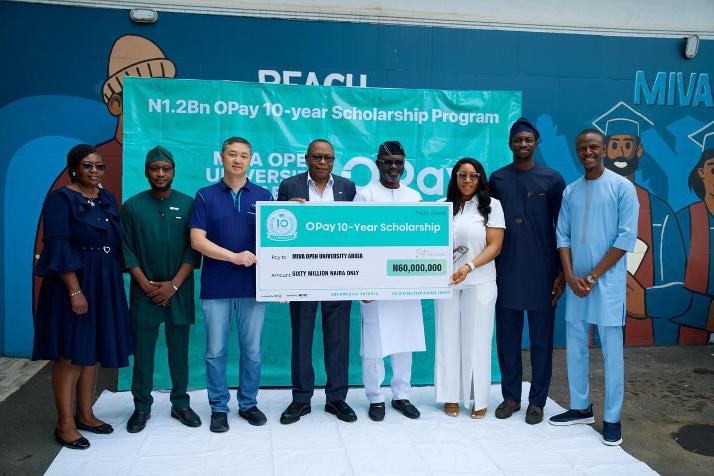
Education is one of the clearest ways to change the direction of a life.
For a young Nigerian whose family is struggling with rising tuition, accommodation, feeding and other expenses, a scholarship can mean more than financial assistance. It can mean staying in school, completing a degree, acquiring skills and eventually gaining access to opportunities that may otherwise have remained out of reach.
That is what makes OPay’s decision to expand its ₦1.2 billion scholarship program worth looking at beyond the headline.
The fintech has announced plans to extend its 10-year scholarship programme to 41 tertiary institutions across Nigeria by the end of 2026. Following a new partnership with Miva Open University, the number of participating institutions has risen from 20 to 25, with 16 additional institutions expected to join the program.
The numbers are significant, but the bigger question is what this kind of corporate investment in education could mean for Nigeria.
Beyond Paying School Fees
Nigeria’s education challenges are not simply about access to classrooms.
For many young people, the difficulty is staying in school once they get there.
The cost of tertiary education continues to place pressure on families, while students often have to balance academic responsibilities with the need to find income. For some, financial pressure can eventually lead to delayed graduation or dropping out altogether.
OPay says its ₦1.2 billion scholarship program was created to address some of these financial barriers and provide sustained support to students pursuing higher education.
That distinction matters.
There is a difference between a company making a one-off donation to an institution and creating a program designed to provide support over a decade.
The first may provide immediate relief. The second has the potential to create a longer-term pipeline of educated young people.
And in a country with a large and growing youth population, that matters.
Why Human Capital Is a Bigger Conversation
Nigeria does not only need more graduates.
It needs graduates with relevant skills who can participate meaningfully in the economy.
A scholarship can remove one barrier to education, but its wider value comes when education translates into capability — the ability to find work, create businesses, solve problems and contribute to economic growth.
That is why corporate investment in education should increasingly be viewed through a human-capital lens.
The question should not simply be: How many students received scholarships?
It should also be: What happened to those students afterwards?
How many completed their degrees?
How many gained employment?
How many started businesses?
How many acquired additional professional or technical skills?
How many went on to create opportunities for others?
These are the questions that can turn a scholarship programme from a CSR statistic into an impact story.
The Importance of a Long-Term Commitment
One of the more notable aspects of the OPay programme is its 10-year structure.
Long-term CSR commitments are important because many of the social challenges companies seek to address cannot be solved within a single financial year.
Education is a good example.
A student entering university today may need several years of support before graduating. The impact of that education may not become visible until years later when the graduate enters the workforce, starts a business or contributes to their community.
A 10-year programme therefore creates an opportunity to think beyond immediate visibility.
It also creates an opportunity for companies to measure outcomes over time.
That is where corporate responsibility becomes more meaningful.
Reaching More Institutions Means Reaching Different Students
The planned expansion to 41 institutions also raises an important question about inclusion.
Nigeria’s tertiary education system is diverse, and students have different educational needs and circumstances.
The addition of Miva Open University is particularly interesting because it brings a technology-enabled and flexible model of higher education into the programme.
As digital learning continues to reshape education, scholarship programmes will need to recognise that access does not always mean attending a traditional campus.
For some students, flexible and technology-enabled education may provide a route to acquiring skills while managing work, location or other responsibilities.
Expanding scholarship opportunities across different types of institutions could therefore broaden the definition of who gets access to corporate-supported education.
What It Could Mean for Nigeria’s Workforce
Nigeria’s future workforce is being built in classrooms today.
The students receiving support are future professionals, entrepreneurs, teachers, engineers, technology specialists, healthcare workers and business owners.
That makes education investment an economic issue, not just a social one.
When a young person gains access to higher education and eventually enters the workforce with useful skills, the benefits can extend beyond that individual.
Employers gain access to talent.
Businesses gain potential founders and employees.
Communities gain professionals.
Families gain earning potential.
And the wider economy gains human capital.
This is why corporate education programmes can have an impact that goes far beyond the value of the scholarship itself.
But Scholarships Alone Cannot Fix the Education Gap
There is also a need for perspective.
Corporate scholarships are valuable, but they cannot substitute for a strong public education system.
Nigeria’s education challenges are structural and require government investment, institutional reform, teacher development, infrastructure, curriculum improvements and broader economic policies that make education accessible and worthwhile.
The private sector can complement those efforts, but it cannot carry the entire responsibility.
That is why the most effective corporate education initiatives should ideally work alongside broader efforts to strengthen skills, employability and innovation.
For companies, this could mean going beyond tuition support to include mentorship, internships, career guidance, digital skills, entrepreneurship training and connections to employment opportunities.
The scholarship gets the student through the door.
The real impact may come from what happens after that.
Measuring What Happens After the Scholarship
This is perhaps the biggest opportunity for OPay and other companies investing in education.
As corporate CSR becomes more sophisticated, the number of beneficiaries should no longer be the only measure of success.
Companies should be asking what changed because the programme existed.
Did students remain in school?
Did graduation rates improve?
Did beneficiaries gain employment?
Did they become entrepreneurs?
Did their income prospects improve?
Did they acquire skills relevant to Nigeria’s changing economy?
Did the programme reach students who would otherwise have been excluded?
These questions matter because impact is not simply about money spent.
It is about outcomes created.
A ₦1.2 billion commitment sounds substantial. But its true value will ultimately be determined by the lives changed by that investment and the opportunities created because those young people were able to complete their education.
A Different Way to Think About Corporate Giving
There is a broader lesson here for corporate Nigeria.
For years, CSR was often associated with donations, sponsorships and short-term community interventions.
But some of the most meaningful corporate contributions may be those that build capacity rather than simply provide relief.
Education is one of them.
When a company supports someone through school, it is not only responding to a present need. It is potentially helping that person become economically independent in the future.
That is a different kind of CSR.
It moves from giving people support today to helping people build capacity for tomorrow.
The Bigger Question
OPay’s expansion to 41 institutions is therefore bigger than the number itself.
It raises a broader question about what responsible business investment should look like in a country where millions of young people are trying to build meaningful futures.
Can companies use their resources to address immediate needs while also contributing to the skills and human capital Nigeria will need in the years ahead?
Can scholarship programmes become pathways to employment, entrepreneurship and innovation rather than simply funding education?
And, perhaps most importantly, can companies stay committed long enough to measure whether their interventions actually changed lives?
Those are the questions that should follow every major corporate education announcement.
Because the real success of a scholarship programme is not how impressive the launch looks.
It is what happens years later when the student who once needed help no longer needs it because the opportunity changed what was possible for them.
[give_form id="20698"]