STEM Africa 2.0: New AI Driven Initiative Targets Africa’s Next Generation of Innovators
 csrreporters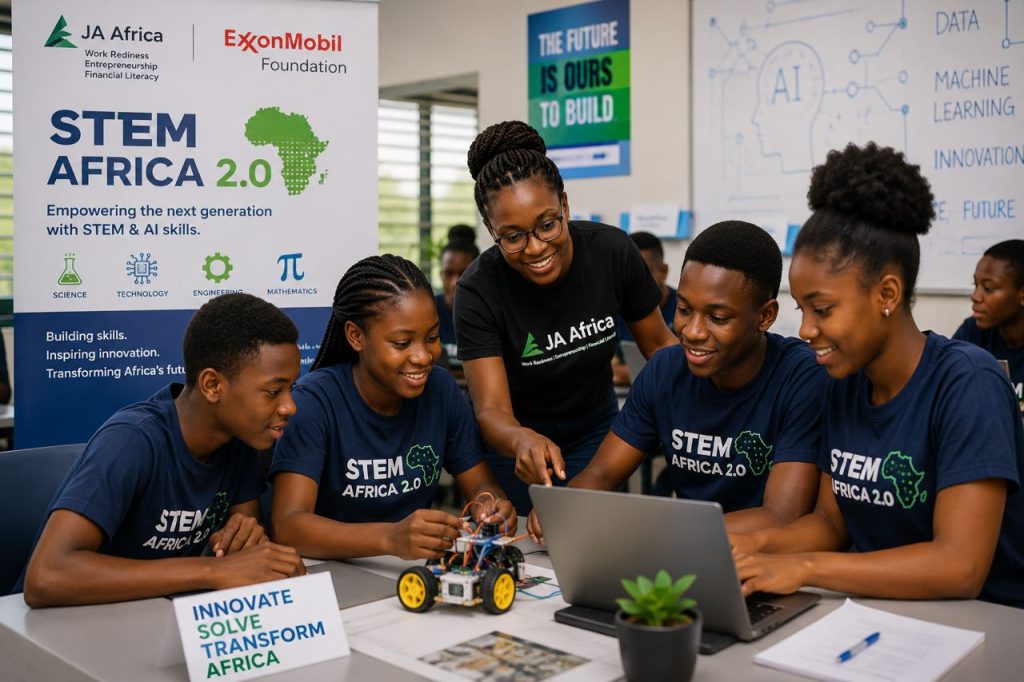
Junior Achievement Africa, in partnership with ExxonMobil Foundation, has announced the 2026 edition of its flagship STEM education initiative, launching STEM Africa 2.0, a scaled programme designed to deepen science, technology, engineering, mathematics (STEM), and artificial intelligence (AI) learning opportunities for young Africans.
The new edition expands the reach and ambition of an initiative that has already demonstrated measurable impact across the continent, having supported more than 10,000 young people in countries including Angola, Mozambique, Namibia, and Nigeria. With STEM Africa 2.0, the partners are targeting an additional 4,000 students aged 14–17, strengthening what they describe as a long-term pipeline of future innovators, engineers, and digital problem-solvers.
The programme is being introduced at a critical moment for Africa’s development trajectory. Across the continent, governments, private sector actors, and development institutions continue to emphasize the urgency of closing the digital skills gap, particularly as artificial intelligence and advanced technologies reshape global labour markets. Despite Africa’s rapidly growing youth population, access to structured, future-focused STEM education remains uneven, particularly in underserved communities and rural areas.
STEM Africa 2.0 is designed to respond directly to this gap by integrating AI learning pathways into secondary-level STEM education. The programme moves beyond traditional classroom instruction, combining experiential learning, mentorship, and competitive innovation challenges to equip students with both technical knowledge and applied problem-solving skills.
According to programme designers, the initiative is not only about improving academic performance in STEM subjects but also about cultivating innovation mindsets that allow young people to identify challenges in their communities and develop practical, scalable solutions.
Building a Future Ready Generation
The central objective of STEM Africa 2.0 is to prepare African youth for a rapidly evolving digital economy where AI literacy, computational thinking, and innovation capability are increasingly essential. The curriculum integrates AI-focused learning modules alongside foundational STEM subjects, ensuring students gain exposure to emerging technologies early in their educational journey.
The programme is structured around a four-phase learning model designed to progressively build knowledge, confidence, and applied skills. The first phase introduces students to STEM and AI concepts through interactive quizzes and guided learning materials. This is followed by zonal competitions, where students apply their knowledge in collaborative and competitive environments that encourage teamwork and critical thinking.
The third phase consists of national innovation camps, where selected participants engage more deeply with mentors, industry professionals, and facilitators to develop prototype solutions to real-world challenges. The final phase culminates in a continental showcase hosted at the Africa Energy Week Conference, where top-performing teams present their innovations on a broader stage that brings together policymakers, industry leaders, and development stakeholders.
This structure is intentionally designed to reflect real-world innovation ecosystems, where ideas are developed, tested, refined, and ultimately presented for adoption or scale. It also introduces young participants to professional environments and expectations, bridging the gap between education and employability.
Strengthening Africa’s Innovation Pipeline
Speaking on the launch, leadership from JA Africa emphasized the importance of equipping young Africans not only with academic knowledge but also with the capacity to lead in emerging industries shaped by digital transformation and artificial intelligence.
They noted that the future of Africa’s economic competitiveness will depend heavily on its ability to nurture homegrown innovation, particularly in sectors such as energy, sustainability, agriculture, and digital services. By embedding AI learning within STEM education, STEM Africa 2.0 aims to position young Africans as active contributors to technological development rather than passive consumers of imported solutions.
The ExxonMobil Foundation also reinforced its commitment to long-term youth development and education as a cornerstone of sustainable economic growth. The foundation highlighted that investments in STEM education are critical to bridging global skills gaps and ensuring that young people are equipped to participate in industries that will define the future of work.
Inclusion and Equitable Access
A key pillar of STEM Africa 2.0 is inclusion. The programme places strong emphasis on ensuring participation from underserved communities, where access to quality STEM education and digital resources is often limited. It also incorporates gender inclusion strategies aimed at encouraging greater participation of girls in STEM fields, addressing persistent disparities in science and technology education across Africa.
By actively targeting underrepresented groups, the programme seeks to reduce structural barriers that have historically limited access to high-growth career pathways. This includes not only access to learning materials but also exposure to mentorship and role models working in STEM-related industries.
The initiative also recognizes that inclusion is not limited to participation alone but extends to outcomes. As such, it aims to track how students progress beyond the programme into further education, technical training, or early-stage innovation pathways.
Learning Beyond the Classroom
One of the defining features of STEM Africa 2.0 is its emphasis on experiential learning. Rather than relying solely on theoretical instruction, the programme integrates practical activities that require students to apply what they learn in real-world contexts.
Participants are encouraged to collaborate in teams, solve problems creatively, and present their ideas in structured formats. This approach is intended to build not only technical competencies but also soft skills such as communication, leadership, adaptability, and resilience.
Mentorship plays a central role in this process. Industry professionals and educators provide guidance throughout the programme, helping students refine their ideas and understand how STEM concepts are applied in real-world industries such as energy systems, environmental sustainability, and digital innovation.
Aligning Education with Future Work
The integration of AI into STEM Africa 2.0 reflects broader global trends in education and workforce development. As artificial intelligence becomes increasingly embedded in sectors ranging from healthcare to finance and energy, digital literacy is no longer optional but essential.
By introducing AI learning pathways at the secondary school level, the programme aims to ensure that African students are not left behind in the global transition toward automation and intelligent systems. Instead, they are being prepared to actively participate in shaping these technologies.
This alignment between education and future labour market demands is also expected to improve employability outcomes for participants, creating stronger linkages between learning experiences and career opportunities in high-growth sectors.
Monitoring Impact and Long-Term Outcomes
STEM Africa 2.0 includes a structured monitoring and evaluation framework designed to track both immediate learning outcomes and long-term impact. This includes assessing improvements in STEM knowledge, problem-solving skills, and teamwork abilities, as well as tracking participants’ educational and career trajectories over time.
The emphasis on measurable outcomes reflects a growing trend in CSR and development programming, where stakeholders increasingly demand evidence of impact beyond participation numbers. By embedding evaluation mechanisms into the programme design, the partners aim to ensure accountability and continuous improvement.
A Strategic Investment in Africa’s Future
Ultimately, STEM Africa 2.0 represents a strategic investment in Africa’s human capital development. It aligns with broader continental priorities around digital transformation, youth employment, and inclusive economic growth.
As Africa continues to navigate the opportunities and challenges of the fourth industrial revolution, initiatives such as this are expected to play a critical role in shaping the continent’s innovation ecosystem. By equipping young people with both foundational STEM knowledge and emerging AI competencies, the programme is helping to build a generation that is better prepared for the demands of a rapidly changing world.
The collaboration between JA Africa and the ExxonMobil Foundation underscores the importance of cross-sector partnerships in addressing complex development challenges. It also highlights the growing role of corporate foundations in supporting education systems and fostering long-term societal impact.
STEM Africa 2.0, therefore, is not only an education initiative but also a forward-looking model for how public-private partnerships can contribute to sustainable development outcomes across Africa.
Further Reading: JA Africa, ExxonMobil Foundation Launch 2026 STEM Africa Program to Equip Youth With AI and Digital Skills
[give_form id="20698"]