ROSEMARY IMOBHIO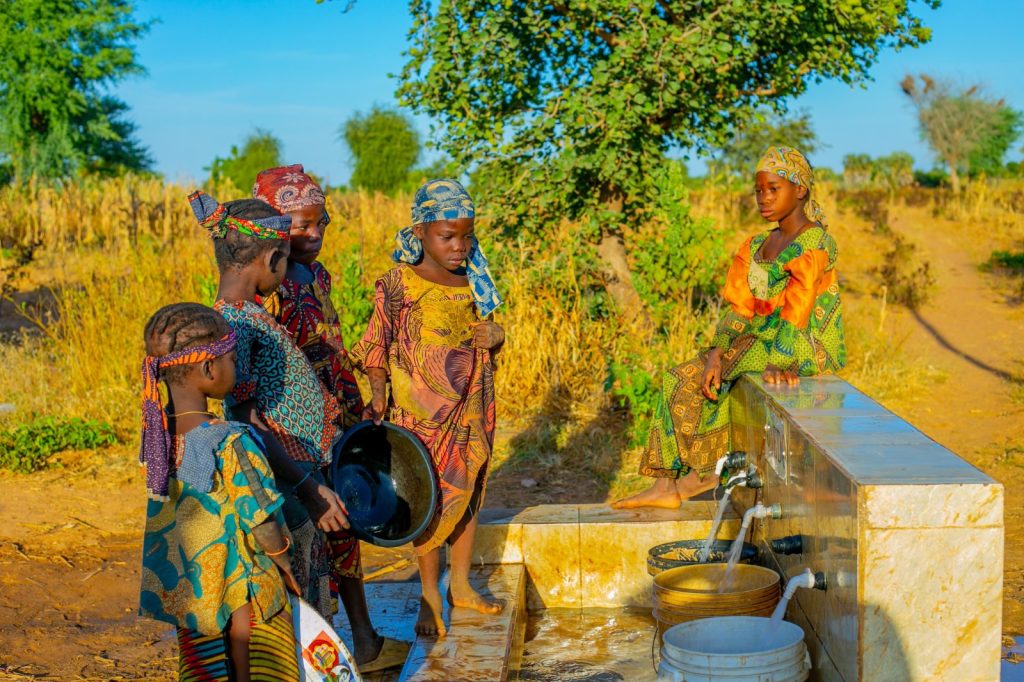
Ask a World Bank official what Nigeria’s water sector is missing, and the answer is not what you might expect. Speaking at a recent consultation workshop in Abuja, the Bank’s Acting Country Director for Nigeria, Taimur Samad, told stakeholders that the country was not short of policies, plans or roadmaps. What it lacked, he argued, was a single platform capable of turning years of commitments into reforms, investment and results that Nigerians could actually see.
That observation captures the challenge facing the Nigeria National Water Compact 2026 to 2030. This is a new framework the Federal Government is developing to pull together fragmented water policies, sanitation efforts, irrigation schemes and environmental protection into one coordinated roadmap.
However, CSR Reporters believes the question is not whether Nigeria can produce another well-written strategy document. It is whether this one behaves differently from the ones that came before it.
What Exactly Is the National Water Compact?
At its most basic, the Compact is a national roadmap that sets out reform priorities, institutional changes and investment directions for Nigeria’s water sector between 2026 and 2030. It does not build a single borehole or pipe on its own. Instead, it is meant to align federal ministries, state governments, development partners, civil society and private investors around a shared set of goals, so that water projects stop being negotiated in isolation, one donor and one state at a time.
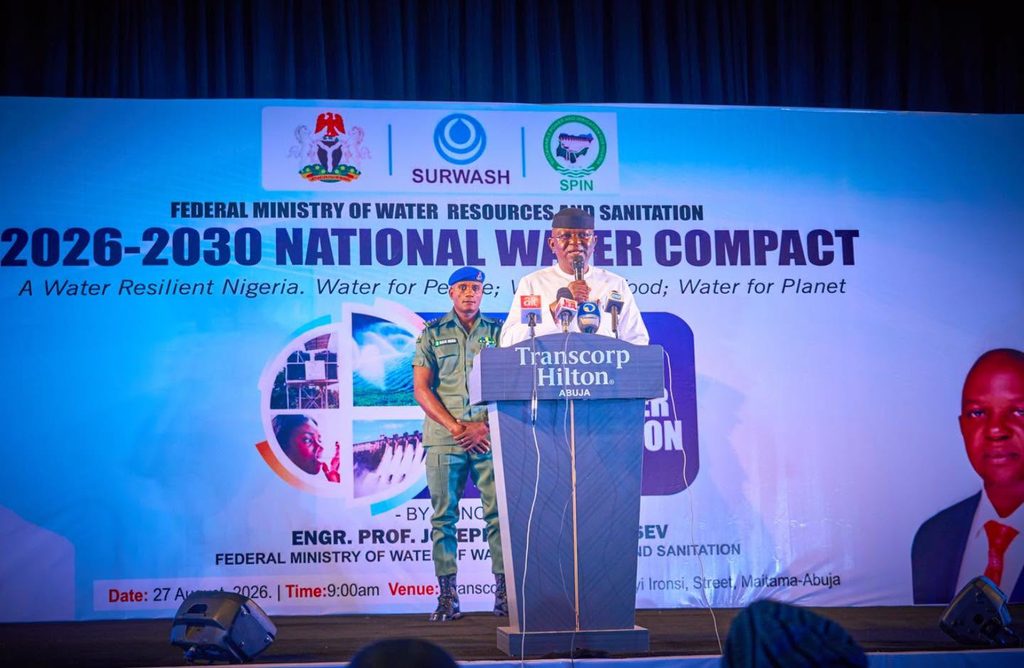
The Federal Ministry of Water Resources and Sanitation, led by Prof. Joseph Utsev, has been running nationwide consultations since August, gathering input from state commissioners before the document is finalised. Utsev has said the Compact draws on the African Union’s Africa Water Vision and Policy 2025 to 2063, adapting that continental framework to Nigeria’s own priorities.
A National Technical Working Committee, made up of federal and state officials, academics, civil society groups and private-sector representatives, produced the first draft. The government expects a final version before the end of 2026, though that timeline still depends on how the ongoing state consultations conclude.
Why Does Nigeria Need This Now?
Nigeria’s water problem is not static. It grows more complicated every year, driven by forces that rarely make headlines individually but compound when stacked together.
Rapid urbanisation is pushing more people into cities whose pipe networks were designed decades ago for far smaller populations. Climate change is bringing both extremes at once: drought stress in parts of the north and increasingly destructive flooding elsewhere.
According to the 2026 Annual Flood Outlook cited by the water resources minister, 1,249 communities across 176 local government areas in 30 states and the FCT have been flagged as high flood risk this year alone. CSR Reporters reported on that risk here.
On the drier side of the ledger, roughly 154,000 hectares of Nigeria’s irrigable land currently support more than 1.6 million farmers. This is a fraction of what the country’s agricultural ambitions would require if irrigation expanded to match population growth.
Layered on top of these physical pressures is an institutional one. Water supply and sanitation in Nigeria are delivered mostly by state governments and local utilities, while policy and coordination sit at the federal level. This division means state governments will have to take the lead on investment and reform, since federal agencies simply do not control the taps.
The Three Pillars, in Practical Terms
The draft Compact organises itself around three pillars:
- Water for People
- Water for Food Security
- Water for Planet
Water for People covers safe drinking water, sanitation and household access. This is the part of the water story most Nigerians feel directly through the reliability, or unreliability, of the taps in their homes, schools and clinics. Health Minister of State Iziaq Salako has argued that spending on water and sanitation should be treated as spending on disease prevention rather than as infrastructure for its own sake, since hospitals cannot deliver safe care without reliable water for hygiene and infection control.
Water for Food Security is about irrigation and agricultural productivity. When rainfall becomes less predictable, farmers who depend entirely on the rains face a widening gap between good and bad harvests. Expanding irrigated farmland gives them a buffer, and it feeds directly into food prices that every Nigerian household notices.
Water for Planet is the pillar most easily dismissed as background environmental concern, yet it underwrites the other two. Without protecting rivers, wetlands and groundwater from pollution and overuse, there is no sustainable source of water left to supply either households or farms. Flood and drought resilience, in other words, is not a separate agenda item. It is the condition that makes the first two pillars possible over the long run.
The States Are Where This Gets Tested
Utsev has written to the Nigeria Governors’ Forum seeking early political commitment from the 36 state governors and the FCT. President Bola Tinubu has reportedly been briefed on the Compact’s progress, too. That outreach reflects a basic reality: because water services are delivered locally, a national document that states quietly file away changes nothing on the ground.
Meaningful state ownership would likely need to go beyond signing on to a shared vision. It would mean states drafting their own implementation plans, allocating budgets to match, maintaining infrastructure that already exists rather than only building new assets, and reporting progress against measurable targets.
None of these mechanisms appear guaranteed by the draft Compact itself. They remain the practical tests that will determine whether “state ownership” becomes a working arrangement or a phrase in a communique.
The Money Question
Financing is where ambition meets constraint. Public financing alone will not be enough, Nigeria needs sustainable revenue systems capable of funding both new infrastructure and its long-term upkeep. That distinction between building and maintaining matters because Nigeria’s water sector has a documented history of the former outpacing the latter.
Consider scale. The World Bank’s $700 million SURWASH programme, approved in 2021, aimed to extend basic drinking water access to six million people. Useful, but modest next to the roughly 70 million Nigerians the Bank estimates still lack basic drinking water access, even after coverage rose from 68 percent to 80 percent between 2015 and 2022 (1).
Closing a gap that size needs private capital and domestic revenue, not just donor credit lines. This is presumably why the Compact leans on private-sector participation as one of its stated priorities. How specific projects will actually get funded, and by whom, remains one of the document’s least resolved questions.
What Could Change, If It Works
Should the Compact translate into functioning systems, the effects would show up in daily routines rather than press statements. Households could spend less on buying water and face fewer waterborne illnesses. Farmers with access to irrigation could plan around dry spells instead of losing entire seasons to them.
Businesses that depend on consistent water supply, from food processing to hospitality, could operate with fewer disruptions. Also, cities gain better tools for managing flooding and rising demand together rather than as separate emergencies. Of course, these outcomes are conditional on implementation, not guaranteed by the Compact’s existence.
The Biggest Risk Is Implementation
Nigeria’s water sector has not previously failed for lack of paperwork. A 2025 report accessed by CSR Reporters examined World Bank-backed water projects in Ekiti, Rivers and Bauchi states. It found systemic failures that continued to compromise access for millions of residents, despite $250 million in financing (2). That history is a useful caution against assuming a new framework automatically fixes execution problems that older, similarly well-funded projects could not solve.
The Compact’s value will ultimately depend on implementation rather than the quality of the finished document. Mutual accountability, regular reporting and measurable results should be built into the framework from the start. Weak data on where infrastructure actually fails, inconsistent state political will, and shifting priorities after elections all remain live risks that no roadmap eliminates by design alone.
How Will Nigeria Know If It Worked?
By 2030, the honest measures of success will include how many more Nigerians gained safely managed drinking water rather than merely basic access, how sanitation coverage moved, how much irrigated farmland expanded, and whether flood-prone communities saw fewer disruptions during the rainy season. None of that is guaranteed simply because Abuja publishes a finished Compact before December.
Nigeria has produced ambitious water strategies before. What will separate this one is not the strength of its language but whether, five years from now, someone in Bauchi, Ekiti or Rivers State can point to a functioning tap and say the plan actually reached them.
The government has indicated the Compact is expected to be finalised before the end of 2026, following the ongoing round of state consultations. Whether that timeline holds, and whether the finished document translates into pipes that work and taps that run, will say far more about Nigeria’s water future than any launch ceremony ever could.
References
- World Bank. The Global Water Security and Sanitation Partnership (GWSP) 2022 Annual Report (English). Washington, D.C. : World Bank Group. https://documents1.worldbank.org/curated/en/099102211102224772/pdf/IDU0a8831b08028b604d070aa0104893aa4ceda2.pdf
- Corporate Accountability and Public Participation Africa. (2025). Big debt, big thirst: A case study of World Bank supported projects in Ekiti, Rivers and Bauchi States. Retrieved from cappaafrica.org
Water security shapes health, food systems and business resilience across Nigeria and the continent. For more analysis on the policies, investments and accountability questions defining Africa’s sustainability agenda, keep reading CSR Reporters.
[give_form id="20698"]