ROSEMARY IMOBHIO
A shipping container does not immediately bring healthcare to mind. In fact, in Nigeria, with all its horror stories, you pray not to get stuck in a vehicle beside it in traffic. That aside, usually, these containers carry goods across oceans, sit in a port, or wait in a warehouse.
However, Texas A&M University students found another use for these steel boxes. They are turning them into functioning medical clinics for communities with limited access to healthcare. Now, that idea has received a major boost from MrBeast’s philanthropic organisation, Beast Philanthropy.
The partnership with Texas A&M’s student-led BUILD programme supports five Texas Aggie Medical Clinics. The clinics are destined for communities in Texas, Massachusetts, Kenya, Nigeria and Ukraine.
The idea on paper is simple. Take an existing shipping container, redesign the interior, install medical infrastructure and equip it with supplies. Then, move the finished clinic to a community that needs it.
Yet, this simplicity hides a bigger lesson. For companies investing in corporate social responsibility, the project raises an important question. Does good CSR have to be expensive, complicated, and slow before it can create meaningful impact?
Perhaps not.
The Real Innovation Is Not The Container
The shipping container makes for a great headline. Still, the container itself is not the most important part of the project. The real innovation lies in the system around it.
BUILD has been converting 40-foot shipping containers into medical clinics since 2013. Over the years, the student-led organisation has built dozens of clinics for underserved communities.
Each clinic can include a waiting area, laboratory testing space and private treatment room. Donated medical equipment and supplies also help make the facilities functional after deployment.
However, more importantly, the model combines several forms of social impact. Students gain practical experience. Communities receive healthcare infrastructure. Donors provide resources. Nonprofits help identify where the clinics are needed. Meanwhile, medical organisations can supply equipment and technical support.
That is a much more interesting CSR model than simply handing out donations. It creates a chain of value.
Why This Matters For Sustainable CSR
For years, corporate philanthropy has often focused on visible projects. A company builds a school. Another donates computers. A third renovates a hospital. Then, photographs are taken, press releases are issued, and everyone moves on to the next project.
There is nothing inherently wrong with that approach. CSR Reporters covers these projects and documents the impact they create. However, sustainability requires a different question.
What happens after the launch ceremony?
That question is particularly important in healthcare. A new clinic cannot serve patients without health workers. And goodness knows Nigerian healthcare workers are leaving for greener pastures in droves.
Equipment cannot help patients if it stops working. Medicines cannot reach communities without reliable supply chains. Furthermore, a facility without electricity, water, sanitation or referrals can quickly become little more than an expensive structure.
That is where the MrBeast and BUILD model offers a useful lesson. The physical infrastructure is only one part of the intervention. Partnerships and local organisations remain essential to its operation.
For example, one BUILD clinic supported through Beast Philanthropy reached Kenya in 2026. The facility was dedicated at Kilifi Regional Hospital on February 4 and is being used by Clubfoot Care for Kenya for specialised treatment. The hospital also uses it for other medical needs during the week.
That matters because the project did not simply stop when the container arrived. There was a local partner, an existing health facility and a defined medical need. Consequently, the infrastructure had somewhere to fit into the broader health system.
Nigeria Should Pay Attention
This model is particularly relevant to Nigeria. Across the country, healthcare access can still depend heavily on geography. In some communities, the nearest functional facility may be too far away. In others, insecurity, flooding, poor roads or unreliable infrastructure can make access even harder.
Recent developments show the problem clearly. In March 2026, the World Health Organization reported that Adamawa deployed 10 mobile clinics to reach underserved communities. Distance, insecurity and seasonal flooding had made access to fixed facilities difficult for many residents.
Likewise, WHO highlighted a nomadic community in Osun where families had lived for years without nearby basic health services. Outreach workers eventually brought vaccination services closer to them.
Meanwhile, electricity remains another major challenge. WHO reported in April that an estimated 40 to 50 percent of primary healthcare facilities in Nigeria experience unreliable electricity. That problem can affect everything from childbirth to refrigeration and essential medical equipment.
See How JMG Used CSR to tackle this here
The verdict is therefore clear, Nigeria does not simply need more buildings. It needs healthcare infrastructure that can reach people.
Could Container Clinics Work Here?
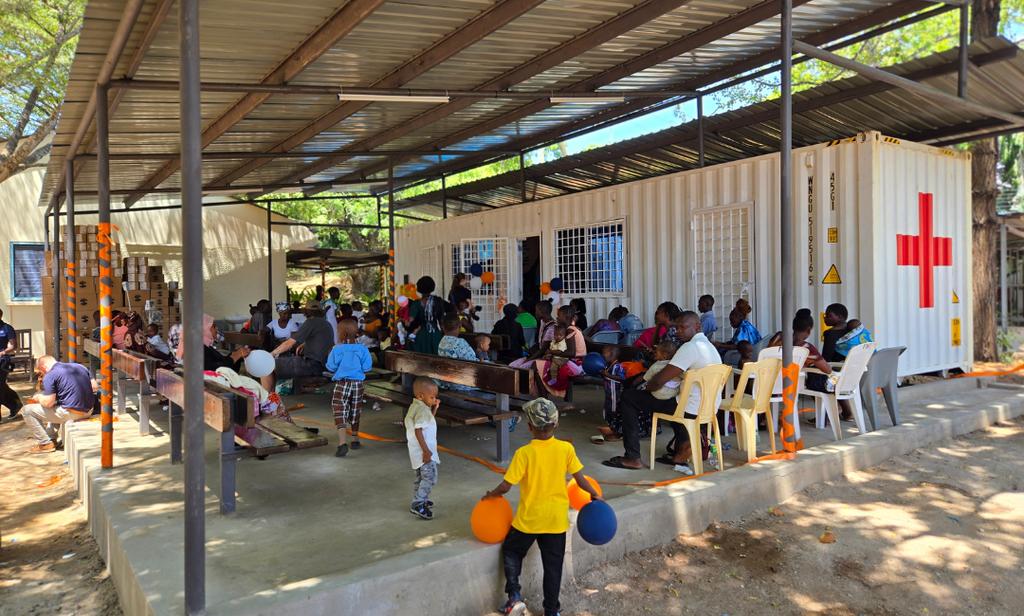
The answer is yes and the container from MrBeast is already here. It is at the Dame Irene Okwuosa Memorial Hospital in Oraifite, Anambra State where it is used for life-saving open heart surgeries. However, copying the MrBeast model without adapting it to Nigeria would miss the point.
A Nigerian version would need to consider local realities from the beginning. For instance, a container clinic in a flood-prone community would require a different design from one in a dry rural settlement. Similarly, communities with unreliable electricity would need dependable power solutions. Solar systems could potentially become part of the design where technically and financially appropriate.
Water and sanitation would also have to be treated as core infrastructure rather than optional extras. Furthermore, medical waste management would need careful planning.
A clinic that generates medical waste without a safe disposal system can create another public health problem. Therefore, sustainability cannot simply mean reusing a steel container. It must mean designing the entire healthcare solution responsibly.
The Environmental Argument Is Complicated
There is also an interesting sustainability angle here. Repurposing an existing shipping container can give an old industrial asset another useful life. Instead of allowing it to remain idle or treating it solely as a transport unit, the structure becomes part of a healthcare facility.
That supports the broader circular economy idea of extending the useful life of existing materials. However, CSR teams should avoid making exaggerated environmental claims. Shipping a heavy steel container across continents still requires transportation. Converting it also requires materials, energy and equipment. Therefore, the environmental benefit depends on the full lifecycle of the project.
That is why responsible CSR reporting should look beyond the attractive phrase “recycled container.” The better question is this: Does the complete solution create more social and environmental value than the resources it consumes?
That is a much harder question. It is also the question serious sustainability programmes should ask.
CSR Should Move From Projects To Systems
Perhaps the biggest lesson from the clinics is that CSR should stop being obsessed with projects. A project has a beginning and an end. A sustainable intervention should have continuity.
For example, a company could fund the construction of a clinic. Yet, another organisation could provide health workers. A local government could support integration into the primary healthcare system. A technology partner could provide telemedicine. Another donor could support medicines. Suddenly, CSR becomes an ecosystem. That approach also creates stronger accountability.
Companies can measure patient visits, referrals, maternal health outcomes, vaccination coverage, equipment uptime and operating costs. They can also monitor whether communities continue using the facility years later. Those indicators tell a much better story than the number of clinics constructed.
Nigeria Already Has Pieces Of The Puzzle
Interestingly, Nigeria does not have to start from scratch or ship in container clinics from outside. The country’s Basic Health Care Provision Fund is designed to strengthen primary healthcare and improve access for vulnerable populations. In March 2026, the government approved more than ₦32 billion for strengthening primary healthcare facilities.
The Federal Government also reported in July that 3,026 primary healthcare facilities had been revitalised nationwide, alongside investments in maternal and newborn care. Those investments are important. However, private-sector CSR can complement government efforts rather than duplicate them.
Instead of every company building another standalone facility, businesses could support gaps that governments and communities have already identified. One company could finance solar power. Another could support cold-chain equipment.
A telecommunications company could provide connectivity while a pharmaceutical company could strengthen medicine access. An engineering firm could then develop modular clinic infrastructure. Together, those interventions could create something much more valuable than isolated donations.
The Danger Of The Camera Leaving
There is, however, one criticism that CSR leaders should take seriously. Celebrity philanthropy can generate enormous attention. That attention can attract funding, inspire volunteers and place neglected problems before millions of people. MrBeast’s enormous audience makes that especially powerful.
Yet, visibility can also create pressure to prioritise what looks impressive on camera. Transforming a container into a clinic is visually compelling. A five-year maintenance plan is not.
A ribbon-cutting ceremony is exciting. Training health workers is less glamorous. A drone shot of a clinic arriving in a community looks spectacular. Paying for replacement equipment three years later does not.
Nevertheless, those less glamorous activities often determine whether the intervention succeeds. Therefore, CSR should resist the temptation to confuse visibility with impact.
The Five-Year Question
CSR Reporters believes that every CSR healthcare project should have a five-year question. Where will this facility be in five years?
- Who will operate it?
- Who will pay for maintenance?
- Who will replace broken equipment?
- Who will supply medicines?
- Who owns the facility?
- Who measures its impact?
- What happens if the original donor leaves?
Those questions should be answered before the cameras arrive.
This is where the MrBeast and BUILD initiative provides a valuable conversation starter. The project demonstrates that unconventional infrastructure can bring healthcare closer to underserved communities. However, its strongest lesson is not that every problem can be solved with a shipping container.
Rather, it shows what becomes possible when innovation, philanthropy, education, partnerships and local need come together.
The Future Of CSR May Be Modular
Businesses are under growing pressure to demonstrate measurable social impact. At the same time, communities need solutions that are faster, more adaptable and more resilient. Modular infrastructure could become part of that conversation.
It could support temporary healthcare during emergencies. It could provide services in remote communities. Additionally, it could supplement existing hospitals. In some locations, it could also serve as a bridge while permanent infrastructure is developed.
Yet, the technology should always follow the need. CSR should not begin with, “We have a container. Where can we put it?” It should begin with, “What problem does this community have, and what is the most sustainable way to solve it?”
That distinction is crucial.
Beyond The MrBeast Effect
MrBeast’s philanthropy has shown how celebrity platforms can bring enormous attention to social problems. However, the deeper opportunity lies beyond the celebrity. Companies do not need millions of YouTube subscribers to create meaningful impact. They need good partnerships, clear objectives, community involvement and a willingness to measure what happens after the launch.
Nigeria, in particular, has plenty of problems that could benefit from that approach. From hard-to-reach communities to unreliable electricity and gaps in primary healthcare, the challenges are enormous. Yet, so are the opportunities for creative CSR.
The container clinic therefore offers more than a clever idea. It offers a challenge to corporate Nigeria. Build less for the camera and more for the community.
If a CSR intervention can remain useful after the cameras leave, survive beyond the launch event and continue delivering value years later, then it has achieved something far more important than publicity. It has created impact that can endure.
[give_form id="20698"]