csrreporters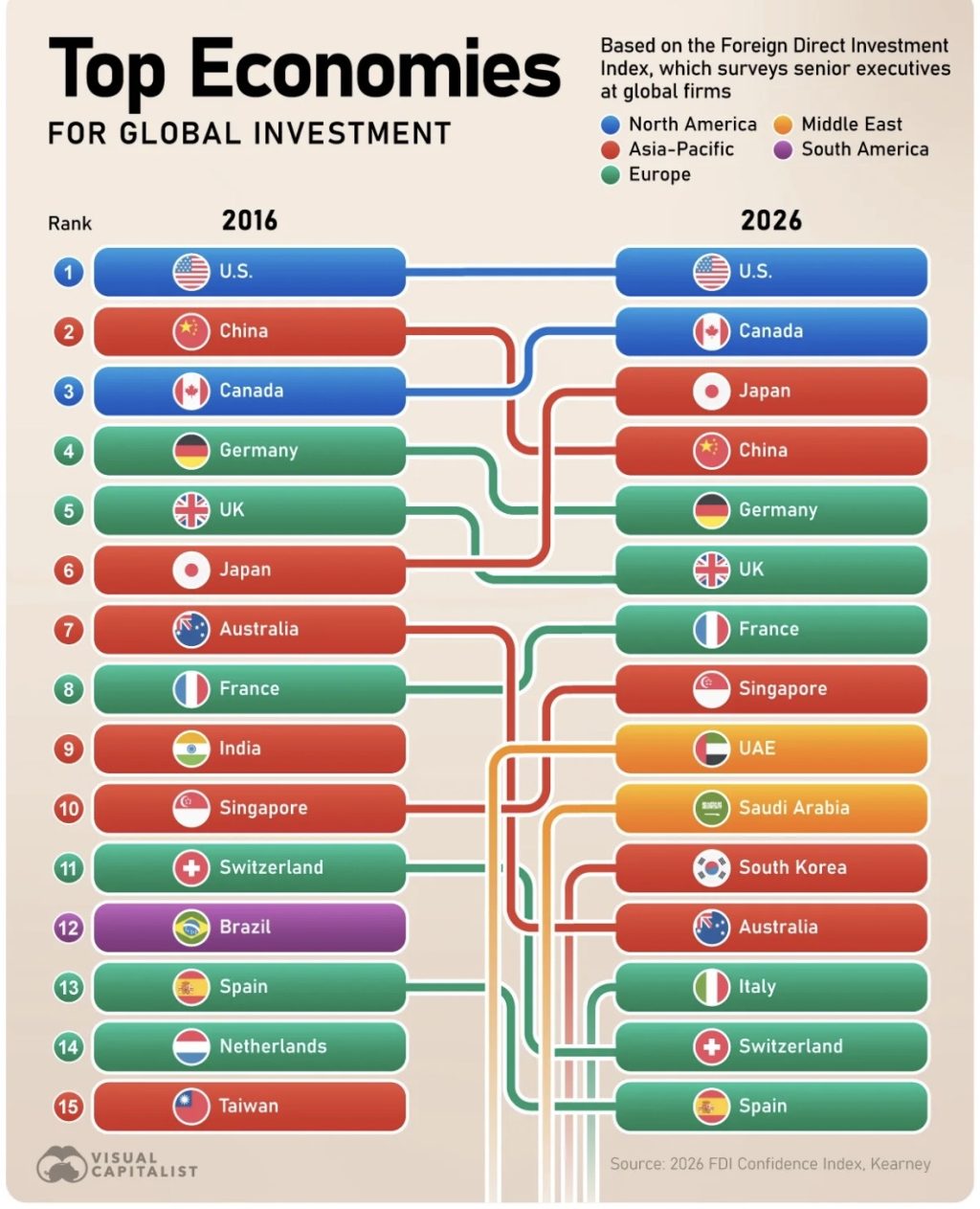
INVESTMENT INTELLIGENCE: Africa Is Not on the Map — And That Is the Point
What the 2026 Global FDI Confidence Index Reveals About the Continent’s Accountability Deficit
By CSR Reporters Editorial
Every three years, Kearney surveys more than 500 senior executives across the world’s largest corporations and asks them a direct question: where do you intend to invest? Their answers, compiled into the Foreign Direct Investment Confidence Index, do not merely track capital flows. They map institutional trust — the kind of trust that takes decades to build and a single governance crisis to erode.
The 2026 edition of that index has just been released. The United States retains its top position. Canada has surged to second. Japan is third. Saudi Arabia, for the first time in the survey’s history, has broken into the global top ten.
Africa is nowhere in the rankings.
Not Kenya. Not Nigeria. Not South Africa. Not Egypt. Not Ghana. The continent does not register — not as a rising market, not as an emerging destination, not even as a footnote in the conversation about where the next decade of global investment will flow.
Africa’s absence from the 2026 FDI Confidence Index is not a data gap. It is a governance verdict.
This is not, as some may argue, simply a reflection of Africa’s smaller economic scale. The index measures investor confidence — sentiment, risk perception, institutional reliability. And on those measures, the continent has not yet made the case. The question for African businesses, policymakers, and civil society is not whether this is unfair. The question is why — and what it demands of us.
The Formula That Is Working Elsewhere
To understand Africa’s absence, it helps to understand what is driving the rankings of those who are rising.
Canada climbed from third to second not on the strength of proximity to the United States alone, but because of a combination that senior investors increasingly prize: political stability, natural resource depth, expanding AI infrastructure, and what Kearney describes as a record 297 foreign direct investment announcements in the first half of 2025 alone. Canada is not just attracting capital; it is signalling to global investors that the institutional environment is predictable and that commitments will be honoured.
Japan’s rise to third place tells a similar story. Amid geopolitical uncertainty in Asia, Japan has positioned itself as a stable counterweight — a society with rule of law, transparent corporate governance, and a long-term industrial strategy that investors can read and rely on.
Saudi Arabia’s entry into the top ten is perhaps the most instructive. A decade ago, it did not appear in the top 25. Today it ranks tenth. The mechanism behind this climb is not oil wealth alone — it is the deliberate deployment of sovereign capital to signal intent and build credibility: AWS investing $5.3 billion in Saudi data infrastructure, Google Cloud partnering with the kingdom’s sovereign wealth fund on AI, Microsoft and Oracle committing to the UAE. These are not charity investments. They are bets placed by global capital on the reliability of institutional environments.
The formula that is attracting global capital is consistent: political stability, institutional transparency, long-term infrastructure commitment, and accountable corporate governance.
The formula is consistent: political stability, transparent institutions, long-term infrastructure, and accountable corporate governance. Africa, for all its resource wealth and demographic momentum, has not yet assembled these components into a coherent signal that global capital can trust.
The Accountability Gap at the Heart of Africa’s Investment Deficit
It would be intellectually dishonest to reduce Africa’s FDI challenge to infrastructure deficits or political instability alone. Those are real. But beneath them lies a more fundamental problem — one that is directly relevant to the work of this platform.
Africa has a corporate accountability crisis that it has not fully named.
Across the continent, billions of naira, cedis, shillings, and rand flow annually through CSR programmes, sustainability commitments, and social investment disclosures — with little independent verification, minimal third-party scrutiny, and almost no standardised reporting. Companies declare impact. Communities experience something different. Investors reading ESG disclosures encounter narratives rather than data.
This gap — between what is claimed and what is measurable — is not invisible to global capital. It is precisely the kind of signal that experienced investors read when they are deciding where to deploy long-term funds. When environmental, social, and governance disclosures cannot be independently verified, when community engagement is theatre rather than consultation, when boards lack genuine accountability mechanisms, the investment calculus shifts. Risk premiums rise. Capital flows elsewhere.
Nigeria offers the sharpest illustration. It is the continent’s largest economy by GDP, home to some of Africa’s most profitable corporations, and the site of considerable annual CSR spending. Yet the governance environment — from inconsistent regulatory enforcement to unverified social investment claims — continues to push risk-adjusted returns in the wrong direction for discerning global investors. The proposed National CSR Registry and the Nigeria CSR Bill, which this platform has tracked closely, remain stalled. The measurement infrastructure that would allow Nigeria’s corporate responsibility story to be told credibly to global capital does not yet exist.
When ESG disclosures cannot be independently verified, global capital reads the silence as risk. That risk is priced into every investment decision.
South Africa, which has the continent’s most sophisticated corporate governance architecture and the JSE’s established sustainability reporting requirements, comes closest to building the kind of institutional credibility that FDI confidence demands. Yet even there, the gap between disclosure and verified impact remains wide.
The Gulf’s Lesson for Africa’s Corporates
The rise of Saudi Arabia and the UAE in the FDI rankings carries a specific lesson that African business leaders should study carefully.
These economies did not simply wait for investors to discover their potential. They made institutional commitments visible, measurable, and credible at scale. They built sovereign wealth infrastructure that could anchor large-ticket partnerships. They established regulatory environments that gave global technology companies confidence to commit billions. They created — deliberately, systematically — the conditions under which trust could be placed.
African corporates cannot manufacture sovereign wealth funds overnight. But they can manufacture something equally powerful: a demonstrable culture of accountability. They can invest in independent third-party impact verification. They can move from narrative sustainability reports to audited social investment disclosures. They can build community consultation processes that global investors can see and assess. They can participate — voluntarily and visibly — in the kind of transparency mechanisms that signal institutional seriousness.
The companies that make these commitments now will be positioned differently in five years. The ones that do not will continue to operate in environments that global capital prices as high-risk — regardless of the underlying opportunity.
What African Governments Must Reckon With
The FDI Confidence Index is ultimately a verdict on enabling environments — the regulatory, institutional, and political conditions that governments construct around business activity. Africa’s governments have, in many cases, created significant headwinds for the very investment they seek.
Inconsistent policy enforcement. Arbitrary regulatory changes. Weak judicial systems that cannot protect commercial interests. Corruption that raises the cost of doing business and depresses returns. These are not new observations — they appear in every investment climate survey. But the 2026 Kearney index serves as a reminder that the problem has not been solved, and that the cost of inaction is visible, quantifiable, and growing.
The countries climbing the global rankings have one thing in common: their governments have made long-term, credible commitments to institutional stability. Canada’s federal AI investment strategy. Japan’s sustained industrial policy. Saudi Arabia’s Vision 2030. These are not perfect — no policy environment is — but they are legible to global capital. Investors can read them, model them, and bet against them.
African governments need to build equivalent legibility. That means regulatory frameworks for sustainability and ESG that are enforced, not aspirational. It means mandatory social investment reporting tied to verifiable community outcomes. It means fast-tracking the institutional infrastructure — stock exchange sustainability requirements, national CSR registries, independent audit mechanisms — that would allow the continent’s corporate responsibility story to be told in a language that global capital understands.
Capital does not flow toward potential. It flows toward predictability. Africa’s task is to make its institutional environment legible to global investors.
The Role of Accountability Intelligence
There is a role here for the kind of independent accountability journalism and intelligence work that this platform is committed to.
Global investors making decisions about African markets do not have access to granular, reliable, independently-produced data about corporate social performance across the continent. The information environment is thin, episodic, and dominated by self-reported narratives. Filling that gap — with credible rankings, verified impact intelligence, and rigorous scrutiny of ESG disclosures — is not merely a media function. It is an infrastructure function.
The Nigeria CSR Impact Ranking, the SISA awards, the Transparency Index — these are not vanity projects. They are the building blocks of the information architecture that global capital needs before it will seriously consider African markets as destinations for long-term, responsible investment. Every rigorous piece of accountability reporting produced about corporate conduct in Africa adds a data point to an information environment that is currently too sparse to support the investment decisions that will transform the continent.
This is the bet that CSR Reporters has made: that accountability intelligence, produced consistently and credibly, is one of the prerequisites for the kind of institutional trust that the 2026 FDI Confidence Index measures. The continent needs more organisations making that bet.
The Urgency Is Not Abstract
The 2026 Kearney index covers investment intentions for the next three years. The companies and governments making the decisions that will shape those flows are making them now — in boardrooms in New York, London, Tokyo, and Riyadh. Africa has a narrow window to make a credible case.
That case cannot be made through press releases or investment summits alone. It has to be made through the visible, verifiable behaviour of African institutions — corporate and governmental — over a sustained period. The work is slow, unglamorous, and often thankless. It involves building measurement systems, enforcing accountability standards, supporting independent oversight, and creating the conditions under which trust can legitimately be placed.
The FDI Confidence Index will be produced again. The question is whether Africa will still be absent from its rankings — or whether the corporate and institutional actors on this continent will have done the work required to change that verdict.
The answer depends, in large part, on choices being made right now.
| WORK WITH CSR REPORTERS If your organisation wants to move from random CSR activities to structured, measurable impact, CSR REPORTERS helps organisations: Conduct community needs assessments Track and measure CSR impact Document and report social investments Communicate CSR efforts transparently and independently Responsible business should not begin when companies become big. It should begin the day the business starts. |
Source: Kearney Foreign Direct Investment Confidence Index, 2026 Edition. Data covers survey responses from 507 senior executives on investment intentions across a three-year horizon.
[give_form id="20698"]