admin
admin 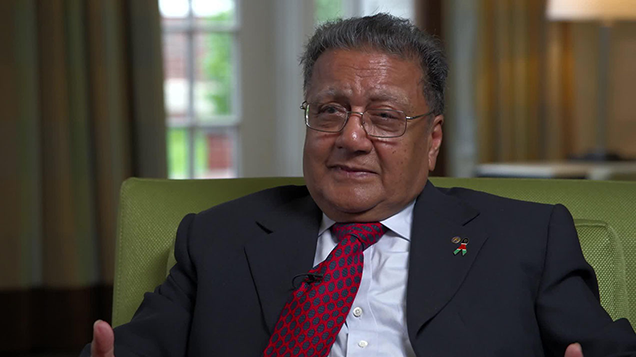
AFRICAN IMPACT CHAMPIONS | Manu Chandaria: Turning Steel Into Service
–
When Manu Chandaria introduces himself, he does not say industrialist. He does not say billionaire, or chairman, or conglomerate chief. He says: ‘I am just a social worker.’ For a man who built one of Africa’s most formidable industrial empires — the Comcraft Group, operating across more than 40 countries and employing over 40,000 people — that is not false modesty. It is a statement of priority. And over nine decades of life on this continent, Chandaria has proven, again and again, that he means it.
In March 2026, the Government of Kenya formally awarded Manu Chandaria the National Heroes Award — presented at his home in Muthaiga, Nairobi, a recognition of a lifetime of giving that has placed his name on hospitals, schools, arts centres, and community development projects across East Africa and beyond. For Chandaria, then 97 years old, the award was less a crowning moment than a quiet confirmation of a conviction he has held since he was a young man: that the wealth a person earns does not fully belong to them. That they are, at best, its trustee.
“The wealth that you have is not yours. You are only the trustee of the wealth you have.”
FROM A MUD HUT IN GUJARAT TO THE HEART OF EAST AFRICA
The Chandaria story begins not in Nairobi’s boardrooms but in the farms and fields of Gujarat, India. Manu Chandaria was born in Nairobi in 1929, to Indian immigrant parents of modest means who had made the difficult journey to East Africa in search of a better life. His father arrived in Kenya in 1916 with little more than resolve — and within months, discovered that his wages from employment barely covered survival. The family made a decision: they would build something of their own.
The decision to build a family business — and eventually a philanthropic foundation — was not born from abundance. It was born from proximity to struggle. The Chandarias had seen what scarcity looked like. They had experienced the vulnerability of communities left without schools, without clinics, without opportunity. That early education in empathy would become the moral engine of everything that followed.
Young Manu studied, worked, absorbed. He trained in the United States — earning a degree from Oklahoma State University — before returning to Kenya to help grow the family enterprise. The Comcraft Group, which would eventually span steel manufacturing, aluminium production, and industrial conglomerates across Africa, Asia, and Europe, became a vehicle not just for wealth creation but for what Chandaria himself calls ‘the responsibility that comes with doing business.’
A FOUNDATION BEFORE THE FORTUNE WAS MADE
In 1955 — long before Comcraft became a continent-spanning empire — Manu Chandaria walked into his father’s office with an idea. He wanted the family to establish a formal philanthropic foundation. His father’s response was blunt: ‘You are stupid.’ They were still a small company, still finding their footing, still nowhere near the wealth that would later define them.
Chandaria persisted. He had been inspired by the models of the Rockefeller and Ford Foundations in the United States — organisations that understood that philanthropy was not a footnote to success but a structural commitment woven into how a business operated. He kept pressing the case. ‘We start with what we have,’ he told his father. Eventually, the family agreed — committing to allocate a proportion of their profits to social impact, even before the profits were significant.
The Chandaria Foundation was formally established in 1955. What began as a small, family-administered fund focused on scholarships and disability support — shaped partly by Manu’s personal experience with a deaf brother — has grown into one of Africa’s most respected philanthropic institutions, with active chapters in Kenya, Uganda, Mumbai, and the United Kingdom.
“When you are doing business, you are responsible from Day 1 to help build the society.”
STEEL, SCHOLARSHIPS, AND SCALPELS: THE CHANDARIA FOOTPRINT
The Chandaria Foundation’s impact across Africa spans over seven decades and touches virtually every domain of human need. To walk through its portfolio is to encounter a philosophy made tangible: that giving should be structural, not episodic; strategic, not sentimental.
In education, the Foundation has funded hundreds of scholarships, administered through the Kenya Community Development Foundation, with an explicit preference for girls. It endowed the Chandaria School of Business at United States International University-Africa — one of East Africa’s leading business schools. It established the Chandaria Centre for Performing Arts at the University of Nairobi, reflecting a conviction that the arts are not a luxury but a dimension of human dignity.
In healthcare, the Chandaria name is literally written into the infrastructure of Kenya’s medical landscape. The Chandaria Accident and Emergency Centre at Nairobi Hospital. The Chandaria Cancer and Chronic Disease Centre in Eldoret. The Chandaria Medical Centre at Gertrude’s Children’s Hospital in Nairobi. These are not plaques on walls. They are functioning facilities that have served, and continue to serve, hundreds of thousands of Kenyans who might otherwise have gone without care.
Across more than 11 African nations where the Comcraft Group operates, the Chandaria family has established local charitable trusts — an embedded model of giving that ties philanthropic responsibility directly to where business profit is generated. In 2022, the Foundation donated to the rehabilitation of inmates at Langata Women’s Prison. In total, the Foundation has contributed over $100 million to education, health, arts, and community development across Africa.
AT A GLANCE
Foundation: Chandaria Foundation (est. 1955)
Flagship Vehicle: Comcraft Group — 40+ countries, 40,000+ employees
Total Giving: Over $100 million across Africa
Key Focus Areas: Education, healthcare, arts, disability, youth empowerment
Landmark Facilities: Chandaria School of Business; Chandaria Cancer Centre, Eldoret; Chandaria A&E Centre, Nairobi
Continental Reach: Charitable trusts in 11+ African nations
Global Recognition: Carnegie Medal of Philanthropy (2022) — first African recipient
National Recognition: Kenya National Heroes Award (2026)
THE JAIN CONSCIENCE: FAITH AS THE ENGINE OF GIVING
To understand Manu Chandaria’s philanthropy, you must understand his faith. A devout follower of Jainism — a philosophy rooted in non-violence, compassion, and the belief that all living beings are interconnected — Chandaria has never treated giving as corporate social responsibility. He has treated it as a spiritual obligation.
This distinction matters. CSR, as commonly practised, is often reactive: a percentage of profit set aside to manage reputational risk, satisfy regulators, or respond to community pressure. Chandaria’s model predates that entire framework. The Chandaria Foundation was not established because regulators demanded it, or because a PR consultant recommended it. It was established because a young man believed — deeply, personally — that the purpose of wealth was service.
When asked what he would change if he could live his life over, Chandaria’s answer was characteristic: he would have started serving others sooner. Not built his empire sooner. Not expanded into more markets sooner. Started serving sooner.
“To succeed and have an impact, you must work together.”
A LIVING LEGACY: WHAT THE CHANDARIA MODEL TEACHES AFRICA
At a time when African philanthropy is often measured in one-off donations, crisis-driven pledges, and headline-chasing charity, the Chandaria model offers a different vocabulary entirely. It speaks of trusteeship rather than ownership. It speaks of structural giving rather than episodic generosity. It speaks of starting before you are ready, and building before the need becomes a crisis.
The Chandaria Foundation was 70 years old before its founder received his first international recognition — the Carnegie Medal of Philanthropy in 2022, making him the first African ever to receive the honour. He was 93 years old when the medal was placed in his hands, joining a distinguished circle that includes Bill and Melinda Gates, George Soros, and Michael Bloomberg. He received Kenya’s National Heroes Award four years later, at 97.
The timing tells a story of its own. Chandaria did not give to win awards. He gave because he believed it was right. Recognition, when it came, was incidental. Impact was always the point.
For African business leaders — especially those navigating the complex question of what responsible wealth looks like on a continent of extraordinary need — Manu Chandaria’s life is less a biography than a blueprint. Build something that matters. Give before you think you can afford to. Tie your giving to your geography. And never, under any circumstances, describe yourself as more than a social worker.
[give_form id="20698"]