Apply Now: ATIF Funding Opportunities for African Agribusinesses, Agriculture-Focused Businesses
 ONYINYECHI NWAIGBA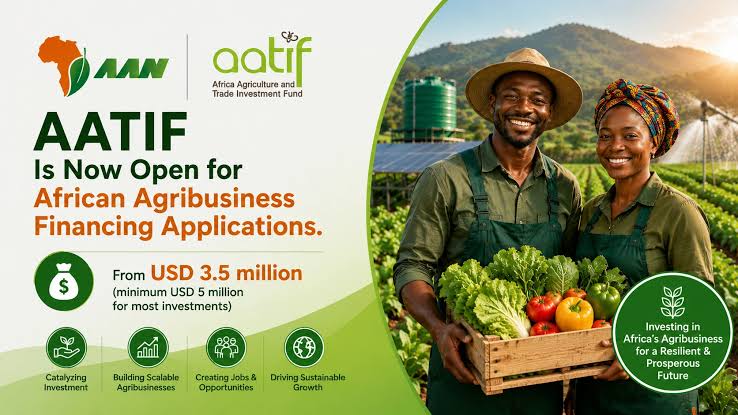
The Africa Agriculture and Trade Investment Fund (AATIF) has opened its funding window to eligible companies, agribusinesses and financial institutions seeking investment to expand activities across Africa’s agricultural sector.
The opportunity is targeted at businesses operating within the agricultural value chain, including farming, agricultural inputs, food processing, agricultural sales and trading, as well as large agribusinesses and financial institutions that provide financing to farmers and agriculture-focused businesses.
Unlike many funding opportunities advertised to entrepreneurs, however, AATIF is not offering a conventional startup grant. The Fund provides market-based financing, meaning applicants must demonstrate that their businesses are operational, financially viable and capable of supporting the investment being sought.
For African businesses that meet these requirements, the opportunity could provide access to substantial long-term capital for expanding production, improving processing capacity, strengthening agricultural supply chains and increasing access to finance for farmers and smaller businesses.
What is AATIF?
The Africa Agriculture and Trade Investment Fund is a blended-finance, private-debt fund established to support Africa’s agricultural potential by investing in local agrifood value chains.
Its focus extends beyond primary farming. AATIF seeks to finance businesses across the agricultural ecosystem, with the broader objective of improving food security while creating jobs, increasing incomes and strengthening local value addition.
The Fund’s investment approach covers both direct and indirect investments. Direct investments can include cooperatives, commercial farms and processing companies, while indirect investments can involve financial institutions and large agribusinesses that provide financing or other services to smallholder farmers and agricultural SMEs.
This distinction is important because agricultural development does not depend solely on farmers having access to land and inputs. Processing companies, aggregators, off-takers, financial institutions, logistics providers and other businesses also determine whether agricultural products can successfully move from farms to consumers and markets.
AATIF therefore positions financing across the value chain as a way of addressing some of the structural challenges affecting African agriculture.
Who Can Apply for AATIF Financing?
The current funding application is structured around three categories of potential applicants.
1. Direct Investee Companies
These are businesses or projects directly involved in agricultural activities in one or more African countries.
Eligible activities include agricultural input provision, farming, processing, sales and trading.
This means established commercial farms, agricultural processors, food and agro-processing companies, cooperatives and other businesses directly involved in the agricultural value chain may potentially qualify.
2. Intermediary Investee Companies
AATIF also considers large agribusinesses that play an intermediary role in the agricultural ecosystem.
These businesses may operate as off-takers, service providers or credit providers for smallholder farmers and local SMEs.
This category is particularly significant because a single large agribusiness can potentially influence thousands of farmers through purchasing arrangements, input distribution, technical services or financing.
3. Financial Institutions
Financial institutions providing financing to Africa’s agricultural sector can also apply.
AATIF specifically identifies commercial banks, microfinance institutions, savings and credit cooperatives and other agricultural finance institutions among the potential applicants.
The model allows AATIF to support agriculture not only by financing businesses directly, but also by strengthening institutions that can subsequently provide capital to farmers and agricultural enterprises.
How Much Funding Is Available?
One of the most important details potential applicants should understand is the scale of financing AATIF is designed to provide.
AATIF states that the principal balance of its loan should generally be above US$5 million.
However, projects seeking approximately US$3.5 million or more may also be considered where the business model demonstrates clear short- or medium-term growth potential.
This immediately separates the opportunity from many small-business grants and accelerator programmes.
AATIF is primarily looking for businesses with significant existing operations and the capacity to deploy institutional-scale capital.
The Fund also says applicants should generally maintain an equity-to-total-assets ratio of more than approximately 30 percent following the investment.
The business must have moved beyond the planning stage and already be operational. It should also have an experienced management team on the ground and either be profitable, with at least positive EBITDA, or have strong sponsor or shareholder backing.
Businesses considering the opportunity should therefore assess their financial position before applying.
Simply having a promising agricultural idea may not be enough.
What Kind of Financing Does AATIF Provide?
This is perhaps the most important clarification for prospective applicants.
AATIF does not provide conventional grants or subsidies.
According to its official FAQ, the Fund provides market-based financing through instruments such as debt and mezzanine financing, while its current strategy is not pursuing new equity investments at this time. Financing may also be structured alongside other investors or local financial institutions in certain circumstances.
Debt financing provided by the Fund can have a maturity of up to 10 years, and in exceptional infrastructure cases, up to 12 years.
That makes AATIF potentially relevant to businesses that need patient capital for expansion rather than short-term working capital alone.
There is also a separate Technical Assistance Facility connected to AATIF. Eligible beneficiaries may receive grants for certain technical-assistance activities, including management training and agricultural risk-management support.
However, this should not be confused with the core investment financing. AATIF explicitly states that, apart from technical assistance, its financing must be repaid.
What Does AATIF Look for in an Applicant?
Beyond financial figures, AATIF assesses the wider viability of an investment.
Its selection criteria include financial, social and environmental viability, as well as the capacity of the management team to successfully implement the proposed investment.
This means applicants should be prepared to demonstrate more than revenue projections.
They should be able to explain:
- What the business does and where it operates
- The agricultural value chain it serves
- How the proposed financing will be used
- How the investment will generate sustainable growth
- The business’s financial performance
- Its management capacity
- Its social and environmental impact
- How the investment will contribute to farmers, workers, consumers or the wider agricultural ecosystem
AATIF’s investment process also involves due diligence, preparation of an investment proposal, Investment Committee consideration, legal documentation and subsequent monitoring of financial, social and environmental performance.
For businesses, this means the application should be treated as an investment proposal rather than a simple grant application.
How to Apply
Interested businesses can apply through AATIF’s online funding application.
Applicants first select the category that best describes their organisation: Direct Investee Company, Intermediary Investee Company or Financial Institution.
They are then required to complete a funding questionnaire and upload supporting documentation for an initial assessment.
AATIF currently requests three key documents for the initial review:
1. Business Plan
Applicants should provide a detailed business plan explaining the company, its operations, market, strategy, financial requirements and proposed use of funds.
2. Audited Financial Statements
Audited financial statements for the previous three years should be provided where available.
3. Environmental and Social Impact Assessment
Applicants should also provide an Environmental and Social Impact Assessment (ESIA), or another document that provides information about the project’s social and environmental impact.
AATIF says applicants should provide as much information as possible to give its investment adviser a comprehensive understanding of the proposed project.
If an application appears eligible after the initial review, the investment adviser says it will contact the applicant within two weeks of submission to discuss the next steps.
Interested organisations can access the official funding application through AATIF’s Funding Application page.
Why the Opportunity Matters for Nigeria and Africa
For Nigeria, the opportunity is particularly relevant because AATIF already has a history of supporting agricultural financing in the country.
In 2022, AATIF announced a US$25 million funding line to Union Bank of Nigeria to expand the bank’s agricultural business footprint and increase financing for Nigerian agribusinesses.
The facility was designed to support value chains including rice, poultry, dairy, cassava, maize and soybean, among others.
AATIF’s existing portfolio also includes investments connected to Nigeria. Its portfolio lists Sterling Bank among its investments, aimed at improving capacity for agricultural lending in Nigeria.
The Fund has also financed agricultural trade involving Nigerian smallholder farmers. One of its investments in Vantage supported the sourcing of organically certified soybeans from smallholder farmers in Nigeria and Benin, alongside sunflower seeds from Tanzania.
These examples demonstrate that Nigeria is already part of AATIF’s agricultural investment footprint.
For Africa more broadly, the significance is even wider.
Agriculture remains central to livelihoods, food systems, rural employment and economic activity across the continent. Yet many businesses operating within agricultural value chains continue to struggle to access sufficiently large and patient financing for expansion.
Capital that can support processing facilities, storage, agricultural inputs, market access, farmer financing and value-chain infrastructure can help address some of those constraints.
AATIF’s model is therefore focused not simply on putting money into individual companies, but on strengthening the systems connecting farmers, businesses, financial institutions and markets.
What Applicants Should Know Before Applying
Businesses should avoid approaching this opportunity as though it were a small-business grant.
The scale of the financing, financial requirements and due diligence process indicate that AATIF is more suitable for established and investment ready agricultural businesses and institutions.
Before applying, companies should make sure their financial records are organised, their business model is clearly documented and their proposed use of funds is supported by realistic projections.
They should also be able to demonstrate how the investment will contribute to agricultural development, employment, local value addition, food security or improved access to finance.
For smaller businesses that do not meet the financial thresholds, AATIF may not be the most suitable funding route at this stage. However, businesses can potentially become stronger candidates in the future by improving their governance, financial reporting, operational scale and investment readiness.
A Bigger Opportunity for Africa’s Agricultural Value Chain
Africa does not only need more farmers; it needs stronger agricultural businesses capable of connecting production to processing, markets, finance and consumers.
That is where investment opportunities such as AATIF become significant.
For an established agribusiness with the right financial foundation, access to patient institutional capital could mean the difference between maintaining current operations and building the infrastructure required to scale.
For financial institutions, it can create additional capacity to lend to farmers and agricultural enterprises. For large agribusinesses, it can support deeper engagement with smallholder farmers and local SMEs.
The opportunity, therefore, is not simply about securing funding.
It is about building businesses that can strengthen Africa’s agricultural value chains, create economic opportunities and contribute to a more resilient food system.
Eligible African agribusinesses and financial institutions with a clear expansion plan should consider reviewing AATIF’s requirements and assessing whether their operations are investment-ready.
For those that meet the criteria, the application window represents an opportunity to put a credible, well-structured agricultural investment proposition before a fund specifically created to help unlock Africa’s agricultural potential.
[give_form id="20698"]