


CSR Personality of the Week: Chidilim Menakaya, The Director Building Nigeria’s Recycling Backbone
 csrreporters
There is a kind of corporate social responsibility that is more than a stage or a keynote slide. It happens, for example, at a filling station in Kaduna, or beside a king’s council in rural Jigawa. There someone in her Foundation’s colours cuts a ribbon and hands a community something it can actually use.
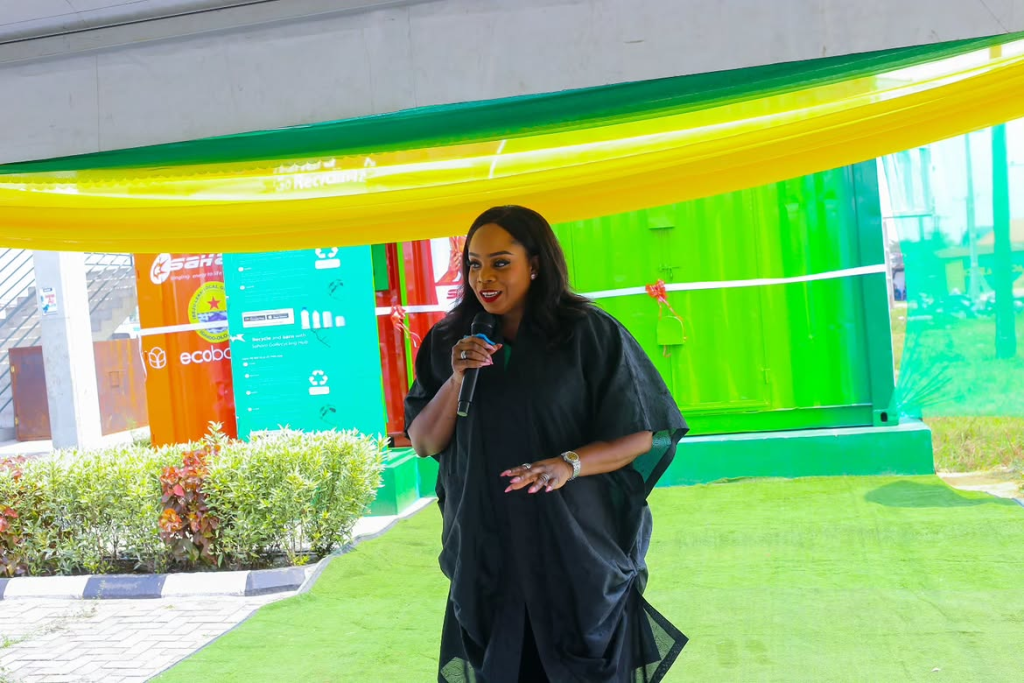
Chidilim Menakaya, Director of the Sahara Group Foundation, spent two days in mid-July 2026 doing precisely that. On July 14, a new recycling hub was commissioned in Gidan Hakimi, in the Shuwarin Local Government Area of Jigawa State. The following day, another was opened in Badiko, Kaduna South, at an Asharami Synergy filling station. Together, these became the Foundation’s 21st and 22nd Sahara Go Recycling Hubs nationwide, and its second and third in Northern Nigeria.
That kind of back-to-back commissioning is not new for Menakaya. In June 2026, she had already opened a similar hub in Masaka, Nasarawa State. That hub was delivered in partnership with the Nasarawa State Waste Management Authority.
Each opening tends to follow a similar rhythm. Local leaders, traditional rulers and government commissioners attend. And Menakaya, consistently, is the one explaining why a recycling hub matters more than it first appears.
From Telecoms to Trash to Transformation
Menakaya’s route into sustainability did not begin with sustainability at all. She started out as a Corporate Affairs Executive at MTN in 2002. There she was gathering market data and managing distribution partnerships for the Network Group.
From MTN, she moved into reputation and communications work. First at Tetra Pak as Communications Manager for West Africa, and later at Sanofi as Head of Corporate Communications for North and East Africa.
Something shifted at Tetra Pak, however. She managed corporate social responsibility projects across the region and deployed the “Recycle Reuse Africa” initiative. Through it packaging waste was converted into furniture and stationery for schools in low-income parts of Kenya, Nigeria, and Ghana. In hindsight, it looks like a rehearsal for the work she leads today.
Menakaya joined Sahara Group in 2006 as a Business Advisor, and that relationship has held for almost two decades since. She moved through Change Management, Corporate Communications, Human Resources, and eventually Head of Corporate Services for the company’s Upstream business. Only later, when she stepped into the Foundation itself, first as Head of Programs in January 2024 and then as Director a year after, did her career come full circle.
Building a Foundation Around EXTRApreneurship
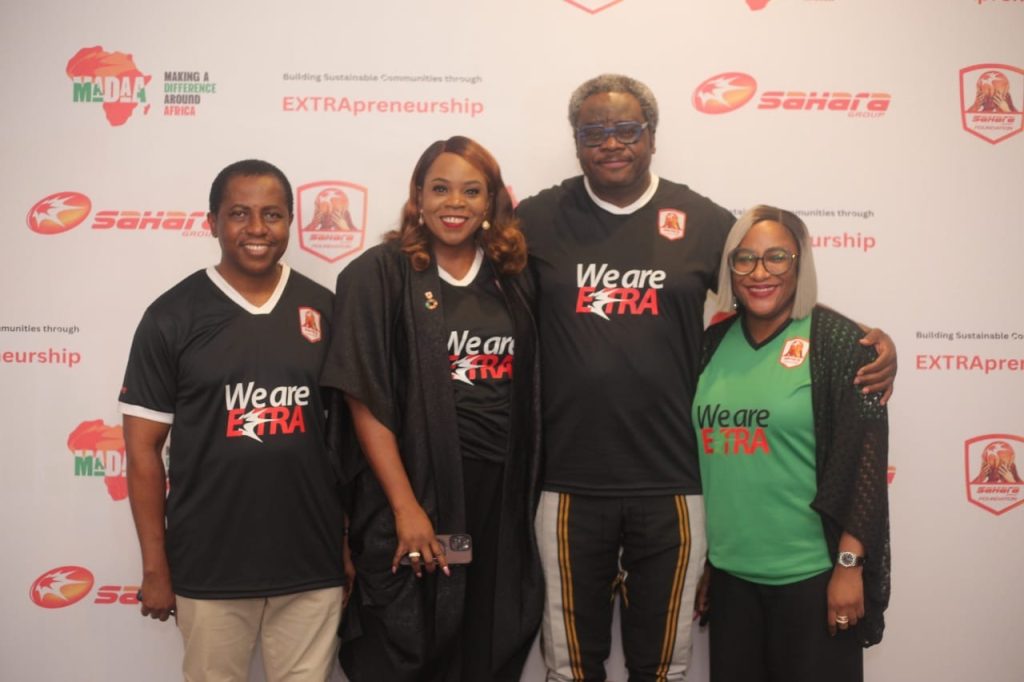
Under Menakaya, the Sahara Group Foundation has organised its work around a concept it calls EXTRApreneurship. The strategy is designed to give entrepreneurs, innovators, and community changemakers the tools to scale their ideas. Speaking at a 2024 event in New York, she explained that the approach promotes economic growth in local communities through platforms built for inventors and social innovators directly.
The numbers behind that strategy are not small. According to the Foundation, its interventions have reached more than two million beneficiaries. This both directly and indirectly, across the regions where Sahara Group operates in Africa, Asia, Europe, and the Middle East. As a result, Sahara Go Recycling has become one of the Foundation’s most visible programmes. It converts a waste problem into an income stream for households that previously had none.
In a recent interview, Menakaya described sustainability at Sahara not as an obligation, but as an engine. “We see sustainability not just as a corporate responsibility, but as the engine for continuous innovation and progress,” she said. She added that the Foundation exists to translate global development goals into experiences that are relevant to everyday people, not simply to corporate stakeholders.
Beyond Recycling
Recycling hubs are the most visible part of Menakaya’s portfolio, but they are not the largest. The Foundation’s actual flagship, in terms of scale and continental reach, is the Sahara Impact Fund. A fellowship launched in 2020 alongside LEAP Africa and the Impact Investment Foundation. Early cohorts gave $5,000 grants to ten fellows at a time. The programme has since grown considerably. It now offers seed funding of up to $30,000 to founders who complete a three-month fellowship built around clearly mapped impact, scalability, and sustainability milestones.

Running alongside it is MADAA, a sister programme that provides business advisory support rather than direct funding. MADAA targets African innovators and researchers who already have proven, tested products, and it helps them navigate the harder problem of scaling. In this year’s cycle alone, more than 2,000 young innovators applied from 15 countries. Their pitches ranged from waste-to-energy systems in Lagos to science-education labs in Nairobi, organic skincare lines in Accra, circular-economy models in Kampala, and wheelchair engineering in Johannesburg.
There is also the Sahara Community Impact Project, or SCIP, which takes a different approach again. Rather than funding individual founders, SCIP builds business hubs inside communities, anchored to whatever economic strength that community already has.
Taken together, SIF, MADAA, SCIP, and the recycling network are not separate charity projects competing for attention. They are, in Menakaya’s own framing, expressions of one strategy. Consequently, EXTRApreneurship is less a slogan than an operating model, one that funds ideas, advises founders, builds physical infrastructure, and processes waste, all under a single Foundation director’s remit.
What the Northern Expansion Actually Means
The push into Jigawa, Kaduna, and Nasarawa is deliberate. Organised waste collection remains scarce across much of Northern Nigeria. The region has historically received less corporate CSR attention than Lagos or the south.
By locating hubs at filling stations and community centres, and by partnering with state waste authorities and traditional institutions, Menakaya’s team is attempting something more durable than a one-off donation.

She was explicit about that design choice at the Jigawa commissioning. “By partnering with institutions and sister companies that understand local needs and realities, we are building a recycling ecosystem that communities can own, sustain, and benefit from over the long term,” she said. Local leaders, for their part, praised the hubs for tackling waste disposal problems while also creating income opportunities, particularly for young people and women.
Meanwhile, similar language echoed through her comments on the Masaka hub in Nasarawa a month earlier. There, she called the opening “an important next step in expanding access to sustainable waste management across Nigeria,” and framed the entire Sahara Go Recycling model as proof that collaboration can unlock cleaner communities and stronger livelihoods at the same time.
A Career That Chose Substance Over Spectacle
What stands out about Menakaya’s record is how her recognition has come from a slow accumulation of hubs, partnerships, and programmes, rather than from any single headline moment. Even so, that accumulation now totals 22 recycling sites nationwide, a policy stage in New York, and millions of documented beneficiaries.
Two decades ago, she was gathering intranet data for MTN’s Network Group. Today, she stands beside kings and commissioners, opening facilities that turn a community’s waste into its next livelihood. Few CSR careers follow that particular arc. Fewer still make it look this consistent.
For a Foundation director whose job could easily stay confined to strategy documents and quarterly reports, Menakaya keeps choosing to show up where the ribbon actually gets cut. That, more than any award, is what earns her this week’s recognition.
Follow CSR Reporters for more stories shaping social impact in Nigeria, Africa, and the World.
[give_form id="20698"]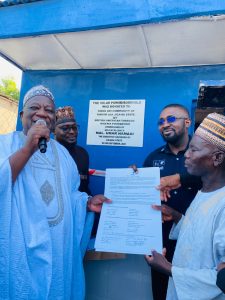


1 thought on “CSR Personality of the Week: Chidilim Menakaya, The Director Building Nigeria’s Recycling Backbone”