ROSEMARY IMOBHIO
In June 2025, Nigerian investors offered ₦91.42 billion for a green bond that the Federal Government had asked ₦50 billion to fund. The Debt Management Office (DMO) allotted ₦47.355 billion at a coupon of 18.95%, and subscriptions reached 183% of the offer. However, strong demand shows only that investors trust the issuer. It does not prove that the money cut emissions or delivered power.
Governments and companies need capital for cleaner energy and climate resilience, and a green label helps them raise it. The harder task is showing that the label matches the results. This explainer covers how green bonds work, what Nigeria’s record shows and how readers can test the evidence.
What A Green Bond Really Is
A green bond is a loan with a declared purpose. The issuer borrows from investors, pays interest and repays the principal at maturity. Unlike an ordinary bond, it commits the proceeds to eligible projects, such as renewable energy, clean transport, reforestation, sustainable farming or flood protection. It also promises to report on them.
Think of a household that borrows to fit solar panels and agrees to show the lender the receipts and the savings. Governments, public agencies and companies can issue green bonds. In practice, pension funds, insurers and asset managers usually buy them.
A green bond is not a grant. Nigeria’s Series III, for example, pays 18.95% a year in half-yearly instalments and returns the principal in 2030. The label also guarantees neither profit nor environmental success. Because the bond differs mainly in the intended use of its proceeds, the issuer’s ability to repay still matters.
From Borrowing to Proof
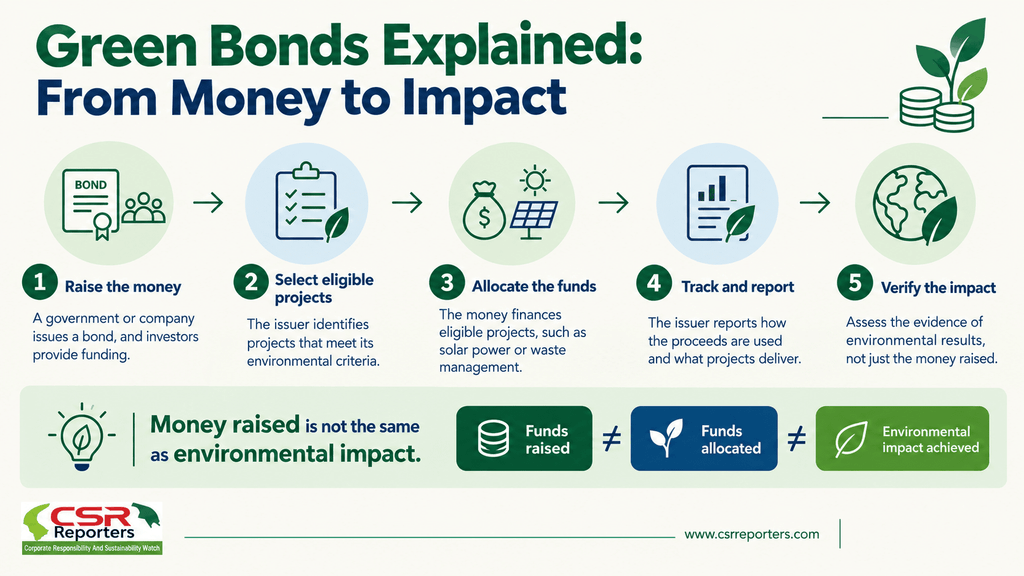
The process follows a sequence. First, the issuer selects projects that meet environmental criteria and sets rules for handling the money. It then explains the structure to investors, raises the funds and allocates them. Afterwards, it tracks allocations and reports results, while external reviewers may assess the design and verifiers may check the figures. Rules differ by framework, regulation and bond document.
Imagine a government that funds solar panels at public clinics. Investors should learn the amount allocated, the clinics covered, the capacity installed, the electricity generated and the emissions avoided. These are separate facts. Money allocated is not work completed, and work completed is not a measured benefit.
Nigeria’s Record: ₦25.69 Billion Raised and 95% Spent
According to the DMO’s May 2025 impact report, the Federal Government issued a ₦10.69 billion pilot green bond in December 2017 and a ₦15 billion follow-up in June 2019. Series III came in June 2025, and the DMO said it listed the ₦47.355 billion bond on the Nigerian Exchange and FMDQ in May 2026. Across three issues, allotments total about ₦73 billion.
The report which CSR Reporters accessed, tracks the 2019 bond, which financed 23 projects in five sectors. It says ₦14.316 billion, or 95.44%, had been used by March 2025, and it estimates annual savings of 41,888 tonnes of carbon dioxide equivalent. It also admits setbacks.
A ₦487 million wind farm in Katsina stalled after the funds arrived, so officials moved the money to a solar project in Abuja. Meanwhile, a ₦500 million solar-tricycle project never started, and the secretariat says it lacks evidence of disbursement.
What The Evidence Can and Cannot Show
The report states that its figures come from implementing agencies and lack independent verification for 2025. Moreover, several benefits remain projections.
The report labels the irrigation emissions savings as expected and unmeasured. Its 25,675-tonne estimate for Abuja’s Kagini rail station also depends on commuters switching to the train. It also concedes that the station’s access road may not qualify as green on its own.
Similarly, the DMO’s green bond page lists no report yet covering Series III proceeds. Because the bond settled only in June 2025, that gap is not evidence of misuse. Still, it is the first thing readers should watch.
Where Green Bonds Fall Short
Some risks appear in Nigeria’s own reporting. First, projected results can pass for achieved ones, because avoided emissions remain a forecast until someone measures them. Second, project selection can stretch the label, as the Abuja road shows.
Third, allocation becomes harder to follow when money moves between projects, as it did in Katsina. Finally, delivery can fail after the money is spent. The report’s photographs show afforestation sites damaged by fire, cattle and vandalism, yet it gives no tree survival rates.
Other risks apply across markets. Greenwashing occurs when issuers claim benefits they cannot demonstrate. Fragmented standards also make bonds hard to compare. Social safeguards matter as well, because a climate project can still disrupt land rights or livelihoods.
In addition, green bonds remain debt, so investors still face credit and interest-rate risk. None of these failures has been shown for every Nigerian bond.
Emomotimi Agama Pushes for Sustainability That Investors Can Verify
Safeguards and Their Limits
Nigeria’s Green Bond Guidelines build on four components. The issuer states the eligible uses of proceeds, explains how projects are selected, tracks the money and reports on allocations and outcomes. The International Capital Market Association’s Green Bond Principles and the Climate Bonds Initiative’s standard offer voluntary benchmarks. Binding rules, by contrast, come only from regulators or contracts.
Each check does a different job. A pre-issuance review tests the design, verification tests reported information and impact reporting shows results. Therefore, a review of a framework is not proof of performance.
Lagos State’s ₦14.815 billion green bond, issued in November 2025, illustrates the point. Agusto & Co reviewed its 52 projects against the Climate Bonds Standard and found nothing suggesting non-conformance. Yet it did not audit the information the state supplied. The state’s framework promises allocation and impact reports starting a year after issuance.
Global Growth Raises The Stakes
The Climate Bonds Initiative recorded $653.5 billion of aligned green bond issuance in 2025, down 3% from 2024. That was 64% of its aligned green, social, sustainability and sustainability-linked total, and cumulative green issuance now exceeds $4 trillion. Emerging markets need this capital for energy access and resilient infrastructure. However, more money makes credible reporting more important, not less.
A company considering a green bond needs eligible projects, a defensible framework, reliable data and the capacity to track proceeds. As a result, finance, sustainability, risk, internal audit and the board should share the work. Weak evidence can erode investor confidence and invite reputational or regulatory scrutiny.
Companies that never issue bonds face the same test, because they should be able to substantiate environmental claims and show how capital supports them.
Questions That Separate Results From Labels
Readers can press on eight points. What exactly will the money finance, and how was each project chosen? Can the issuer account for every Naira?
Who checks the information, and what did they check? Are reported benefits projected or measured, and could anyone assess them independently? Finally, are affected communities protected, and what happens when a project is delayed, changed or fails?
Nigeria’s green bond market has shown that investors will lend for climate projects. The next stage should be judged by what the money financed and what the evidence shows it achieved. A bond earns its label when the issuer can trace the naira, measure the outcome and explain the gaps.
| DON’T JUST ANNOUNCE YOUR IMPACT. PROVE IT. CSR REPORTERS helps organisations verify, assess, document and communicate the real impact of their CSR and sustainability initiatives. Project Verification | Beneficiary Feedback | Impact Assessment | Impact Storytelling | Stakeholder Engagement Have an initiative worth documenting? Let us verify it. Document it. Tell the story. Talk to CSR REPORTERS enquiries@csrreporters.com 📞 Call/WhatsApp: 0803 401 2198 | 0903 329 6374 | 0905 024 4468 | 0803 209 8499 www.csrreporters.com |