ROSEMARY IMOBHIO
Green buildings in Nigeria are shifting from luxury to necessity
Every morning across Lagos, Abuja, and Port Harcourt, a familiar sound fills the air before the workday even begins. Generators rumble to life, as businesses brace for a grid that, according to the National Bureau of Statistics, delivers reliable power for an average of just seven hours a day. For Nigerian companies, energy is not merely an operational line item. It is a survival strategy, and it is becoming prohibitively expensive.
This reality, more than any global sustainability trend, is quietly driving one of the most consequential shifts in Nigeria’s built environment. There is a slow but accelerating move toward green buildings. What was once considered a luxury of wealthy developers chasing international prestige is increasingly looking like a financial and strategic imperative.
So, the question Nigeria’s businesses, developers, and policymakers must confront is no longer whether green buildings make environmental sense. The real question is whether they can afford to keep building any other way.
What Is a Green Building, and Why Does It Matter in Nigeria?
A green building is not simply a structure painted in earthy tones or decorated with a few solar panels on the roof. Rather, it is a building designed from the ground up to use significantly less energy, water, and materials than a conventional structure. This while also producing healthier environments for occupants and reducing its environmental footprint across its entire lifecycle.
Globally, buildings account for approximately 37 percent of greenhouse gas emissions (1). They consume 40 percent of the world’s energy. They also use 16 percent of water annually, according to the United Nations Environment Programme. In Nigeria, where grid unreliability forces buildings to generate their own power through generators, these figures carry even greater weight.
Green buildings tackle this problem through a combination of passive design strategies. These include natural ventilation, solar shading, and thermal insulation. As well as active technologies such as rooftop solar, rainwater harvesting, and energy-efficient lighting. Taken together, these features can dramatically reduce a building’s operational costs. This is precisely why Nigerian businesses are starting to pay close attention.
The Business Case: Energy Costs Are Making Sustainability a Financial Decision
Nigeria’s energy crisis has reached a tipping point that makes green building not just a moral choice, but a cold financial calculation. Nigerian manufacturers spent N1.35 trillion on alternative power supply in 2025. This is up 21.6 percent from the N1.11 trillion spent in 2024, according to the Manufacturers Association of Nigeria (MAN). Energy costs now account for roughly 40 percent of factory operating expenses across the country.
Meanwhile, the cost of diesel and petrol, the fuels powering most of this backup generation, has surged sharply. The arithmetic is stark. A Lagos-based business owner who switched from diesel to solar reported that his generator was consuming N180,000 in fuel every week before the transition. After installing solar panels, his electricity cost dropped to nearly zero, and he recovered the installation cost within eight months.
The Solar Tipping Point
Fortunately, the economics of alternatives are shifting rapidly. The landed cost of commercial rooftop solar installations in Nigeria fell by roughly 35 percent in naira terms between 2022 and 2025. Even when accounting for currency depreciation, according to industry figures from the Nigeria Renewable Energy Association. Solar panels that once sat out of reach for most commercial developers are now offering payback periods of three to five years. Sometimes even less in high-consumption environments.
For households and businesses that can manage the upfront cost, solar installations in Nigeria can pay for themselves within six months given current petrol and diesel prices. This is the economic logic that increasingly links green building design to bottom-line performance.
Can Green Buildings Reduce Nigeria’s Generator Dependence?
The generator economy is a powerful and deeply entrenched system in Nigeria. The country’s diesel generator market was valued at approximately $548 million in hardware terms in 2023. It is projected to reach $849 million by 2029. This is growth at a compound annual rate of 7.4 percent. Nigeria’s grid collapsed at least twelve times in the first half of 2024 alone, and unreliable supply continued well into 2026.
Yet buildings designed for energy independence, incorporating solar photovoltaic systems, battery storage, energy-efficient air conditioning, LED lighting, and passive cooling through orientation and cross-ventilation, can dramatically reduce or even eliminate the need for petrol and diesel backup. This is the central promise of green building in the Nigerian context. Rather than working around a broken grid, these structures are designed to function without it.
Across Nigeria’s roughly 14,000 licensed filling stations, a quiet transition is already underway. Station operators who treated diesel generators as an unavoidable cost of doing business are now switching to solar-battery hybrid systems. The Petroleum Products Retail Outlets Owners Association of Nigeria estimates that fewer than 12 percent of stations have made a full or partial switch to solar so far, but that share has nearly tripled since 2023.
A Path to Systemic Change
Scaling this shift from individual buildings to the broader built environment would require embedding solar and energy storage into building design from the planning stage. Rather than retrofitting after construction. Green building certification frameworks are specifically structured to encourage this approach. Setting measurable targets for energy reduction and promoting integration of renewables from the earliest design decisions.
Climate Resilience and the Rising Cost of Inaction
Beyond energy, Nigeria faces escalating climate risks that are directly shaping how buildings must be designed. Urban flooding is perhaps the most visible threat. In August 2025, floodwaters submerged the Agric and Ijede communities of Ikorodu in Lagos, forcing families to flee and leaving homes and vehicles underwater. There is still a classification of major sections of Lagos State, as high-risk flood zones for 2026.
Extreme heat is equally alarming. Urban settlements including Lagos, Kano, and Abuja now experience heat indices above 50 degrees Celsius during peak months. Extreme heat events are now at least ten times more likely in West Africa due to human-caused global warming. More than 60 percent of Nigeria’s population is regularly exposed to dangerous heatwaves.
Building for a Hotter, Wetter Future
Green buildings address both challenges directly. Flood-resilient design incorporates permeable surfaces, elevated foundations, bioswales, and green roofs that absorb stormwater. Passive cooling strategies, including deep roof overhangs, shaded facades, cross-ventilation, and reflective or vegetated rooftops. These can substantially reduce indoor temperatures without relying on energy-intensive air conditioning.
These are not abstract technical choices. They determine whether a building remains habitable and operational during extreme weather events, and whether its occupants stay safe and productive. As climate risks intensify, buildings that lack these features will face growing insurance costs, reduced asset values, and potential regulatory liabilities.
The Technologies Driving Green Construction in Nigeria
Several technologies are converging to make sustainable construction increasingly practical in Nigeria’s specific environment.
Solar PV and battery storage now offer cost-effective energy independence. Chinese manufacturers are facing excess capacity at home and tariff pressures in Western markets. So they have redirected exports to Africa, pushing down panel costs significantly. Lithium-iron-phosphate battery packs, which are better suited to tropical heat conditions, have also become more widely available. There are distributors in Lagos, Kano, and Port Harcourt.
Passive design principles appropriate to Nigeria’s tropical climate already exist. Examples are building orientation to capture prevailing breezes, shaded windows, thermal mass in walls, and natural daylighting. They can reduce cooling loads by 30 to 50 percent before any active technology is added.
Locally sourced sustainable materials are gaining traction. Rammed earth, which compacts local soil into strong and thermally efficient walls, is experiencing a revival. Insulated concrete forms offer excellent insulation suited to Nigeria’s climate. Green roofs, with their planting and vegetation, reduce heat absorption and manage stormwater simultaneously.
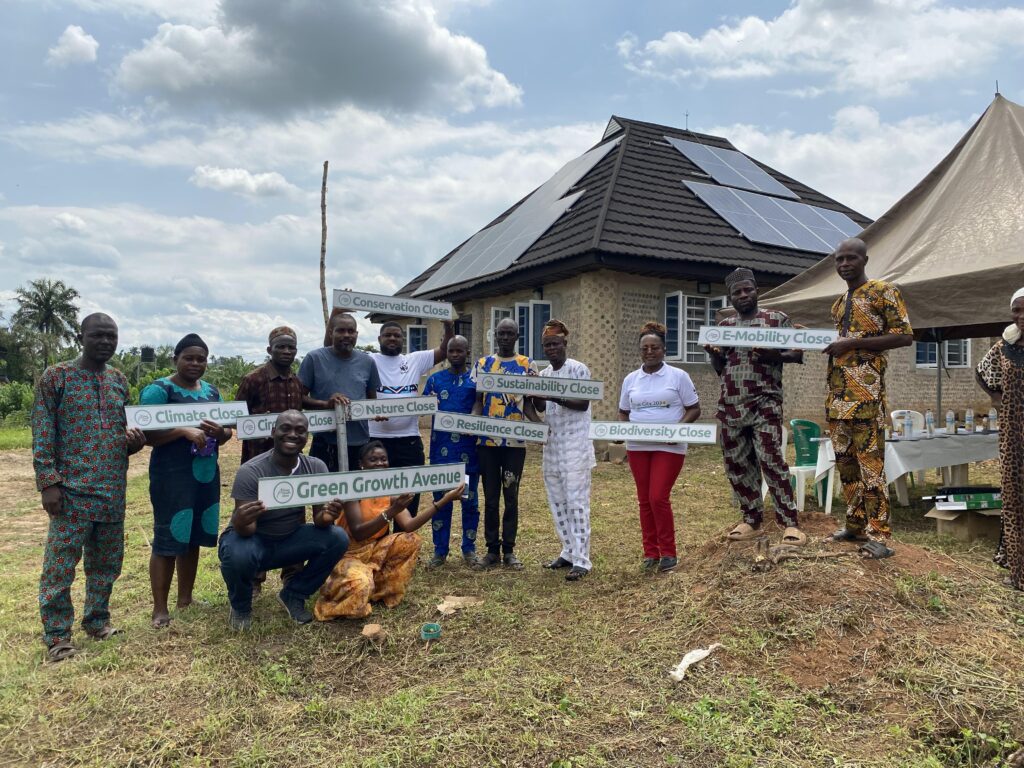
Recycled and waste materials are also entering the construction supply chain. In Ibadan, Green Growth Africa completed Nigeria’s first ultramodern green building constructed from 27,333 recycled plastic bottles, completed in just two months. The structure is fully powered by an off-grid solar system. It demonstrates that sustainable construction can be both innovative and fast.
Companies Already Leading the Way in Nigeria
Green Building Council Nigeria
Since its revitalization in 2021, the Green Building Council Nigeria (GBCN) has expanded its reach significantly. GBCN is developing the Nigeria Built Environment Carbon Database, which will provide the country’s first-ever local dataset on the carbon footprint of buildings, materials, and construction processes. The Council is also working on a national NDC Scorecard to track building-sector policies against Nigeria’s climate goals.
The Sintali and GBCN Partnership
In a significant milestone for the sector, Sintali and GBCN signed a strategic Memorandum of Understanding in June 2025. It was unveiled simultaneously in Abuja and London, to accelerate the adoption of EDGE green building certification across Nigeria. EDGE was developed by the International Finance Corporation (IFC). It is a global standard that provides measurable, affordable pathways to design buildings that use at least 20 percent less energy, water, and embodied materials than conventional structures.
The partnership includes joint marketing campaigns, training workshops, and mentorship programmes. Ones designed to build a community of green building professionals across Nigeria.
Green Growth Africa
Based in Ibadan, Green Growth Africa has pioneered circular construction methods using recycled plastic waste. This directly tackles Nigeria’s plastic pollution crisis, which generates 3.5 million tonnes of plastic waste annually with less than 10 percent being recycled. Their solar-powered demonstration building, completed in 2024, serves as both a functional structure and a model for what sustainable, community-scaled construction can look like in Nigeria.
The Financing Opportunity: Green Bonds, Sustainable Finance, and ESG Capital
One of the most compelling arguments for green buildings in Nigeria is the growing pool of capital that is specifically structured to fund them. Nigeria’s green finance market moved from experimentation to consolidation in 2025. It is driven by record sovereign bond issuances, subnational climate financing, and growing private-sector participation.
In June 2025, the Federal Government launched its Series III Sovereign Green Bond, valued at N50 billion. The bond attracted N91.42 billion in subscriptions, making it significantly oversubscribed. It targeted renewable energy, clean transportation, water management, and climate adaptation. This strong investor response signals growing confidence in Nigeria’s green finance infrastructure.
Additionally, Gombe State announced plans for a N30 billion green bond to fund climate-smart infrastructure and sustainable agriculture. This illustrates that green finance is spreading beyond the federal level. Nigeria’s third Nationally Determined Contribution, submitted in September 2025, sets a target of 32 percent greenhouse gas emissions reduction by 2035. It estimates the country will require US$337 billion in total investment between 2026 and 2060.
ESG Capital and Multinational Tenants
Beyond public bonds, green buildings increasingly attract ESG-conscious institutional investors and multinational corporate tenants. International companies operating in Nigeria face growing pressure from their global headquarters, investors, and regulatory frameworks to ensure that their real estate footprint meets sustainability standards. A certified green building, whether under EDGE, LEED, or an equivalent system, serves as a verifiable asset in this context.
The Nigerian Exchange Limited has played a leading role in developing Nigeria’s and West Africa’s green bond market. It is creating frameworks that align domestic capital with global sustainability standards. Nigeria is moving toward adopting ISSB (IFRS S1/S2) sustainability reporting standards. Thus ESG transparency will become an increasingly important factor in investment decisions across real estate and construction.
Challenges Holding the Sector Back
Despite the momentum, significant barriers continue to slow green building adoption in Nigeria.
High upfront costs remain the primary obstacle. While green buildings offer strong long-term returns, the initial investment in certified design, high-performance materials, and renewable energy systems can be 10 to 20 percent higher than conventional construction. In an environment of high inflation and limited access to long-term financing, many developers choose the cheaper short-term option.
Complex permitting compounds the challenge. Securing a building permit in Lagos involves navigating 17 distinct procedures over an average of 118 days, according to research published by the Society for Planet and Prosperity. Faced with such delays, many developers choose informal construction pathways that bypass sustainability standards entirely.
Skills and awareness gaps persist across the industry. While organisations like GBCN and Sintali are working to close this gap, the pipeline of architects, engineers, and contractors trained in green building principles remains limited relative to the scale of construction underway.
Affordability pressures in housing also create tensions. Nigeria faces a housing deficit of over 20 million units, according to the Federal Mortgage Bank of Nigeria. Integrating green features into affordable housing requires policy support, cross-subsidisation, and innovative financing models that the market has not yet fully developed.
What Government, Developers, and Businesses Must Do Next
For policymakers, the most impactful near-term actions include mandating green building standards for all new public buildings and major commercial developments. Streamlining permitting processes, and providing tax incentives for certified green construction also matters. Nigeria’s National Building Code already contains guidelines promoting sustainable materials, but enforcement remains inconsistent. Strengthening this code and linking compliance to access to public finance would significantly accelerate adoption.
For developers and real estate firms, the opportunity lies in positioning green certification as a premium differentiator. This justifies higher rental rates and attracts international corporate tenants. Developers who build to EDGE or equivalent standards today will access a growing pool of ESG-aligned capital. They would also secure tenants who are themselves under sustainability reporting obligations.
For banks and financial institutions, developing green mortgage and construction finance products with preferential rates for certified buildings would lower the cost of entry and expand the market significantly. Nigeria’s blended finance structures and Development Finance Institutions are well positioned to de-risk early-mover investments.
For businesses and corporate occupiers, conducting energy audits of existing buildings and factoring energy performance into lease decisions sends a demand signal to the market. Companies that commit publicly to green building occupancy strengthen Nigeria’s ESG credentials with international investors and partners.
Lessons from Across Africa
Kenya and South Africa have moved furthest on this journey. Kenya’s Green Building Society has certified dozens of commercial buildings. Nairobi’s corporate real estate market increasingly demands green credentials.
South Africa’s Green Building Council operates an established rating system. Their major retail and office developments routinely seek certification as a marketing and investment tool. Nigeria can accelerate its own trajectory by building on these models. It can also adapt them to local construction costs, climate conditions, and financing constraints.
Sustainability Luxury or Business Necessity?
The framing of green buildings as a luxury is rapidly becoming a relic of an earlier era. In a country where businesses spend N1.35 trillion per year on diesel generators, where heat indices regularly exceed 50 degrees Celsius in major cities, where flooding displaces communities with growing frequency, and where housing demand outpaces supply by millions of units, the cost of conventional construction is no longer just an environmental concern. It is an economic and strategic liability.
Green buildings in Nigeria offer a genuinely compelling value proposition. They dramatically lower energy costs and promote stronger climate resilience. They offer access to growing pools of ESG capital, and competitive advantage in attracting multinational tenants and international investment.
The technologies are available and the financing mechanisms are being developed. The certification frameworks are being established. Early movers, from Green Growth Africa’s plastic-bottle building in Ibadan to the Sintali-GBCN partnership expanding EDGE certification nationwide, are already demonstrating what is possible.
What remains is political will, policy coherence, and the collective recognition among Nigeria’s developers, financiers, businesses, and policymakers that building sustainably is no longer about doing the right thing for the environment alone. Increasingly, it is about building something that can survive, perform, and create value in the world that climate change is creating.
Nigeria is at a pivotal moment. The cities being built today will shape the country’s economic competitiveness, climate vulnerability, and quality of life for the next fifty years. The question is not whether Nigeria can afford green buildings. The question is whether it can afford to build anything else.
Frequently Asked Questions (FAQ)
1. What is a green building and how is it defined in Nigeria?
A green building is a structure designed to minimise environmental impact by using significantly less energy, water, and materials than conventional buildings throughout its lifecycle. In Nigeria, the most commonly adopted international standard is the EDGE (Excellence in Design for Greater Efficiencies) framework, developed by the IFC, which certifies buildings that achieve at least 20 percent reductions in energy, water, and embodied energy in materials compared to a baseline.
2. Are green buildings more expensive to build in Nigeria?
Green buildings typically carry an upfront cost premium of 10 to 20 percent over conventional construction. Depending on the level of certification pursued and the technologies incorporated. However, studies from comparable markets consistently show that these initial costs are recovered through lower energy bills, reduced water usage, and lower maintenance expenditures over a building’s lifetime. In Nigeria’s context, where petrol and diesel costs for backup power alone can exceed 40 percent of operating expenses, the payback period for green features is often shorter than in countries with reliable grids.
3. Which green building certifications are available in Nigeria?
The two most relevant certifications for Nigeria are EDGE, promoted through the partnership between Sintali and the Green Building Council Nigeria, and LEED (Leadership in Energy and Environmental Design), developed by the U.S. Green Building Council. EDGE is specifically designed for developing country contexts and offers a more accessible and cost-effective pathway than LEED. The Green Building Council Nigeria is also developing DGNB Nigeria, a German-origin certification system adapted to local conditions.
4. How can green buildings help address Nigeria’s flooding and extreme heat challenges?
Green buildings incorporate flood-resilient design elements such as permeable paving, green roofs that absorb stormwater, elevated foundations, and bioswale drainage. For extreme heat, passive cooling strategies including natural cross-ventilation, shaded facades, reflective roofing materials, and high-performance insulation reduce indoor temperatures substantially without relying on energy-intensive air conditioning. Together, these measures make buildings more resilient to the climate risks that Nigeria’s cities already face.
5. What financing options exist for green buildings in Nigeria?
Several financing pathways are available and growing. Nigeria’s Federal Government issued its third Sovereign Green Bond in June 2025, raising N50 billion for climate-aligned projects. State-level green bonds are also emerging. The Nigerian Exchange Limited has developed a Green Bond Market Development Programme that enables corporate issuers to raise capital for certified green projects. Additionally, international development finance institutions such as the IFC provide technical assistance and concessional finance for EDGE-certified developments, and blended finance structures are being developed to de-risk early-stage green real estate investments.
References
- United Nations Environment Programme (2026). Global Status Report for Buildings and Construction 2025–2026: As climate risks rise and cities grow, we must rethink how we build to create better lives for all. Paris, 2026. https://doi.org//10.59117/20.500.11822/49531