Greenpeace Africa Demands Immediate Freeze on New Gold Concessions in Cameroon Amid Ongoing Theft
 CHUKS OLUIGBO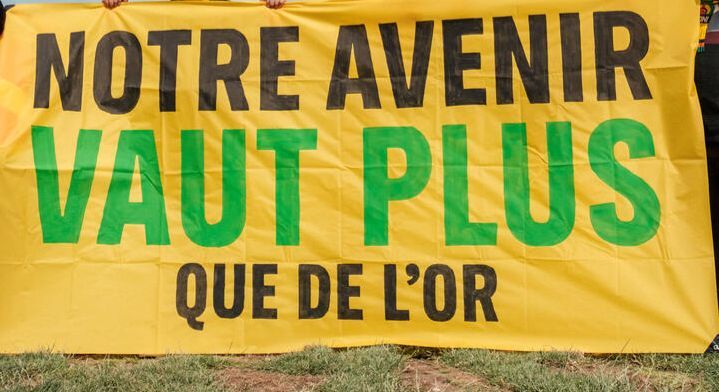
Image credit: Greenpeace Africa
Greenpeace Africa, an independent environmental campaigning organisation, has called for an immediate freeze on new gold concessions in Cameroon pending a structural reform of the sector to strengthen governance.
The call comes in the wake of revelations that 44,000 kilograms (44 tons) of gold, worth approximately $3.4 billion, were stolen from Cameroon between 2021 and 2025.
But beyond the financial loss, Greenpeace Africa is also concerned about the environmental cost of illegal gold mining in Cameroon.
A Huge Loss
An estimated 44,000 kilograms (44 tons) of gold left Cameroon for Dubai between 2021 and 2025, while Cameroon Customs declared only 148 kilograms for export, according to data made public by the Director General of SONAMINES on May 25, 2026.
Greenpeace Africa, which uses non-violent, creative confrontation to expose environmental injustices globally, said this quantity of gold, valued at nearly 2,000 billion CFA francs (approximately $3.4 billion), is equivalent to the annual budget of the country’s Ministry of Public Health for five consecutive years.
The organisation further said these numbers confirm what the Extractive Industries Transparency Initiative (EITI) had documented in its 2023 report: that while Cameroon Customs declared 22 kilograms exported in that single year, the UN Comtrade international database registered 15,194 kilograms of Cameroonian-origin gold imports, primarily to the United Arab Emirates.
A Legal System Enabling Gold Theft
Stella Tchoukep, Forest Campaigner at Greenpeace Africa, said the legal system for awarding mining titles is one of the entry points for gold theft in Cameroon.
“The Cameroonian state is not losing gold; it is being stolen from it. And the legal system for awarding mining titles is one of the entry points for this theft. Continuing to issue titles without reforming the framework and improving governance is to perpetuate the plunder,” Tchoukep said.
The other reason the massive theft continues, according to Greenpeace Africa, is the absence of deterrence: the system allows people to get away with it.
A System Fuelled By Corruption
The system is fuelled primarily by corruption, according to Greenpeace Africa.
There are more than 200 companies operating illegally in the East and Adamawa regions, with over 95 per cent of them being foreign enterprises, the Ministry of Mines, Industry and Technological Development (MINMITD) said recently.
These operators, allegedly acting through front partnerships with small local cooperatives, exploit isolated forest areas and benefit from internal complicity to smuggle gold out of the territory without declaring it.
“Corruption is the primary fuel of this system. Private actors, both national and foreign, are enriching themselves massively, while the average Cameroonian earns a minimum wage still below 50,000 CFA francs (around 76 Euros),” Tchoukep said.
The Environmental Cost
The environmental cost of illegal gold mining is well documented. A report by the NGO Forêt et Developpement Rural (FODER) published in April 2025 reveals that the area of mining sites in the Batouri, Ketté, and Kenzou zones alone surged from 82 hectares in 2010 to over 4,600 hectares in 2024 – a 5,000 per cent explosion in 14 years. The agricultural lands of local communities are destroyed, and waterways are degraded.
Furthermore, the 2023 EITI Cameroon report establishes that the Mining Site Restoration and Rehabilitation Fund, although provided for by the Mining Code, is still not operational due to the lack of an implementing decree, and no environmental fines were collected in 2023.
The impact is real, but remediation is non-existent, said Greenpeace Africa.
Greenpeace Africa’s Demand
Greenpeace Africa is asking the government to cancel the allocation of new mining exploitation titles and proceed with a structural reform of the sector to strengthen governance, protect Indigenous Peoples and Local Communities (IPLCs), and preserve ecosystems.
“The losses already recorded are merely a warning sign that should command our attention. In the absence of effective and efficient control over operations in the mining sector, and as long as Cameroon continues to issue mining titles without traceability mechanisms, the 44,000 kg of gold stolen between 2021 and 2025 will just be another statistic.” Tchoukep said.
[give_form id="20698"]