ROSEMARY IMOBHIO
The United Kingdom wants companies to write less about the environment, less about their workforce, and less about human rights in their annual reports. At first glance, that sounds like a retreat from sustainability disclosure, arriving at a moment when investors, regulators, and the public are paying closer attention to corporate ESG performance than ever before. But look closer, and the story is more complicated than a simple rollback.
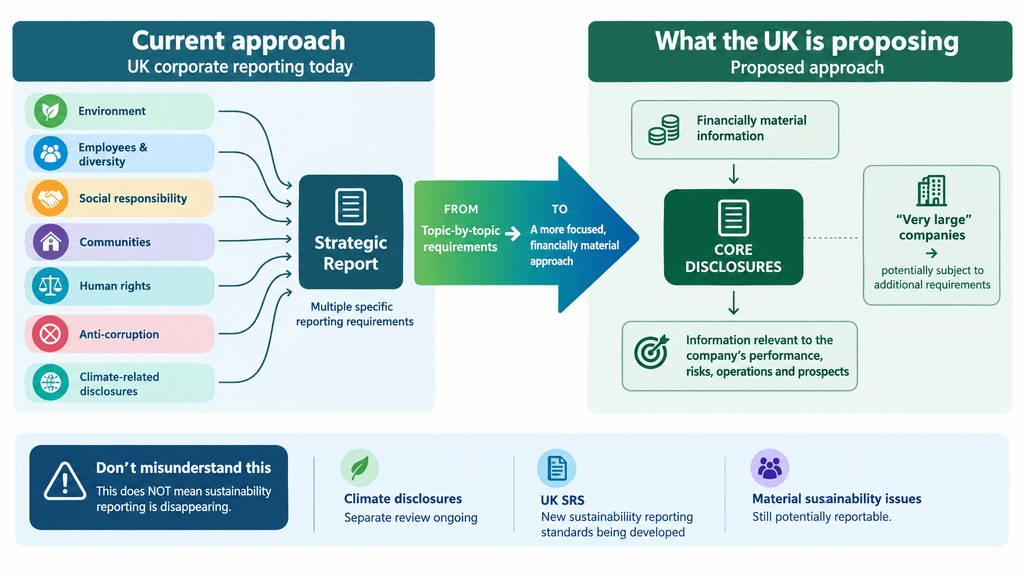
The UK government has opened a consultation proposing to strip out many of the specific, topic-by-topic reporting duties currently built into company law. In their place, it wants a leaner set of baseline disclosures. Companies would no longer face a checklist requiring them to address, say, community relations or anti-bribery controls by name. Instead, they would need to report on whatever genuinely matters to their business, financially.
So which is it: a weakening of sustainability reporting, or a redesign of how it works? The honest answer might be that it is both, depending on where you sit.
What The Government Is Actually Proposing
The core complaint driving this reform is that the UK’s “strategic report,” the main narrative section of a company’s annual report, has become bloated. According to the government, businesses have told regulators that the document has lost focus, growing longer and more repetitive without necessarily becoming more useful to the people reading it.
To fix that, the consultation proposes removing most of the existing topic-specific strategic reporting requirements, It plans to replace them with a smaller core of baseline narrative disclosures. In effect, the law would shift from prescribing exactly what companies must cover to trusting companies to tell their own story, provided it is grounded in what actually affects the business.
The areas potentially losing their explicit legal mandate include environmental impact, employee matters and workforce diversity, social responsibility, community relations, human rights across operations and supply chains, and anti-corruption and bribery controls. Some other specific duties, including certain workforce diversity breakdowns, are also on the table for removal.
That is a meaningful list. However, removing a requirement to report on a topic is not the same as removing the topic from consideration altogether. That distinction sits at the heart of this entire reform.
What “Financially Material” Really Means
Here is the part that deserves careful attention. Financial materiality, in plain terms, means information that could reasonably affect how an investor or lender views a company’s financial position, performance, or prospects. If something could move the numbers or change the risk profile, it counts as material and should still be disclosed, requirement or no requirement.
The government has been explicit that scrapping the topic-specific rules does not give companies a free pass. Firms would still need to report on environmental, social, or human rights issues where those issues carry genuine financial consequences for the business.
Consider two companies. An energy producer facing carbon pricing, stranded asset risk, or regulatory transition costs would likely still need to discuss environmental exposure at length, because that exposure shapes its financial future.
Meanwhile, a labour-intensive retailer with a complex overseas supply chain might find that human rights and workforce risks remain highly material to it too, even without a specific legal clause demanding that disclosure. The topic does not disappear. What changes is who decides it matters, and on what basis.
Read Also: Stronger UK Supply Chain Rules to Target Deforestation
So Does This Weaken Sustainability Reporting?
There is a real tension here, and pretending otherwise would do readers a disservice. On one hand, a simpler, less duplicative reporting regime could genuinely help. Annual reports have grown thick with boilerplate, and a narrower, more focused document could be easier for investors to actually read and use.
On the other hand, tying disclosure strictly to financial materiality risks narrowing the lens through which companies view their own impact. Some environmental or social effects matter enormously to communities, workers, or ecosystems without immediately threatening a company’s bottom line. Under a stricter materiality test, that kind of information could quietly fall out of mandatory reporting, even though it still matters to society.
Consequently, whether this reform represents progress or a step backward depends heavily on how narrowly or broadly “financially material” ends up being interpreted once the rules are finalised. That detail has not yet been settled, and it is worth watching closely.
Climate Disclosure Is A Separate Story
It is important to be precise here, because confusion on this point would be easy. The existing climate-related financial disclosure requirements, which apply to large UK companies, are not touched by this consultation. They remain in force exactly as they are today.
Instead, the government is reviewing those climate rules separately, with conclusions expected by spring 2027. Any changes arising from that review would go through their own consultation process before taking effect.
Meanwhile, the UK has already published its own Sustainability Reporting Standards, known as UK SRS, built closely on the global framework developed by the International Sustainability Standards Board. The Financial Conduct Authority is separately consulting on making UK SRS reporting mandatory for listed companies. Taken together, these moves suggest a government that is reorganising its sustainability reporting architecture rather than dismantling it.
A New “Very Large” Company Category
Another strand of the proposal involves simplifying who falls under non-financial reporting duties in the first place. At present, different thresholds apply depending on company size and type, creating an uneven and sometimes confusing patchwork.
The government is testing the idea of a single new “very large” company threshold to bring more coherence to that system. It has not yet specified exactly which companies would land in that category, so the practical effect remains genuinely open. Separately, the consultation also asks whether private companies should carry any non-financial reporting obligations at all. A question with real implications for investment risk assessment.
Lessons For Nigeria And The Wider African Market
For readers in Nigeria and across Africa, where sustainability and climate disclosure frameworks are still taking shape, the UK’s experiment raises questions worth sitting with rather than answers to copy.
Should reporting rules aim for breadth, covering every plausible sustainability topic, or should they concentrate on what is financially decision-useful to investors? How do regulators strike that balance without either overwhelming companies with obligations or leaving genuine risks invisible? And can a materiality-first approach still protect transparency around issues that matter deeply to communities, even when they do not immediately show up in a company’s financial statements?
These are not settled questions in London any more than they are in Lagos or Nairobi. But the UK’s willingness to test a leaner, materiality-driven model offers a useful case study for regulators elsewhere who are still designing their own reporting systems from the ground up.
The Bigger Question Ahead
Perhaps the real shift underway is not about companies reporting less. It is about reporting differently, with an emphasis on relevance over volume. The future of sustainability disclosure may hinge less on how many boxes get ticked and more on whether the information that survives actually tells investors, and society, what they need to know.
Getting that balance right, without letting quieter but still important risks slip through the cracks, will be the real test of whether this reform succeeds.
For clear, grounded reporting on how sustainability, business, and regulation intersect across markets, stay with CSR Reporters.
[give_form id="20698"]