csrreporters
By Rosemary Imobhio
Lagos is Nigeria’s commercial nerve center. It is also its toughest rental market. The state hosts over 22 million people. Yet the housing deficit approaches 4 million units. For decades, this shortage has fueled brutal landlord-tenant conflicts.
The rental landscape follows a painful norm. Extortionate advance payments rule the day. Landlords routinely demand one, two, or even three years of rent upfront. Housing costs then consume over 50% of household income. The United Nations recommends a 30% ceiling. Estate agents add illegal fees with little regulation. Disputes often end in violent, self-help evictions.
In response, the Lagos State House of Assembly introduced the Tenancy and Recovery of Premises Bill 2025. This bill awaits legislative passage and is currently at the committee stage. It seeks to repeal the outdated Tenancy Law of 2011. The new policy promises to reset the power balance between landlords and tenants. It caps fees and restricts rent advances.
On Tuesday at a Ministerial Press Briefing at Alausa, the Hon Commissioner for Housing, Lagos State Moruf Akinderu-Fatai referenced the bill. He pointed out that it will address growing concerns over excessive rent hikes. Fradulent practices and arbitrary agency fees by unregistered estate agents will also be curtailed under the new law.
Tenants hail the bill as a lifeline. Landlords fear an erosion of their returns. This article moves beyond the headlines. It dissects the meat and bones of the policy. We analyze economic ripple effects, enforcement hurdles, and the true future of housing in Africa’s largest megacity.
Key Provisions of the New Lagos Tenancy Rule
The Bill introduces surgical changes to the old framework. It has been with the Lagos state house of assembly since last year. Below is a breakdown of the most critical sections. Each provision moves from official theory to practical reality.
Restriction on Advance Rent
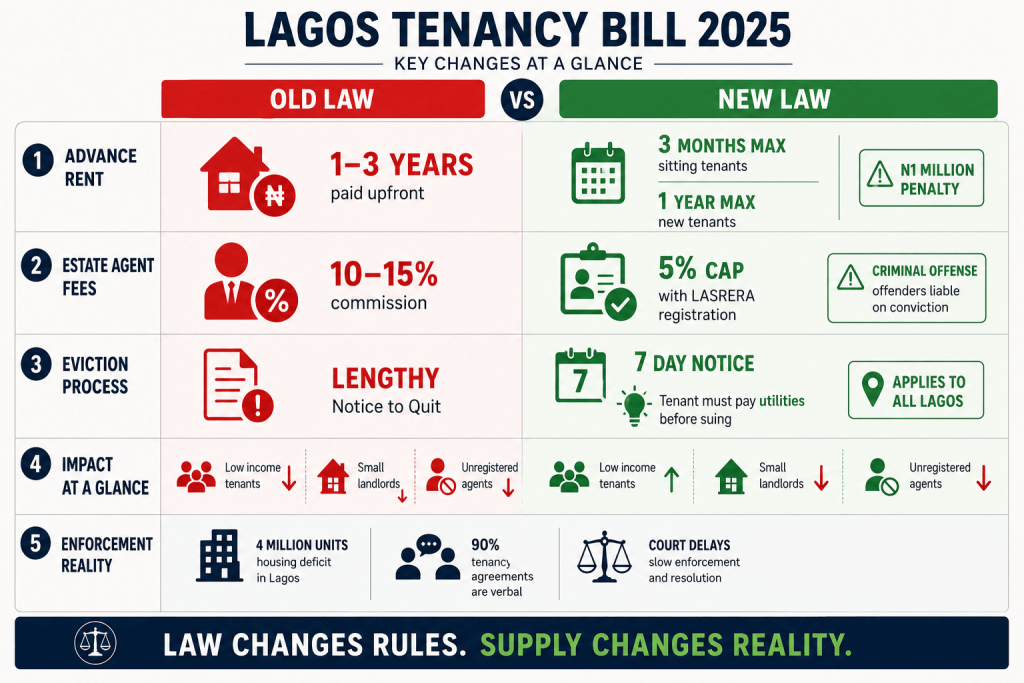
The Provision: Landlords cannot demand more than three months rent from sitting monthly tenants. For new or yearly tenants, the cap is one year. Tenants are also prohibited from offering excess amounts. Violators face fines up to N1 million or three months imprisonment.
Government Purpose: This ends the systemic practice of paying multiple years upfront. The barrier to entry for housing should drop significantly.
Real World Impact: For the salaried worker, this is transformative. Rent turns from an annual catastrophe into a manageable monthly expense.
Possible Concern: Lawyers warn about market distortion. If a landlord cannot secure two years of cash flow, they may simply raise the monthly rate to mitigate risk. The law also stays silent on sitting tenants who previously paid two years rent. Transitioning them to monthly payments could trigger serious friction.
Regulation of Estate Agents
The Provision: Agents must register with the Lagos State Real Estate Regulatory Authority (LASRERA). The commission caps at 5% of annual rent. The informal standard was 10% to 15%. Double collection or failure to remit funds within seven days becomes a criminal offense.
Government Purpose: This sanitizes a sector overrun by unqualified agents. It also reduces hidden transaction costs for tenants.
Real World Impact: Moving into a new apartment becomes cheaper. Agencies must now justify their value through service, not exploitation.
Possible Concern: Industry experts fear a rise in informal agents. Unregistered brokers may circumvent the law entirely. They will operate in the shadows without receipts. Landlords might also increase base rent to compensate for lost rebates or side payments previously received from agents.
Dispute Resolution and Eviction
The Provision: The bill streamlines recovery for landlords when a tenant defaults. If a monthly tenant falls three months into arrears, the landlord serves a seven day notice to recover possession. This replaces the lengthy Notice to Quit. Critically, a tenant cannot drag a landlord to court unless they have paid all outstanding utility bills. They must also lodge an undertaking to keep paying rent during the trial.
Government Purpose: Landlords gain protection from bad faith litigation. Tenants gain protection from illegal eviction. The balance aims to be fair.
Possible Concern: Property lawyers call this a double edged sword. While landlords get faster justice, protection for professional tenants remains strong. These are tenants who know the law and exploit technical delays. The requirement for tenants to pay rent before suing might also deter genuine complaints about uninhabitable conditions.
Elimination of Geographic Exemptions
The Provision: The 2011 law famously excluded highbrow areas. These included Ikoyi, Victoria Island, and Ikeja GRA. The 2025 Bill applies to all of Lagos State without exception.
Government Purpose: This ends a colonial era dual system. The wealthy and the poor now live under the same legal standard.
Real World Impact: Wealthy landlords in high end zones can no longer evict tenants arbitrarily. Court orders become mandatory for everyone. A single unified legal standard now exists.
Possible Concern: Institutional landlords in prime areas rely on bespoke commercial leases. The bill attempts to regulate advance rent at a one year cap. This may clash with corporate leases that negotiate longer terms for business stability.
Economic and Social Implications
For Tenants
The primary gain is financial breathing room. A shift to monthly payments allows lower income households to access better neighborhoods. However, a psychological downside exists. Paying monthly creates rent fatigue. The cost of housing feels more persistent than paying a painful but forgotten lump sum annually.
For Landlords
This is where the analysis gets complex. Small scale landlords face a cash flow crisis. Many rely on rent to fund their own children education or medical bills. Collecting rent monthly increases transaction costs, vacancy risk, and the administrative headache of chasing 30 different payments per year. Some might opt to sell their properties. Others may convert units to short stay Airbnb models. Either outcome reduces long term rental supply.
For the Housing Market
Property developers view the cap on advance rent as a threat to financing models. Many small developers rely on off plan sales. Two years of rent from future tenants finances construction. If developers cannot access that capital, housing supply may stagnate. This stagnation would further drive up prices, defeating the bill affordability goal.
For Corporate Nigeria and ESG Reporting
This is where the bill intersects with corporate responsibility. Banks, telecoms, and large employers now face a new question: how do they support employee housing under the new rules?
Under the Social pillar of ESG, companies can convert their staff housing support from annual lump sum loans to monthly rent deduction systems. This directly improves employee financial wellness. A worker paying rent monthly has more disposable income and less stress. Productivity rises as a result.
Under the Governance pillar, property firms must now register with LASRERA and cap agent fees at 5%. ESG rating agencies like MSCI and Sustainalytics will view this compliance as a sign of ethical operations. Real estate investment trusts that adopt the law early can market themselves as governance leaders.
For CSR, the bill creates ready made programs. A company can run tenant education workshops in low income communities. It can offer pro bono legal clinics for tenants facing illegal eviction. It can even create a rental assistance fund to help staff transition from yearly to monthly payment cycles without disruption.
In short, the bill turns housing regulation from a compliance headache into a measurable ESG and CSR opportunity. Companies that ignore this will fall behind. Companies that embrace it will gain a competitive edge in talent retention and investor confidence.
Reality Versus Enforcement
Lagos has a notorious enforcement gap. The old law also banned excessive advance rent. Yet the practice persisted for years. Here is why the new law might face similar hurdles.
The Demand Scarcity Factor
Over 22 million people chase too few homes. Landlords hold all the power. A desperate tenant will happily sign a side agreement. That illegal and unenforceable document promises two years rent under the table. No government official will ever see it.
Judicial Bottlenecks
Even with a seven day notice rule, the Lagos judiciary remains overburdened. A magistrate court might take months to hear a single case. This renders the fast track provision largely theoretical.
The Informal Sector Size
Over 90% of tenancy agreements in Lagos are verbal. Others are scribbled on a piece of paper. Regulating a cash based informal economy is notoriously difficult for LASRERA. Inspectors cannot police every street corner.
Expert and Stakeholder Perspectives
Reactions to the bill remain sharply polarized across key voices.
Government View: Moruf Akinderu Fatai, the Housing Commissioner, describes the move as breathing space. The government is actively engaging ERCAN, the Estate Agents body, to sanitize the system.
Landlord Legal View: A Landlord that CSR Reporters spoke to argues the law protects tenants more than property owners. He states that without solving land access and building material costs, affordability will remain a fantasy.
Tenant Advocacy Perspective: Tenants contacted praise the bill but identify gaps. The law lacks a limit on how often rent can be increased. It also has no anti discrimination clauses for tribe or religion. Agents also collect vast personal data with zero accountability under the Nigeria Data Protection Act.
The Middle Ground View: The law represents a reset button. However, it must be paired with housing supply reforms and specialized tenancy courts. Without more homes, regulation is just moving deck chairs on the Titanic.
Policy Gaps and Critical Review
The Bill is robust but not bulletproof. Several critical gaps remain unaddressed.
The Reasonable Rent Increase Vagueness: The Bill states rent increases must not be unreasonable. Yet it does not define a percentage cap. A landlord could keep the payment monthly but double the rent amount overnight. This would nullify all tenant protections.
Service Charge Obfuscation: The Bill demands receipts for service charges. However, it does not strictly enforce itemized billing. This remains a major loophole for hidden profiteering. A landlord could add 50% to service fees with no legal consequence.
Exclusion of Care Facilities: The Bill exempts staff quarters and care facilities. This creates a potential loophole. Employers could now house workers in exempted quarters without any tenancy protections. Labor rights advocates have already flagged this concern.
Conclusion
The Lagos Tenancy Bill 2025 acknowledges that the days of asking for three years rent are numbered. It criminalizes rogue agents and for the average tenant, this is a victory for financial sanity.
But laws do not build houses. The long term success of this policy hinges on three forces working in concert.
First, housing supply must expand. If Lagos continues to suffer a massive deficit, landlords will simply raise the monthly price to match the market rate. The tenant will pay the same proportion of income, just in smaller installments. No law can override basic supply and demand.
Second, enforcement must improve. The seven day notice rule means nothing if courts take months. The 5% agent fee cap means nothing if unregistered brokers operate openly. Lagos needs specialized tenancy courts and a public awareness campaign that reaches every street corner.
Third, the private sector must step up. This is where CSR and ESG become essential. Banks can restructure staff housing loans to match the new monthly payment reality. Telecoms can run tenant education campaigns as a customer retention tool. Real estate firms can use LASRERA compliance as a competitive badge of governance. Property developers can pair green building certifications with tenancy law compliance to attract ESG conscious capital.
The Bill shifts risk from the tenant to the landlord. Capital risk becomes cash flow risk. That is a fairer distribution of burden. But fairness alone does not create a single new apartment.
Ultimately, the Lagos Factor will determine the outcome. Scarcity always finds a way around statutes. However, when government regulation is joined by corporate responsibility and a genuine push for new housing, the odds shift. The Bill is the opening move. Whether Lagos plays the rest of the game well will decide if millions of renters finally breathe free.
[give_form id="20698"]