ROSEMARY IMOBHIO
Very recently Nigerian households were queuing for scarce cooking gas. At the same time, flare stacks across the Niger Delta burned through the very fuel they needed. They are still doing the same right now as you read this article. That contradiction sits at the heart of the country’s energy story in 2026.
For years, gas flaring has been treated casually in Nigeria’s energy narrative, mentioned in passing before talk shifts to oil prices or subsidy reform. Meanwhile, the numbers keep growing. So does the gap between what Nigeria burns off and what its own citizens and factories can access.
Therefore, the latest data on flaring volumes, export patterns and losses demands more than a passing mention. It calls for a serious look at what the crisis reveals about governance, sustainability and Nigeria’s direction as Africa’s largest gas reserve holder.
Fresh Data Reveal the Scale of the Problem
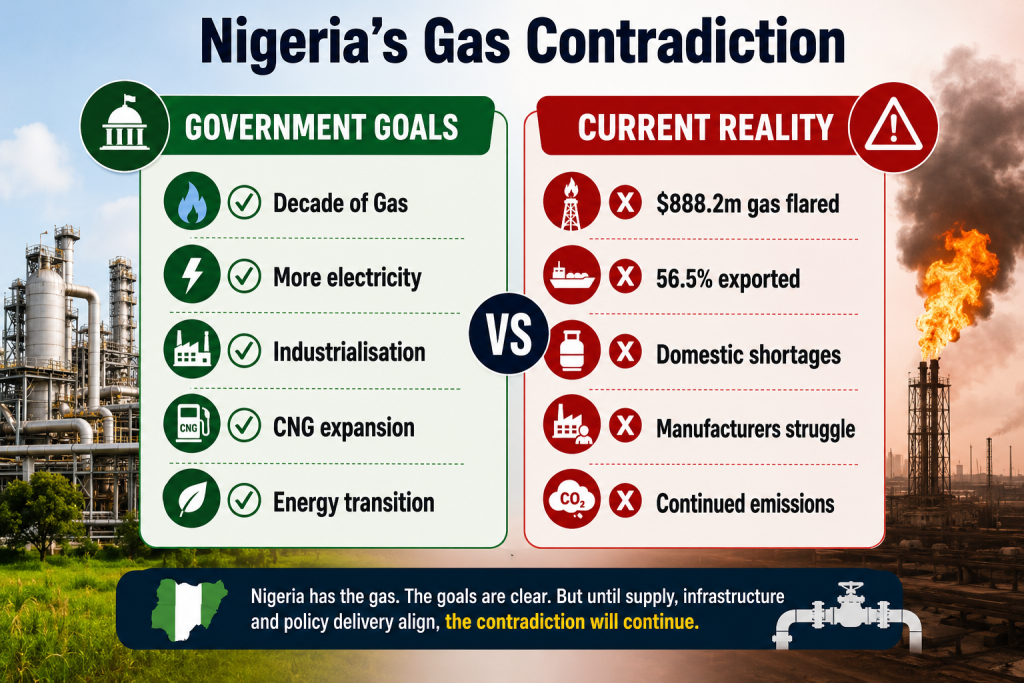
According to an analysis of production data published by the Nigerian Upstream Petroleum Regulatory Commission (NUPRC), Nigeria flared roughly 301.6 billion standard cubic feet of gas between January 2025 and June 2026. At a benchmark price of $2.84 per million British thermal units, that volume carries an estimated market value of $888.2 million.
During the same 18 month window, the country produced about 4.132 trillion standard cubic feet of gas. It utilised more than 3.823 trillion cubic feet, giving an average flaring rate of 7.3 per cent.
Export volumes tell an equally revealing story. Nigeria shipped out 1.506 trillion standard cubic feet of gas over the period, compared with only 1.162 trillion cubic feet supplied to the domestic market. In other words, close to 60 per cent of marketed gas left the country while shortages persisted at home. NUPRC data pegs the precise split at 56.5 per cent exported against 43.5 per cent retained locally.
Separately, NOSDRA reported that Nigeria flared about 323 billion standard cubic feet in 2025 alone, valued near $1.1 billion. The World Bank’s 2026 Global Gas Flaring Tracker placed Nigeria eighth among flaring nations worldwide and first in sub-Saharan Africa. Figures differ slightly across agencies because of methodology, but the direction is unmistakable. Flaring remains stubbornly high even as officials tout gains in utilisation.
Why This Matters Beyond Energy
Flaring is not simply a wasted commercial opportunity. It also releases methane, a greenhouse gas that traps far more heat than carbon dioxide over a short timeframe. Carbon dioxide, black carbon and other pollutants follow close behind. Consequently, communities near flare sites in Bayelsa, Rivers and Delta states report declining fish stocks and degraded farmland.
Rising respiratory illness has become common too. Recently a Chief in Bayelsa State reported that a flare stack less than 200 metres from his community had altered the local ecosystem. He added that fish species residents once relied on had disappeared entirely.
Furthermore, gas flaring undercuts Nigeria’s own climate pledges. The country has committed to net zero emissions by 2060. It has also included methane reduction targets in its Nationally Determined Contributions under the Paris Agreement.
However, continued flaring at current levels makes those commitments harder to defend. Investors, development partners and multilateral lenders increasingly scrutinise emissions data before committing capital. As a result, gas flaring has become an ESG issue as much as an oil and gas issue. It touches biodiversity, public health and Nigeria’s standing in global climate diplomacy all at once.
Nigeria’s Energy Transition Faces a Contradiction
Since 2021, Nigeria has promoted its Decade of Gas initiative as a route to industrialisation, expanded power generation and a shift toward compressed natural gas for transport. Meanwhile, the government has renewed its target to end routine flaring, moving the deadline to 2030 after similar goals for 1984, 2010 and 2025 were missed. These two ambitions sit uneasily together.
Officials describe gas as the bridge fuel for Nigeria’s industrial future. Yet the country keeps exporting most of its marketed gas. Domestic power plants, fertiliser producers and CNG stations still wait for their share. Consequently, the Decade of Gas risks becoming a slogan rather than a lived reality for manufacturers starved of reliable supply.
Business and Economic Implications
Domestic gas shortages ripple quickly through the economy. Thermal power plants depend on gas as their primary fuel source, and several have gone offline. Generation fell to around 4,300 megawatts in early 2026 due to supply gaps, grid operator data CSR Reporters accessed shows.
Manufacturers, meanwhile, absorb higher costs from self-generation and unstable power. This erodes their competitiveness against imports. Fertiliser producers need gas as feedstock too, exposing them to similar risk.
Meanwhile, cooking gas imports jumped 1,400 per cent in June 2026 alone as local LPG supply weakened. Prices rose for households and small firms that rely on it daily. For investors, this pattern signals a structural mismatch between upstream strategy and downstream demand.
CSR and ESG Perspective
Gas flaring also raises hard questions about corporate accountability. Oil companies paid an estimated $646 million in flaring penalties in 2025, the highest in five years. Yet flaring volumes rose rather than fell.
That imbalance suggests penalties alone are not changing behaviour. Rather many operators appear to treat fines as a routine cost rather than a deterrent. For companies reporting under ESG frameworks, unresolved flaring exposes a gap between stated climate commitments and actual field practice.
Investors and ratings agencies are increasingly likely to flag that gap. Responsible resource management means matching upstream investment with midstream infrastructure so associated gas gets captured and monetised rather than burned. Doing so would also strengthen the credibility of sustainability reports that reference methane reduction or net zero targets.
What Needs to Change
Experts and civil society groups point to enforcement and investment gaps alike. Experts CSR Reporters spoke to, argue that valuing flared gas only by its market price understates its true cost. Lost electricity, feedstock and environmental damage all add to the bill.
Meanwhile, many environmental groups call for an outright ban on routine flaring. They argue penalties alone have not worked, since companies appear willing to absorb them.
More gas gathering infrastructure would help close the gap between ambition and outcome. So would stronger enforcement of existing methane regulations and faster rollout of gas commercialisation projects. Pipeline expansion, including the AKK line, could connect industries to stranded gas, provided credible offtake deals follow.
Ultimately, Nigeria’s flaring numbers are not just a statistic buried in a regulator’s spreadsheet. They represent a choice, repeated month after month, about whose energy needs come first.
As the country pursues its Decade of Gas vision, aligning export strategy with domestic supply will matter just as much as attracting fresh investment. Only then can Nigeria turn a wasted resource into the energy security, industrial growth and cleaner air that its own gas ambitions were meant to deliver.
At CSR Reporters, we believe informed conversations drive meaningful change. If this story matters to you, share it with your network, join the discussion in the comments, and follow us for credible reporting on the policies, businesses, and innovations shaping a more sustainable Africa.
[give_form id="20698"]